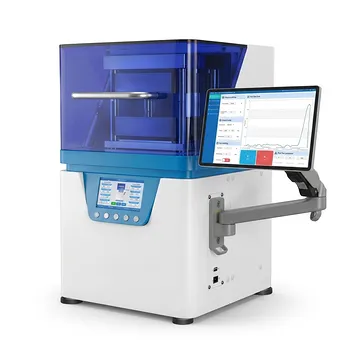
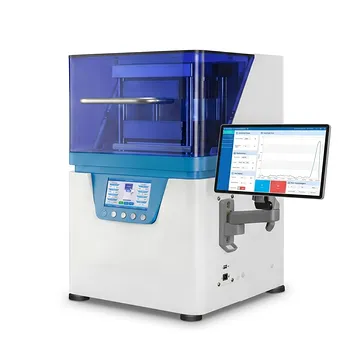
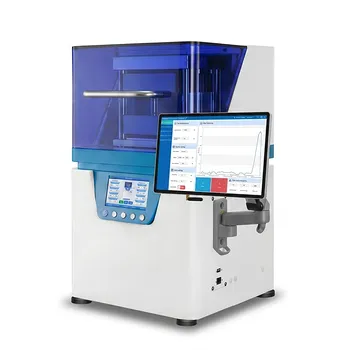
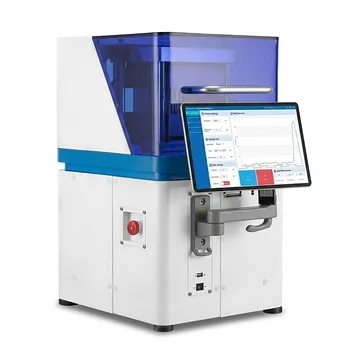
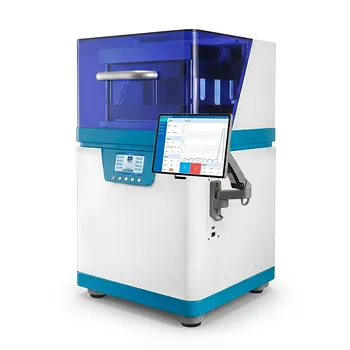
A laboratory hydraulic press is a precise instrument that utilizes fluid pressure to generate significant force within a compact footprint. Its primary applications involve testing the strength and durability of materials, investigating how substances react under high pressure, and compressing powders into solid pellets for chemical analysis.
Core Takeaway: While often associated with heavy industry, laboratory hydraulic presses are specialized for precision rather than mass production. They are essential for preparing homogenous samples for spectroscopy (like FTIR and XRF) and for conducting rigorous destructive testing on materials to determine their breaking points.
Material Testing and Characterization
Assessing Strength and Durability
One of the most frequent uses of a laboratory press is to determine the physical limits of a material.
By applying controlled, immense pressure, researchers can assess a sample's durability and yield strength. This allows labs to verify if a material meets specific industrial standards before it moves to larger-scale production.
Investigating High-Pressure Effects
Beyond simple destruction, these presses allow scientists to observe how matter behaves under stress.
Researchers use the press to simulate high-pressure environments, investigating fundamental changes in phase or structure. This is critical for understanding how substances will perform in extreme real-world conditions.
Sample Preparation for Analysis
Creating Pellets for Spectroscopy
In chemical analysis, the consistency of the sample is paramount.
Laboratory presses are standard tools for creating pellets used in FTIR (Fourier Transform Infrared) and XRF (X-ray Fluorescence) spectroscopy. The press compacts powder samples into uniform, thin discs, ensuring the analytical light passes through or reflects off the sample evenly for accurate results.
Powder Compaction and Composites
For materials science, achieving high density in composite materials is a common goal.
The press is used to compact powders into solid forms, removing air pockets and ensuring homogeneity. This is a vital step in the research and development of new composite materials and pharmaceutical formulations.
Research and Prototyping Applications
Pharmaceutical R&D
In drug development, the physical properties of a pill are just as important as its chemical makeup.
Hydraulic presses help researchers test the compressibility of pharmaceutical powders. This ensures that final tablet formulations are stable, durable enough for transport, and dissolve correctly.
Microfluidic Prototyping
Modern laboratory presses have found a niche in the fabrication of microfluidic devices.
They are used to imprint micro-channels into polymers or bond layers of materials together. The precision control of the press ensures that delicate micro-structures are formed accurately without crushing the device.
Operational Advantages
Precision and Control
Unlike their industrial counterparts, laboratory presses are designed for exactitude.
Operators can adjust the pressure to meet specific requirements, allowing for repeatable experiments. This control is essential when a variance of a few bars of pressure could alter the outcome of a sensitive experiment.
Safety and Efficiency
Despite the high forces involved, these machines are designed for the laboratory environment.
They typically feature overload protection and safety guards to prevent operator injury. Furthermore, they allow for the generation of massive force with relatively low manual or mechanical effort, increasing lab efficiency.
Understanding the Trade-offs
Capacity vs. Footprint
While powerful, a laboratory press is a scaled-down version of industrial machinery.
The Limitation: You cannot process large bulk materials or high-volume production runs. These units are strictly for small-batch testing and sample preparation; attempting to use them for manufacturing will lead to equipment failure or bottlenecks.
Speed vs. Precision
The hydraulic mechanism is excellent for generating force, but it is not inherently fast.
The Limitation: The cycle time for compressing and releasing a sample can be slow compared to mechanical presses. If your goal is rapid-fire testing of thousands of units, a hydraulic system may introduce significant time delays.
Making the Right Choice for Your Goal
To select the right hydraulic press workflow, identify your specific laboratory objective:
- If your primary focus is Analytical Chemistry (Spectroscopy): Prioritize a press known for creating uniform, defect-free KBr pellets for FTIR or XRF analysis.
- If your primary focus is Material Engineering: Ensure the press has a high enough force capacity to test the breaking points of your strongest composite samples.
- If your primary focus is Micro-fabrication: Look for a press with heated platens and fine-grain pressure control to bond polymers without deformation.
A laboratory hydraulic press is the bridge between loose raw materials and the solid, testable data required for scientific breakthrough.
Summary Table:
| Application Category | Primary Uses & Tasks | Key Goal/Benefit |
|---|---|---|
| Analytical Chemistry | Pelletizing powders for FTIR and XRF spectroscopy | Homogenous samples for accurate light transmission |
| Materials Science | Destructive testing, yield strength assessment | Verifying durability and industrial standards |
| Pharma Research | Testing powder compressibility and tablet stability | Ensuring durable formulations and proper dissolution |
| Micro-fabrication | Bonding polymers and imprinting micro-channels | Precision forming of delicate microfluidic structures |
| Powder Engineering | Compacting composites and removing air pockets | Achieving high density and material homogeneity |
Elevate Your Research Precision with KINTEK
Maximize your laboratory's potential with KINTEK, your specialized partner in comprehensive laboratory pressing solutions. Whether you are advancing battery research, developing new pharmaceuticals, or performing critical material analysis, our equipment delivers the exactitude your data demands.
Why Choose KINTEK?
- Versatile Range: From manual and automatic models to heated and multifunctional systems.
- Specialized Capabilities: Glovebox-compatible designs and advanced Cold/Warm Isostatic Presses (CIP/WIP).
- Targeted Performance: Engineered specifically for the rigorous needs of spectroscopy, composite development, and material characterization.
Don't let equipment limitations bottleneck your innovation. Contact our technical experts today to find the perfect pressing solution for your lab's unique requirements!
Related Products
- Laboratory Hydraulic Press Lab Pellet Press Button Battery Press
- Laboratory Hydraulic Press 2T Lab Pellet Press for KBR FTIR
- Laboratory Hydraulic Press Lab Pellet Press Machine for Glove Box
- 24T 30T 60T Heated Hydraulic Lab Press Machine with Hot Plates for Laboratory
- Automatic Laboratory Hydraulic Press Lab Pellet Press Machine
People Also Ask
- How is a laboratory hydraulic press used for HAP composite gels? Master Mineral Substrate Standardization
- What role does a laboratory hydraulic press play in reaction pellets? Optimizing Lunar Soil and Metal Fuel Density
- What role does a laboratory hydraulic press play in the preparation of piezoelectric ceramic discs for DC-PG? | KINTEK
- What role does a laboratory hydraulic press play in the assembly of all-solid-state battery test cells? Expert Guide
- Why is a laboratory hydraulic press required for PBAT and PLA sample preparation? Achieve Flawless Characterization