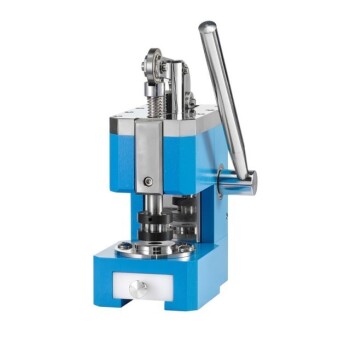
The core function of a laboratory melt-mixer is to act as a high-intensity dispersion tool that integrates solid additives into a polymer matrix. By utilizing rotating blades, the equipment generates powerful shear forces to mechanically force calcium pimelate particles into molten high-density polyethylene (HDPE). This process is designed to break down particle clusters and ensure a homogenous blend at a processing temperature of 190°C.
The mixer’s primary value lies in its ability to de-agglomerate nanoparticles through mechanical force. This ensures that even very low concentrations of additives achieve the uniform distribution necessary to enhance the material's thermal and mechanical performance.
The Mechanics of High-Shear Mixing
Generating Shear Force
The laboratory melt-mixer relies on rotating blades to drive the mixing process. These blades do not simply stir the material; they provide powerful high-shear forces. This intense mechanical energy is required to manipulate the viscous polymer melt effectively.
Thermal Processing Environment
Effective mixing cannot occur without precise thermal control. The process takes place at 190°C, a temperature specifically chosen to maintain the high-density polyethylene in a molten state. This allows the solid calcium pimelate to be mechanically incorporated into the fluid matrix.
Achieving Nanocomposite Uniformity
Breaking Down Agglomerates
A major challenge in nanocomposite preparation is the tendency of particles to clump together. The mixer’s high-shear action forcibly disperses solid calcium pimelate particles. This mechanical shearing is the mechanism responsible for breaking down nanoparticle agglomerates into smaller, discrete units.
Ensuring Homogeneous Distribution
The ultimate goal of the mixing process is uniformity. The equipment is capable of achieving a highly uniform distribution of the additive throughout the HDPE matrix. This homogeneity is critical for the consistency of the final material.
The Impact on Material Properties
Optimizing Low Concentrations
The melt-mixer is highly efficient, capable of dispersing additives effectively even at low loading levels. It allows concentrations of calcium pimelate ranging from 0.1% to 1% to be spread evenly throughout the polymer.
Enhancing Stability and Strength
Uniform dispersion is not an end in itself; it is a prerequisite for material enhancement. By ensuring the additive is evenly spread, the mixer enables improvements in the thermal stability and mechanical properties of the nanocomposite.
Understanding Process Dependencies
The Necessity of Shear and Heat
It is important to recognize that the mixer relies on a combination of factors to function. Without the specific 190°C temperature, the HDPE would not be sufficiently molten to accept the additive. Conversely, without the high-shear blades, the particles would likely remain agglomerated, failing to improve the material properties.
Making the Right Choice for Your Goal
To ensure you are utilizing the melt-mixer effectively for your specific requirements:
- If your primary focus is material performance: Ensure the mixer generates sufficient shear to break down all agglomerates, as this is the prerequisite for improved thermal and mechanical properties.
- If your primary focus is formulation efficiency: Leverage the mixer's high-shear capability to achieve uniform distribution using low additive concentrations (0.1% to 1%).
Mastering the balance of temperature and mechanical shear is the key to unlocking the full potential of your nanocomposites.
Summary Table:
| Feature | Specification/Action | Benefit |
|---|---|---|
| Processing Temp | 190°C | Maintains HDPE in a molten state for additive integration |
| Mechanism | Rotating High-Shear Blades | Breaks down nanoparticle clusters and agglomerates |
| Additive Range | 0.1% to 1% Concentration | Ensures efficiency with minimal additive loading |
| Key Outcome | Homogeneous Distribution | Enhances thermal stability and mechanical strength |
Elevate Your Material Research with KINTEK Precision
Are you looking to optimize your polymer compounding and nanocomposite preparation? KINTEK specializes in comprehensive laboratory pressing and mixing solutions designed for precision and durability. Whether you require manual, automatic, heated, or multifunctional models—including glovebox-compatible and isostatic presses—our equipment is engineered to provide the consistent shear and thermal control necessary for advanced battery research and material science.
Unlock superior material properties today. Contact our technical experts to find the perfect laboratory solution for your HDPE and additive dispersion needs.
References
- Christina Samiotaki, Dimitrios Ν. Bikiaris. Structural Characteristics and Improved Thermal Stability of HDPE/Calcium Pimelate Nanocomposites. DOI: 10.3390/macromol4010003
This article is also based on technical information from Kintek Solution Knowledge Base .
Related Products
- Lab Cylindrical Press Mold with Scale
- Automatic Heated Hydraulic Press Machine with Hot Plates for Laboratory
- Lab Ball Press Mold
- Automatic High Temperature Heated Hydraulic Press Machine with Heated Plates for Lab
- Lab Round Bidirectional Press Mold
People Also Ask
- What is the purpose of incorporating cartridge heaters into a lab press mold for MLCC block compression? Optimize Results
- What is the function of a pressing tool in thermoplastic panels? Master Precision Shaping & Fusion Bonding
- Why is precise cooling management of the lab press mold necessary? Protect Core Integrity in Thermoforming
- Why is a standardized cylindrical mold necessary when testing electrode materials? Ensure Data Precision & Consistency
- What is the technical significance of specific cylindrical molds in aluminum foaming? Achieve Near-Net-Shape Precision