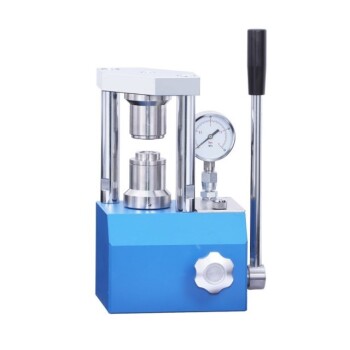
A laboratory press machine is the cornerstone of solid-state battery fabrication, primarily utilized to compress electrode powders into pellets and hermetically seal cell casings. Its most critical function, however, is applying precise, uniform axial pressure to establish intimate physical contact between the anode, solid electrolyte, and cathode, thereby minimizing contact resistance and ensuring an airtight seal against environmental contamination.
Core Takeaway In all-solid-state batteries, the absence of liquid electrolytes means ions cannot flow across microscopic gaps or voids. The laboratory press bridges this gap by mechanically forcing solid components into atomic-level contact, a prerequisite for efficient ion transport, reduced impedance, and structural integrity.
Solving the Solid-Solid Interface Challenge
Eliminating Microscopic Voids
Unlike traditional batteries where liquid electrolytes flow into every crevice, solid-state batteries rely on solid-to-solid contact. This interface inherently contains air gaps and holes.
A laboratory hydraulic press provides the controlled external pressure necessary to force air out from between these layers. This creates tight physical adhesion between the electrode and the solid electrolyte, which is fundamental for ion transport.
Minimizing Interfacial Impedance
The primary barrier to performance in solid-state batteries is high interfacial resistance. By applying uniform axial pressure, the press ensures the contact area is maximized.
This "intimate" contact reduces the impedance at the interface. Lower impedance directly translates to stable electrochemical measurements and prevents overpotential during battery cycling.
Enhancing Polymer Penetration
For batteries utilizing polymer electrolytes, pressure plays a dynamic role. The press applies force that causes microscopic deformation of the polymer.
This deformation forces the electrolyte to penetrate the porous structure of the cathode material. This infiltration significantly improves charge transfer resistance, essential for high-performance cycling.
Material Densification and Formation
Compressing Composite Powders
To create effective solid electrolytes and cathodes, raw composite powders must be compressed into highly dense structures.
Laboratory presses often apply high uniaxial pressure (e.g., up to 445 MPa) to achieve this. High densification minimizes voids between particles, maximizing the effective contact area for lithium-ion transport.
Optimizing Lithium Metal Contact
When working with lithium metal anodes, precise pressure control is vital. A press is used to apply specific pressures (e.g., approximately 70 MPa) to bond lithium foil to the electrolyte.
This ensures atomic-level physical contact without causing excessive deformation of the soft lithium metal.
Structural Integrity and Sealing
Hermetic Sealing
The laboratory press is the standard tool for the final packaging of coin cells. It applies the force needed to crimp and seal the battery case.
This seal must be airtight to prevent atmospheric contamination. Internal active materials in solid-state batteries are highly sensitive to moisture and air; a compromised seal leads to immediate degradation.
Suppressing Dendrite Growth
Pressure applied during assembly influences the battery's long-term safety. Proper compression helps suppress the growth of lithium dendrites.
Dendrites are needle-like structures that can puncture the electrolyte and cause short circuits. Uniform pressure helps maintain a void-free interface that inhibits this growth.
Understanding the Trade-offs: Precision is Key
The Risk of Over-Compression
While pressure is essential, more is not always better. Excessive force can mechanically fail ultra-thin solid electrolyte layers, causing cracks that render the cell useless.
Furthermore, applying too much pressure to lithium metal can deform it beyond its tolerance. The press must offer fine control to hit the "Goldilocks" zone—tight enough for contact, but gentle enough to preserve material integrity.
The Necessity of Uniformity
The pressure applied must be perfectly uniform across the entire surface area of the cell.
If the press applies uneven pressure, it creates "hot spots" of high current density and areas of poor contact. This leads to localized degradation, inconsistent data, and premature cell failure.
Making the Right Choice for Your Goal
To maximize the utility of a laboratory press in your solid-state battery projects, align your usage with your specific objectives:
- If your primary focus is Assembly Quality: Prioritize a press with high precision to apply exact pressures (e.g., 70 MPa) that ensure atomic-level contact without cracking thin electrolytes.
- If your primary focus is Electrochemical Performance: Ensure your press delivers high densification capabilities (up to 445 MPa) to minimize void space and reduce interfacial impedance.
- If your primary focus is Long-term Reliability: Use pressure fixtures that maintain constant external pressure during testing to manage volume expansion and prevent layer delamination.
Success in solid-state battery development relies not just on the materials chosen, but on the precise mechanical force used to unite them.
Summary Table:
| Application Category | Primary Function | Key Benefit |
|---|---|---|
| Interface Engineering | Eliminating microscopic voids | Maximizes ion transport & reduces impedance |
| Material Densification | Compressing composite powders | Achieves high density for better particle contact |
| Anode Integration | Bonding lithium foil | Ensures atomic-level contact without deformation |
| Cell Packaging | Hermetic sealing/Crimping | Prevents moisture and atmospheric contamination |
| Safety & Stability | Suppressing dendrite growth | Inhibits short circuits for long-term reliability |
Elevate Your Battery Research with KINTEK
Precision pressure is the difference between a failing interface and a high-performance solid-state cell. KINTEK specializes in comprehensive laboratory pressing solutions tailored for advanced energy research.
Whether you need manual, automatic, heated, or glovebox-compatible models, our equipment ensures the uniform axial pressure and high densification (up to 445 MPa) required to eliminate voids and minimize impedance. From initial material densification to cold and warm isostatic pressing, we provide the tools to advance your battery formation.
Ready to optimize your solid-state assembly? Contact our experts today to find the perfect press for your lab.
References
- Kristen Lason, Arumugam Manthiram. Tunable Crosslinked Ether Polymer Network Electrolytes for High‐Performance All‐Solid‐State Sodium Batteries. DOI: 10.1002/smtd.202502020
This article is also based on technical information from Kintek Solution Knowledge Base .
Related Products
- Warm Isostatic Press for Solid State Battery Research Warm Isostatic Press
- Button Battery Sealing Press Machine for Lab
- Laboratory Hydraulic Press Lab Pellet Press Button Battery Press
- Lab Infrared Press Mold for Laboratory Applications
- Lab Cylindrical Press Mold for Laboratory Use
People Also Ask
- Why must composite cathodes be sealed in vacuum lamination bags for WIP? Ensure Battery Stability and Density
- How do sacrificial volume materials (SVM) maintain microchannels in isostatic pressing? Ensure Structural Integrity
- What is the function of elastic molds in warm isostatic pressing? Achieve Uniform Density in Composite Particles
- What is the role of the flexible material in warm isostatic pressing? Key to Uniform Density & Precision
- How does Warm Isostatic Pressing differ from traditional pressing methods? Unlock Uniform Density for Complex Parts