
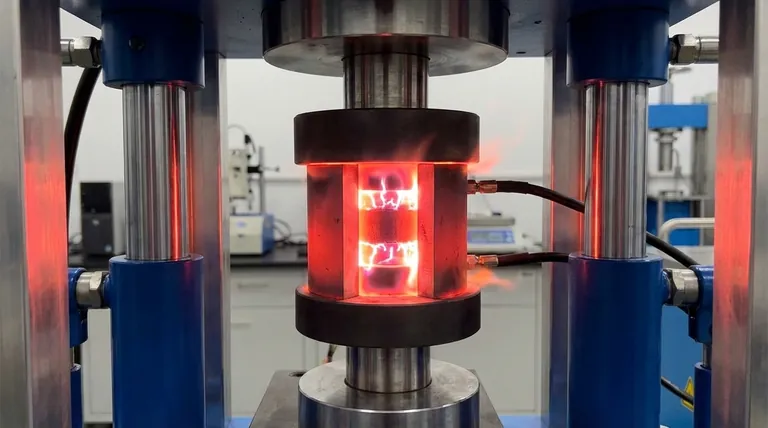
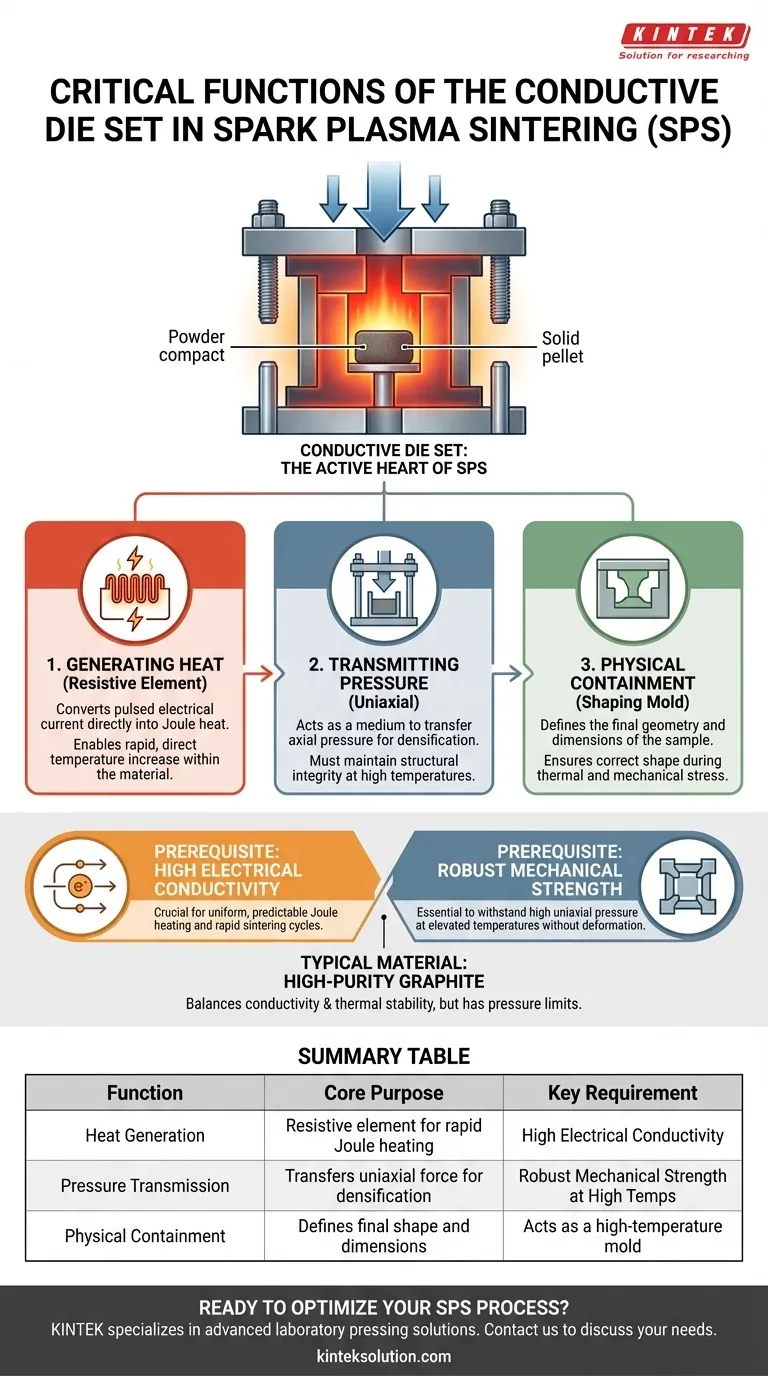
The conductive die set acts as the active heart of the Spark Plasma Sintering (SPS) system. Unlike passive molds used in traditional casting, the SPS die performs three simultaneous roles: it generates the heat via electrical resistance, transmits the mechanical force for densification, and defines the final geometry of the material.
Core Insight: In Spark Plasma Sintering, the die set is not just a container; it is the primary energy source. By integrating electrical heating, pressure transmission, and physical containment into a single component, the die enables the rapid, simultaneous application of heat and force that defines the efficiency of the SPS technique.
The Three Pillars of Die Functionality
The efficiency of SPS fabrication relies on the die set performing three distinct operations at the exact same time.
1. Generating Heat as a Resistive Element
The most distinct function of the SPS die is its role as a heater.
In traditional hot pressing, heat is often applied externally via induction coils. In SPS, the die itself acts as the primary resistive heating element.
The system passes a high-density pulsed electrical current directly through the conductive die. This converts electrical energy into Joule heat, allowing for rapid and direct temperature increases.
2. Transmitting Uniaxial Pressure
While the die is generating heat, it must also act as a mechanical transmission tool.
The die assembly serves as the medium to transfer axial pressure from the press rams directly to the powder compact.
This requires the die to maintain structural integrity while subjected to significant force. This pressure-assisted densification is critical for removing porosity from the material.
3. Physical Containment and Shaping
Finally, the die serves the foundational role of a mold.
It physically contains the powder material, defining the shape and final dimensions of the sample (e.g., the LLZO pellet).
It ensures the powder remains in the correct geometry while undergoing the intense thermal and mechanical stress of the sintering process.
Material Prerequisites and Trade-offs
To perform these functions, the die set must meet specific material requirements, which introduces operational constraints.
Requirement: High Electrical Conductivity
Because the die generates the heat, it must have excellent electrical conductivity.
If the conductivity is inconsistent, the heating rate will be unpredictable, compromising the rapid sintering characteristic of SPS.
Requirement: Robust Mechanical Strength
The die must possess high mechanical strength at elevated temperatures.
It acts as the pressure vessel; if the material softens or becomes brittle under heat, it cannot transfer the necessary uniaxial pressure required for densification.
The Material Trade-off
Typically, these dies are made of high-purity graphite.
While graphite offers the necessary balance of conductivity and thermal stability, its mechanical strength has limits compared to cold steel tools. This limits the maximum pressure that can be applied during the process compared to non-heated pressing methods.
Making the Right Choice for Your Goal
When selecting die configurations or designing your SPS experiments, consider how the die functions align with your specific objectives.
- If your primary focus is Rapid Densification: Ensure your die material has high electrical conductivity to maximize Joule heating rates and minimize cycle time.
- If your primary focus is Dimensional Accuracy: Prioritize the mechanical strength of the die material to prevent deformation under the high uniaxial pressures required to remove porosity.
Ultimately, the success of your SPS fabrication depends on treating the die set not as a simple mold, but as the critical active component that drives both the thermal and mechanical dynamics of the process.
Summary Table:
| Function | Core Purpose | Key Requirement |
|---|---|---|
| Heat Generation | Acts as a resistive element for rapid Joule heating | High Electrical Conductivity |
| Pressure Transmission | Transfers uniaxial force for material densification | Robust Mechanical Strength at High Temperatures |
| Physical Containment | Defines the final shape and dimensions of the sample | Acts as a high-temperature mold |
Ready to optimize your Spark Plasma Sintering process?
The conductive die set is the active heart of your SPS system. Choosing the right configuration is critical for achieving rapid densification and precise dimensional accuracy in your materials.
At KINTEK, we specialize in advanced laboratory pressing solutions, including SPS technology. Our expertise can help you select the ideal die materials and designs to meet your specific research and fabrication goals.
Contact us today using the form below to discuss how our lab press machines and consumables can enhance your SPS efficiency and results.
Visual Guide
Related Products
- Square Bidirectional Pressure Mold for Lab
- Lab Ring Press Mold for Sample Preparation
- Lab Ball Press Mold
- Lab Infrared Press Mold for No Demolding
- Laboratory Hydraulic Split Electric Lab Pellet Press
People Also Ask
- What is the purpose of incorporating cartridge heaters into a lab press mold for MLCC block compression? Optimize Results
- How do industrial-grade pressure molds affect zinc metal pouch cells? Maximize Energy Density & Performance
- What role do precision positioning and pressure molds play in single-lap joints? Ensure 100% Data Integrity
- How does the geometry of laboratory molds influence mycelium-based composites? Optimize Density and Strength
- Why are precision laboratory molds essential for forming basalt-reinforced lightweight concrete specimens?




