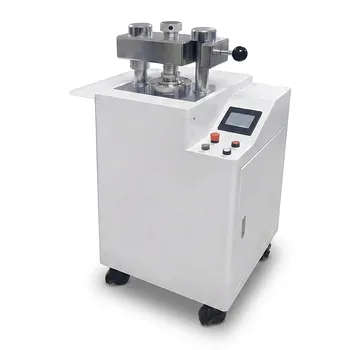
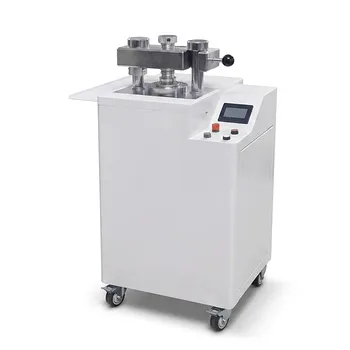
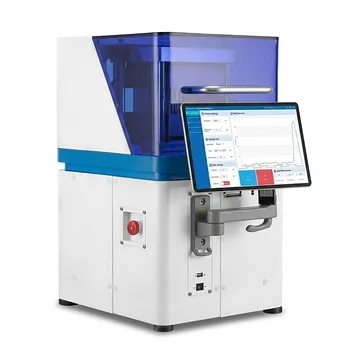
Laboratory pellet-making tools generally fall into three primary categories: hand presses, hydraulic presses, and automated presses. Each type offers distinct levels of force application and throughput to accommodate the specific physical properties of your samples and your experimental volume.
The right choice of equipment depends less on the pellet itself and more on your laboratory's need for sample throughput, reproducibility, and the specific force required to bind your material.
The Spectrum of Pressing Technology
To select the right tool, you must understand how different mechanisms apply force and what that means for your workflow.
Hand Presses for Portability and Low Cost
Hand presses are the entry-level solution for pellet preparation. They are typically compact, portable, and rely on manual mechanical force to compress the sample.
These tools are ideal for field work or laboratories with very low sample volumes. They are best suited for soft materials that do not require immense pressure to bind.
Hydraulic Presses for Higher Force
Hydraulic presses represent the standard for most analytical laboratories. By utilizing hydraulic fluid mechanics, these tools can generate significantly higher pressures than simple hand presses.
This category is essential when working with hard, brittle, or resistant sample types that require substantial force to form a stable pellet. They offer a balance between manual operation and high-performance output.
Automated Presses for Consistency
Automated presses remove the variable of human operation entirely. These systems are programmable, allowing you to set specific pressure dwell times and force levels.
They are designed for high-throughput environments where consistency is paramount. Automation ensures that every pellet is processed under identical conditions, reducing experimental error.
Understanding the Trade-offs
Choosing a press is an exercise in balancing budget against data quality and volume.
Labor vs. Reproducibility
Hand presses are inexpensive but labor-intensive. Because the force is applied manually, it is difficult to achieve perfect consistency between different operators or even different samples processed by the same person.
Power vs. Footprint
Hydraulic presses provide the necessary power for professional results but often require more bench space. While they solve the force issue, manual hydraulic versions can still result in operator fatigue during large batches.
Cost vs. Efficiency
Automated presses offer the highest efficiency and reproducibility but come with the highest capital cost. They are an investment in data quality and time savings, rather than a simple utility purchase.
Making the Right Choice for Your Goal
To maximize your lab's efficiency, match the tool to your specific operational constraints.
- If your primary focus is field work or low budgets: Stick to a hand press, which offers portability and simplicity for soft samples.
- If your primary focus is general analytical versatility: Invest in a hydraulic press, which provides the necessary force for a wide variety of sample types.
- If your primary focus is high throughput and consistency: Choose an automated press to eliminate operator error and streamline large-volume workflows.
Selecting the correct press ensures your sample preparation acts as a reliable foundation for your analysis, rather than a source of error.
Summary Table:
| Press Type | Operation | Force Capacity | Best Used For |
|---|---|---|---|
| Hand Press | Manual Mechanical | Low | Field work, soft materials, and low budgets |
| Hydraulic Press | Manual Hydraulic | High | General analytical labs and hard/brittle samples |
| Automated Press | Programmable Electric | Precision High | High-throughput labs requiring maximum consistency |
Elevate Your Sample Preparation with KINTEK
Consistency in pellet formation is the bedrock of reliable analytical data. KINTEK specializes in comprehensive laboratory pressing solutions, offering a versatile range of manual, automatic, heated, multifunctional, and glovebox-compatible models, alongside advanced cold and warm isostatic presses.
Whether you are conducting cutting-edge battery research or routine material analysis, our equipment is designed to eliminate operator error and maximize throughput.
Ready to optimize your lab’s workflow? Contact our experts today to find the perfect pressing solution for your specific application.
Related Products
- Laboratory Hydraulic Split Electric Lab Pellet Press
- Automatic Laboratory Hydraulic Press Lab Pellet Press Machine
- Laboratory Hydraulic Pellet Press for XRF KBR FTIR Lab Press
- Manual Laboratory Hydraulic Pellet Press Lab Hydraulic Press
- Automatic Fluorescence Sample Preparation Press 40 Ton Lab Pellet Press for XRF Analysis
People Also Ask
- What are the emerging trends in the design and materials of lab pellet presses? Modernize Your Lab Efficiency
- What are common lab pellet press issues? Expert Troubleshooting Guide for Reliable Material Research
- How do lab pellet presses support customization and flexibility? Optimize Your Sample Prep for Any Material
- What are the common operational types of lab pellet presses? Choosing the Right Manual, Automatic, or Hydraulic System
- Why use a laboratory pellet press for solid-state battery evaluation? Ensure Accuracy in Interface Stability Testing