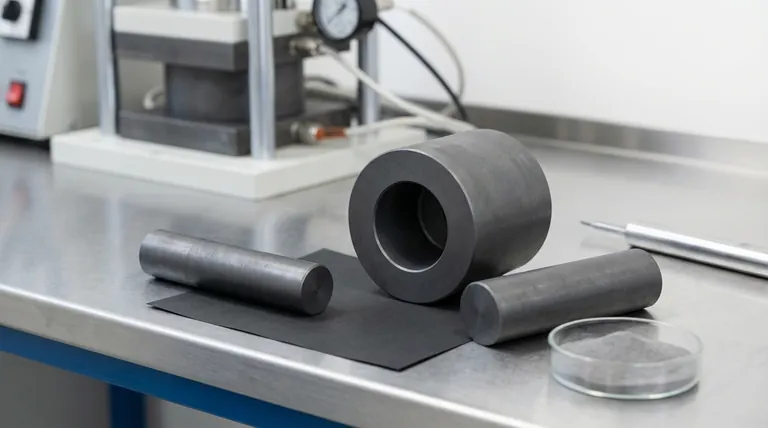
In a Spark Plasma Sintering (SPS) system, the graphite die functions simultaneously as a physical mold, a resistive heater, and a pressure transmitter.
It serves as the container that defines the shape of the powder, acts as the primary electrical resistor to generate rapid Joule heating from high-density pulsed current, and functions as the medium through which uniaxial force is transferred to densify the sample.
By integrating thermal, electrical, and mechanical functions into a single component, the graphite die eliminates the lag of external heating. This enables the rapid heating rates and simultaneous pressure application that define the efficiency of the SPS process.
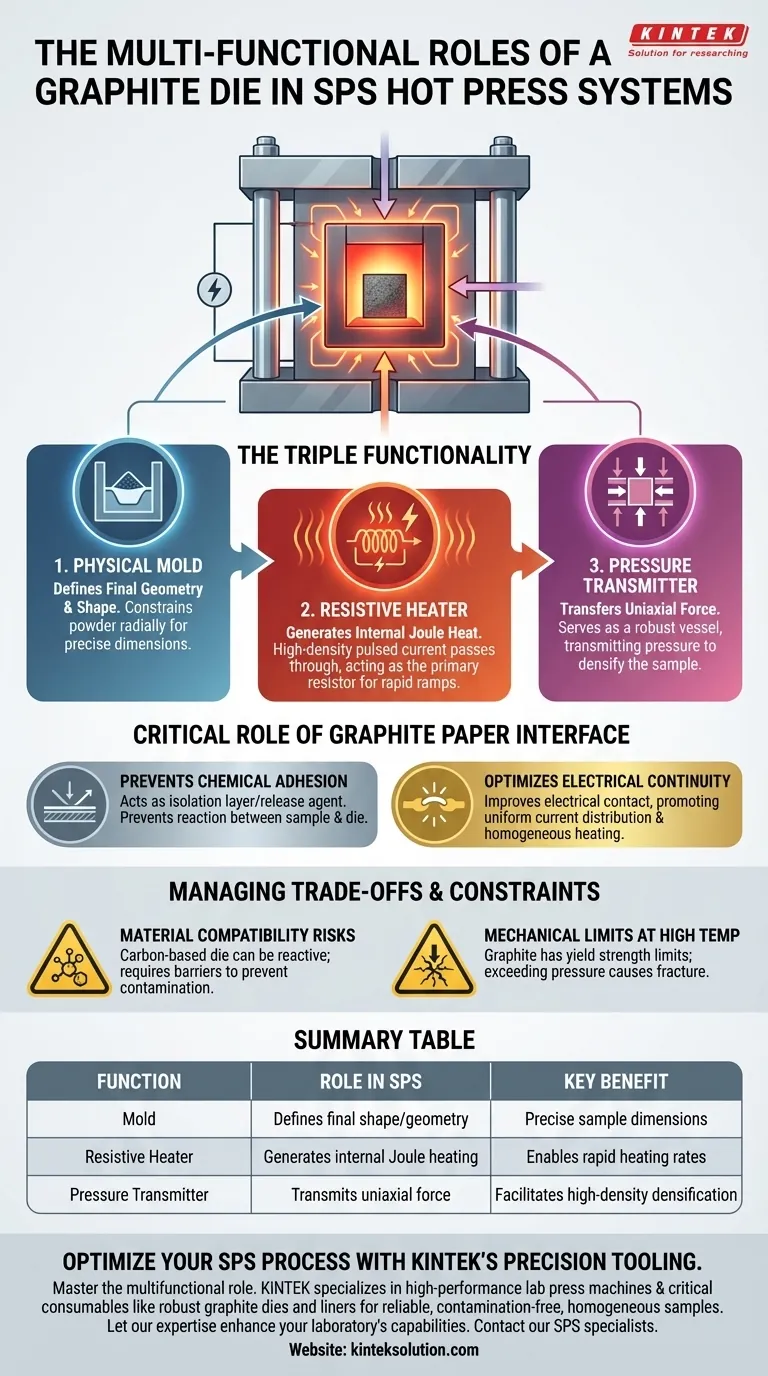
The Triple Functionality of the Die Assembly
To understand the SPS process, you must view the die not as passive tooling, but as an active component of the machine's electrical and mechanical circuit.
Acting as the Primary Heat Source
Unlike conventional hot pressing where heat is applied externally, the SPS die generates heat internally.
The die is electrically conductive. When high-density pulsed current passes through it, the graphite acts as a resistive heating element. This conversion of electricity into Joule heat allows for rapid, direct temperature ramps.
Facilitating Mechanical Densification
The die serves as the robust structural vessel required for pressure-assisted sintering.
It must maintain mechanical strength at high temperatures to transmit axial pressure from the press rams to the powder. This pressure is critical for achieving high density in the final ceramic or metallic pellet.
Defining Physical Geometry
At its most basic level, the die is the mold that contains the raw powder.
It constrains the material radially while the punches compress it axially. This confinement dictates the final dimensions and shape of the sintered sample.
The Critical Role of the Interface (Graphite Paper)
The references highlight that the "die assembly" often includes graphite paper liners. This lining is not optional; it performs essential auxiliary roles.
Preventing Chemical Adhesion
Graphite paper acts as a release agent or isolation layer between the powder and the die wall.
Without this layer, the sample could chemically react with or adhere to the die under high heat and pressure. The paper ensures the sintered pellet can be removed intact without damaging the tooling.
Optimizing Electrical Continuity
The liner improves the electrical contact between the powder sample and the press punches.
By bridging gaps at the interface, the paper promotes a uniform distribution of electric current. This leads to more homogeneous heating and consistent sintering across the entire sample.
Understanding the Trade-offs
While the graphite die is versatile, its multifunctional nature introduces specific constraints that you must manage.
Material Compatibility Risks
Because the die is carbon-based and subjected to extreme heat, it is chemically reactive.
As noted regarding the isolation layer, there is a constant risk of diffusion or reaction between the sample and the die. You must use barriers (like graphite paper) to prevent carbon contamination or carbide formation on your sample's surface.
Mechanical Limits at High Temperature
The die is the only thing stopping the powder from squeezing out sideways.
While graphite has excellent high-temperature strength, it has limits. If the pressure requirements of your specific material exceed the mechanical yield strength of the graphite at sintering temperatures, the die will fracture.
Making the Right Choice for Your Goal
The effectiveness of your SPS run depends on how well you manage the die assembly's multiple roles.
- If your primary focus is sample homogeneity: Ensure precise installation of the graphite paper liner to maximize electrical contact uniformity and prevent hot spots.
- If your primary focus is sample purity: Prioritize the quality of the isolation layer (carbon paper) to prevent chemical reactions between the reactive powder and the graphite die walls.
Successful SPS processing requires treating the graphite die as a consumable, active electronic component rather than simple, static hardware.
Summary Table:
| Function | Role in SPS Process | Key Benefit |
|---|---|---|
| Mold | Defines the final shape and geometry of the powder sample. | Precise sample dimensions. |
| Resistive Heater | Generates internal Joule heating from pulsed electrical current. | Enables rapid heating rates. |
| Pressure Transmitter | Transmits uniaxial force from the press rams to the powder. | Facilitates high-density densification. |
Optimize Your SPS Process with KINTEK's Precision Tooling
Mastering the multifunctional role of the graphite die is key to successful Spark Plasma Sintering. KINTEK specializes in high-performance lab press machines, including SPS systems, and the critical consumables that make them work.
We provide robust graphite dies and essential components like graphite paper liners, designed for reliability and to prevent contamination, ensuring you achieve homogeneous and pure sintered samples every time.
Let our expertise enhance your laboratory's capabilities. Contact our SPS specialists today via our contact form to discuss your specific application needs and discover how our solutions can drive your research forward.
Visual Guide
Related Products
- Lab Infrared Press Mold for No Demolding
- Lab Ring Press Mold for Sample Preparation
- Lab Cylindrical Press Mold with Scale
- Lab XRF Boric Acid Powder Pellet Pressing Mold for Laboratory Use
- XRF KBR Plastic Ring Lab Powder Pellet Pressing Mold for FTIR
People Also Ask
- What is the purpose of incorporating cartridge heaters into a lab press mold for MLCC block compression? Optimize Results
- What is the function of a pressing tool in thermoplastic panels? Master Precision Shaping & Fusion Bonding
- Why is precise cooling management of the lab press mold necessary? Protect Core Integrity in Thermoforming
- What role do precision positioning and pressure molds play in single-lap joints? Ensure 100% Data Integrity
- Why is a lab press used for KBr pellet preparation in polyurethane FTIR? Achieve High-Resolution Spectral Data