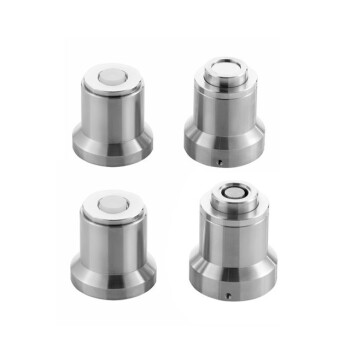
Titanium rods function as dual-purpose components within all-solid-state battery testing molds, serving simultaneously as high-strength pressure plungers and electrical current collectors. They are engineered to conduct electrons efficiently while transmitting the immense mechanical pressure required to maintain contact between the battery's solid layers.
Core Takeaway Solid-state batteries rely on perfect interfacial contact and chemical purity to function. Titanium rods are the industry standard for testing because they uniquely combine the mechanical hardness to withstand pressures up to 75 MPa with the electrochemical inertness required to prevent corrosion or side reactions with reactive electrolytes.
The Critical Role of Mechanical Pressure
Acting as High-Force Plungers
In all-solid-state batteries, the interfaces between components—specifically the lithium metal and solid electrolyte—must remain in tight contact. Titanium rods act as pressure plungers, transferring significant external stack pressure directly to the cell components.
Withstanding Extreme Compression
Testing these batteries often requires pressures as high as 75 MPa. Titanium's high mechanical strength allows the rods to endure this compaction without deforming. This rigidity ensures the pressure remains uniform, maintaining "intimate interfacial contact" throughout the testing cycle.
Preventing Interfacial Failure
By maintaining constant stack pressure, titanium rods stabilize the active material interfaces during charge and discharge cycles. This mechanical stability prevents common failure modes such as interface cracking, contact loss, or issues related to lithium deposition and stripping.
Electrical and Chemical Performance
Efficient Current Collection
Beyond their mechanical role, titanium rods serve as the primary current collectors within the assembly. They provide a low-resistance path for electron conduction, allowing for the transmission of electrical signals from the battery cell inside the insulating mold (often made of PEEK) to the external testing equipment.
Chemical Stability and Inertness
Titanium exhibits an excellent chemical stability profile across a wide electrochemical window. This is critical when testing reactive materials, particularly sulfide-based solid electrolytes, which can corrode other metals.
Eliminating Side Reactions
The material's resistance to corrosion ensures that the rods do not engage in unwanted side reactions with the electrolyte. This inertness preserves the integrity of the battery components and ensures that test data reflects the true performance of the battery chemistry, rather than artifacts caused by the testing hardware.
Why Material Selection Matters (Common Pitfalls)
The Risk of Chemical Contamination
Using a plunger material with lower chemical stability than titanium is a critical error in solid-state testing. Reactive metals can corrode when in contact with solid electrolytes under high pressure, leading to false failure readings and degraded cell performance.
The Danger of Mechanical Deformation
If a rod material lacks titanium's hardness, it may warp under the required 75 MPa load. This deformation leads to uneven pressure distribution, resulting in localized contact loss and unreliable cycling data.
Ensuring Reliable Testing Data
To maximize the accuracy of your all-solid-state battery evaluations, select your mold components based on your specific testing parameters:
- If your primary focus is interfacial stability: Rely on titanium's high hardness to apply uniform, high-magnitude pressure (75 MPa) to prevent contact loss during lithium stripping.
- If your primary focus is electrochemical purity: Leverage titanium's chemical inertness to test reactive sulfide-based electrolytes without the risk of corrosion or side reactions.
Titanium rods are not just structural supports; they are active enablers of the precise mechanical and chemical environment needed to validate solid-state battery technology.
Summary Table:
| Feature | Role of Titanium Rod | Impact on Battery Testing |
|---|---|---|
| Mechanical Action | High-strength pressure plunger | Maintains intimate contact between layers; prevents interfacial failure. |
| Pressure Limit | High-force endurance (up to 75 MPa) | Ensures uniform compaction without deformation under extreme load. |
| Electrical Role | Current collector | Provides low-resistance electron path for accurate signal transmission. |
| Chemical Profile | High electrochemical inertness | Prevents corrosion and side reactions with sulfide-based electrolytes. |
Elevate Your Battery Research with KINTEK Precision
Maximize the reliability of your solid-state battery evaluations with hardware designed for extreme conditions. KINTEK specializes in comprehensive laboratory pressing solutions, including high-performance testing molds and a wide range of manual, automatic, and isostatic presses.
Whether you are focusing on interfacial stability or electrochemical purity, our titanium-equipped solutions ensure uniform pressure distribution and chemical inertness for your most critical research.
Ready to optimize your lab's workflow? Contact us today to find the perfect pressing solution!
References
- So‐Yeon Ham, Ying Shirley Meng. Overcoming low initial coulombic efficiencies of Si anodes through prelithiation in all-solid-state batteries. DOI: 10.1038/s41467-024-47352-y
This article is also based on technical information from Kintek Solution Knowledge Base .
Related Products
- Carbide Lab Press Mold for Laboratory Sample Preparation
- Lab Button Battery Disassembly and Sealing Mold
- Lab Button Battery Tablet Press Sealing Mold
- Lab Cylindrical Press Mold for Laboratory Use
- Warm Isostatic Press for Solid State Battery Research Warm Isostatic Press
People Also Ask
- What is the purpose of incorporating cartridge heaters into a lab press mold for MLCC block compression? Optimize Results
- What is the function of a pressing tool in thermoplastic panels? Master Precision Shaping & Fusion Bonding
- Why is precise cooling management of the lab press mold necessary? Protect Core Integrity in Thermoforming
- How does the geometry of laboratory molds influence mycelium-based composites? Optimize Density and Strength
- What is the significance of standardized molds in lab presses? Ensure Precise Seal Material Evaluation