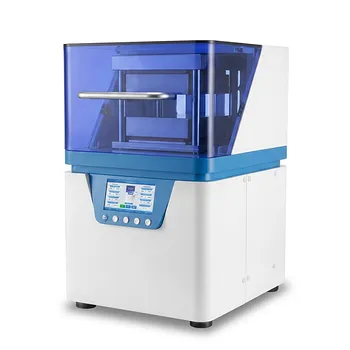
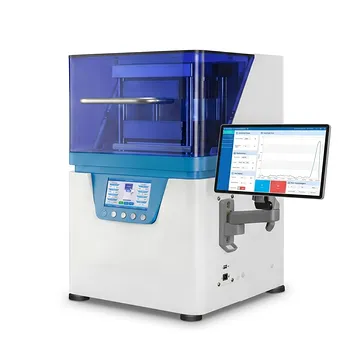
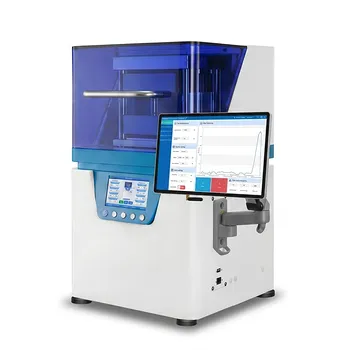
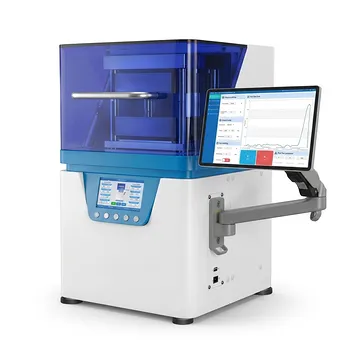
Hydraulic presses are fundamental tools used broadly across two main sectors: heavy industrial manufacturing and scientific laboratory research. In industrial settings, they provide the immense force required for shaping, flattening, and joining materials, while in laboratories, they offer the precision needed for material testing and sample preparation.
The Core Utility The defining characteristic of a hydraulic press is its ability to generate massive, controlled pressure—often reaching 10,000 psi—to manipulate materials in ways that manual force or pneumatic systems cannot achieve.
Industrial and Manufacturing Operations
The most visible applications of hydraulic presses are found in manufacturing, where they process raw materials into usable components.
Metal Forming and Fabrication
The primary reference highlights that these machines are essential for straightening, bending, stamping, and flattening materials. By applying compressive force, a press can reshape metal billets or sheets without removing material.
Forging and Molding
Beyond simple bending, industries use hydraulic presses for forging, which shapes metal using localized compressive forces. They are also heavily relied upon for compression molding, where materials like plastics, rubber, and composites are shaped within a mold cavity.
Assembly and Joining
Hydraulic presses are not just for shaping; they are critical for assembly. They are used to press-fit components, such as forcing bearings or fittings into place. They also perform joining operations like riveting and crimping, ensuring secure connections between parts.
Waste Management and Recycling
In heavy industrial applications, the crushing power of these presses is utilized for scrap baling. This involves crushing metal objects, such as cars or loose scrap, into dense bales for easier transport and recycling.
Laboratory and Research Applications
While industrial presses focus on volume and raw power, laboratory presses focus on data and precision.
Material Testing
Laboratories use these presses to investigate the strength and durability of various materials. This includes concrete compression testing to verify tensile strength and investigating how substances react under high-pressure conditions.
Sample Preparation
A critical function in the lab is the preparation of pellets for sample analysis. Presses compact powders into uniform solid shapes, which is often a prerequisite for analytical techniques like spectroscopy.
Specialized Niche Applications
The versatility of hydraulic technology allows it to bridge into unique industries beyond standard metalwork.
Food and Consumer Goods
Hydraulic presses facilitate specific production processes, such as producing fat-free cocoa powder. In the ceramics industry, they are used to manufacture items like tiles and bricks at room temperature through high-pressure compaction.
Understanding the Capabilities and Limitations
When selecting a force application system, it is vital to understand where hydraulic presses fit in the hierarchy of power.
Hydraulic vs. Pneumatic Systems
The primary advantage of a hydraulic system is sheer power. While pneumatic (air-driven) systems typically operate around 100 psi, hydraulic systems efficiently transmit power to apply pressures in the range of 10,000 psi.
The Trade-off of Force
Because they operate at such high pressures, hydraulic presses are the superior choice for heavy-duty tasks that require deformation of resistant materials. However, for lighter tasks requiring high speed and lower force, a pneumatic system might be more appropriate.
Making the Right Choice for Your Goal
To determine if a hydraulic press is the right tool for your specific application, consider your core objective:
- If your primary focus is Heavy Fabrication: You need a hydraulic press for operations like stamping, forging, or straightening metal where high PSI is non-negotiable.
- If your primary focus is Material Science: You need a laboratory-grade press to create consistent sample pellets or to perform destructive testing on new materials.
- If your primary focus is Assembly: You should utilize a press for force-fitting bearings or crimping components where consistency and joint integrity are critical.
Hydraulic presses remain the industry standard wherever the requirement is the efficient delivery of immense, controlled force.
Summary Table:
| Application Sector | Primary Uses | Key Benefits |
|---|---|---|
| Manufacturing | Metal forging, stamping, bending, and assembly | Immense force (up to 10,000 psi) for shaping |
| Laboratory | Sample pelletizing, material strength testing | Precision control and uniform compaction |
| Recycling | Scrap baling and metal crushing | High compression ratios for waste management |
| Specialized | Food processing (cocoa), ceramic tile production | Room temperature high-pressure compaction |
Elevate Your Research with KINTEK Pressing Solutions
Whether you are conducting advanced battery research or preparing delicate samples for spectroscopy, KINTEK provides the precision and power your lab demands. Our comprehensive range of laboratory pressing solutions includes manual, automatic, heated, and multifunctional models, as well as specialized cold and warm isostatic presses designed for glovebox compatibility.
Partner with KINTEK today to achieve unmatched consistency in your material testing.
Contact Our Technical Experts Now
Related Products
- Automatic Hydraulic Hot Press with Large Plate and Precision Temperature Control for Advanced Material Sample Preparation and Industrial Research
- Automatic Hydraulic Heat Press Machine with Multi Stage Programmable Control and Integrated Water Cooling Plate Size 180x180mm
- Automatic High Temperature Heated Hydraulic Press Machine with Heated Plates for Lab
- Automatic Heated Hydraulic Lab Press with Programmable Touch Screen Controls and Precision Temperature Regulation
- Manual Heated Hydraulic Lab Press with Integrated Hot Plates Hydraulic Press Machine
People Also Ask
- What are the specific features and applications of hydraulic hot press machines? Precision Solutions for Modern Labs
- How does an automatic hydraulic press operate? Achieve Precision and Consistency in Lab Pelleting
- What are the advantages and common applications of an automatic hydraulic press? Elevate Your Lab's Precision
- What is the technical significance of setting a precise dwell time? Achieve Peak Material Density and Stability
- When is an automatic hydraulic press more suitable than a manual press? Scale Your Lab with Precision & Speed