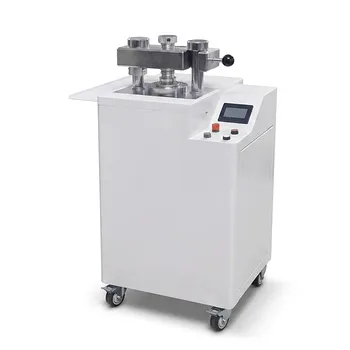
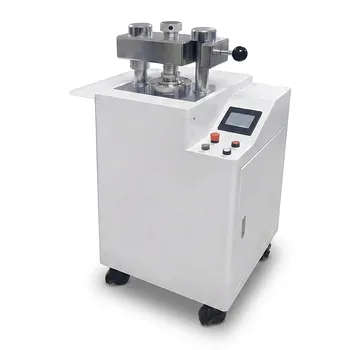
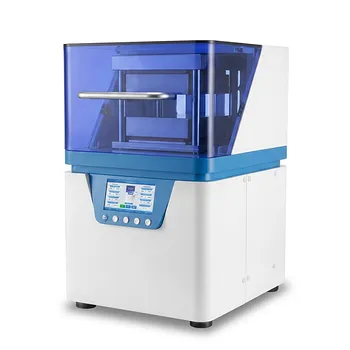
A programmable XRF pellet press transforms sample preparation from a manual task into a precise, repeatable scientific process. Key features such as step-ramping functions, automatic timers, and pressure top-up mechanisms allow laboratories to produce high-quality pellets with minimal operator intervention. By standardizing the load application and duration, these devices ensure that every sample meets the rigorous density and surface requirements necessary for accurate X-ray Fluorescence (XRF) analysis.
The true value of a programmable press lies in its ability to mitigate physical anomalies in the sample. Features like gradual pressure ramping allow trapped air to escape before the pellet seals, preventing analytical errors and structural failure.
Achieving Structural Integrity Through Controlled Pressure
The primary advantage of a programmable system is the ability to manage how force is applied, not just the total amount of force used.
The Importance of the 'Step Function'
A programmable press often features a step function, which allows the load to be ramped up gradually rather than applied all at once. This is particularly beneficial when working with lighter, low-density samples that might disperse or deform unpredictably under sudden force.
Eliminating Trapped Air
Rapid compression often traps air and gases inside the powder matrix. By using the step function to increase pressure slowly, the system allows these gases to escape through the porous die components. This prevents the pellet from cracking or "capping" after ejection, ensuring a smooth, uniform surface for analysis.
Automating Consistency for Reliable Data
In XRF analysis, the consistency of sample preparation is directly linked to the reproducibility of analytical results.
Precision Timers for Uniform Duration
Programmable units include timers that control exactly how long the sample remains under pressure. This ensures that every pellet in a batch experiences the precise same dwell time, eliminating the variance caused by human timing errors.
The 'Auto Top-Up' Advantage
Many materials will slightly compress or "relax" after the initial load is applied, causing the effective pressure to drop. An auto top-up function detects this drop and automatically reapplies pressure to maintain the target load throughout the cycle, ensuring maximum density is achieved.
Operational Considerations and Trade-offs
While programmable presses offer superior control, selecting the right unit requires balancing capability with infrastructure and sample requirements.
Power Supply Infrastructure
High-performance machinery often requires specific power setups. A significant advantage of modern programmable models is that many are designed for standard mains plugs, offering convenience over older or larger units that may require a specialized 3-phase installation.
Load Capacity vs. Sample Hardness
While a load of 10–20 tonnes is typically sufficient for standard 32 mm or 40 mm pellets, this may not be enough for all materials. Difficult samples, such as hard geological powders mixed with binders, may require presses capable of delivering up to 40 tonnes. Under-specifying the tonnage can lead to fragile pellets that crumble during handling.
Making the Right Choice for Your Goal
To maximize the efficiency and reliability of your laboratory, match the press features to your specific analytical needs.
- If your primary focus is delicate or light samples: Prioritize a model with a robust step function to allow for gradual compression and gas escape.
- If your primary focus is high-throughput consistency: Ensure the unit features an auto top-up capability and precise timers to guarantee identical density across large batches.
- If your primary focus is facility integration: Verify whether the unit operates on a standard mains plug or requires a dedicated 3-phase power line to avoid unexpected installation costs.
By automating the critical variables of pressure, time, and rate of force, you secure the foundation of accurate XRF analysis.
Summary Table:
| Feature | Function | Benefit for XRF Analysis |
|---|---|---|
| Step-Ramping | Gradual pressure increase | Allows trapped air to escape; prevents pellet cracking |
| Automatic Timers | Precise dwell time control | Eliminates human error; ensures batch-to-batch consistency |
| Auto Top-Up | Constant load maintenance | Compensates for material relaxation; ensures maximum density |
| High Tonnage (40T) | Heavy force application | Handles hard geological samples and large diameters |
| Mains Plug Compatibility | Standard power integration | Easier lab installation without specialized 3-phase wiring |
Elevate Your Sample Preparation with KINTEK
Ready to eliminate variability in your XRF analysis? KINTEK specializes in comprehensive laboratory pressing solutions, offering manual, automatic, heated, multifunctional, and glovebox-compatible models. Whether you are conducting cutting-edge battery research or routine geological testing, our programmable presses and isostatic solutions provide the precision your data demands.
Why choose KINTEK?
- Versatility: Solutions ranging from 10 to 40+ tonnes.
- Precision: Advanced step-ramping and auto top-up features.
- Support: Expert guidance to match the right press to your specific material needs.
Contact our specialists today to find your perfect pressing solution!
Related Products
- Automatic XRF Pellet Press for Laboratory Spectrometry Sample Preparation
- Automatic Fluorescence Sample Preparation Press 40 Ton Lab Pellet Press for XRF Analysis
- Automatic Laboratory Hydraulic Press for XRF and KBR Pellet Pressing
- Laboratory Hydraulic Pellet Press for XRF KBR FTIR Lab Press
- XRF KBR Plastic Ring Lab Powder Pellet Pressing Mold for FTIR
People Also Ask
- How can contamination occur during the preparation of pressed pellets for XRF analysis? Expert Prevention Guide
- How does the sample material influence the required pressing load for making an XRF pellet? Find the Optimal Pressure
- What are the different methods for preparing a sample pellet for XRF analysis? Expert Guide to Superior XRF Results
- What are the advantages of preparing a sample as a dense pellet for XRF? Unlock High-Precision Trace Element Analysis
- What is the primary purpose of using an automatic pellet press? Achieve Precise Geopolymer Analysis Results