
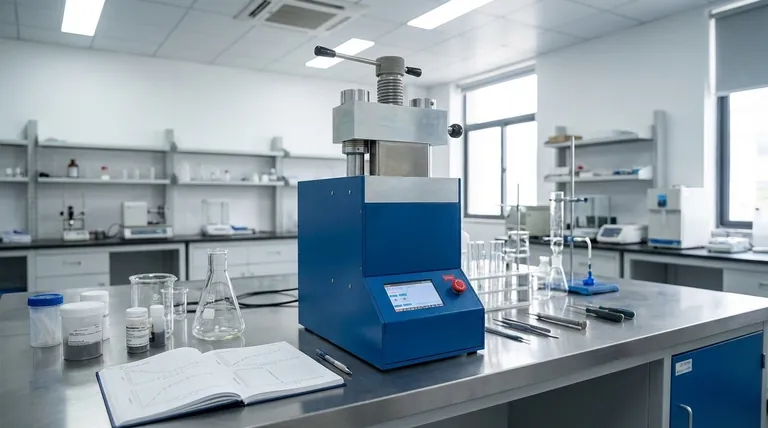
Automated laboratory Cold Isostatic Press (CIP) systems are defined by their ability to deliver precise, high-pressure consolidation of powder materials with minimal operator intervention. Key features include fully automated loading and unloading cycles, electrical control systems for exact pressurization and depressurization profiles, and robust safety monitoring. These systems accommodate pressures up to 150,000 psi and offer versatile vessel configurations, making them essential for achieving uniform microstructures and high green density in research environments.
Core Takeaway Automation in CIP systems serves two primary functions: enhancing safety by removing operators from immediate high-pressure zones and ensuring data reproducibility. By precisely controlling pressure gradients and dwell times, these systems eliminate the variability inherent in manual operation, resulting in consistent, high-integrity material samples.
Precision Control and Material Quality
Customizable Pressure Profiles
Advanced CIP systems allow researchers to program specific pressurization and depressurization rates. This control is critical for preventing internal cracks or defects that can occur if pressure is released too quickly after the dwell period.
Electrical Control Systems
Unlike manual pumps, electrical CIP systems provide granular control over the hydraulic environment. This precision ensures that the target pressure is held stable for the exact duration required, improving the consistency of the final "green" (unsintered) body.
Isotropic Force Application
The defining feature of CIP is the application of uniform pressure from all directions via a liquid medium. This eliminates the density gradients common in uniaxial pressing, ensuring the material has uniform density and shrinks predictably during sintering.
High Green Density Achievement
Automated systems are engineered to produce parts with high green strength, typically achieving 60% to 80% of theoretical density. This high density is crucial for handling the parts prior to sintering without breakage.
Operational Efficiency and Safety
Automated Workflow Cycles
Modern laboratory systems often automate the entire sequence from loading to demoulding. This feature significantly improves production efficiency and throughput, allowing for stable mass production or high-volume testing sequences.
Real-Time Safety Monitoring
Safety is paramount when working with pressures up to 150,000 psi. Automated systems include sensors that monitor the stress and deformation of high-pressure components in real-time, helping to prevent accidents before they occur.
Contamination Control
Automated designs reduce the risk of medium pollution. By containing the fluid and automating the handling, the system minimizes the mess and cross-contamination risks associated with traditional, manual wet-bag pressing.
Versatility for Research Applications
Flexible Vessel Configurations
Research CIP systems are highly modular, offering pressure vessels ranging from 2 to 60 inches in diameter. This allows laboratories to scale their experiments from small sample pellets to larger, complex components without changing the underlying technology.
Integrated Warm Pressing
Some advanced units include an optional warm pressing capability, allowing operations up to 100°C. This feature is beneficial for materials that require slight thermal activation to achieve optimal plasticity and bonding during the pressing phase.
Complex Shape Fabrication
Because the pressure is applied via fluid, the system can mold complex shapes effectively. This capability facilitates "near-net-shape" manufacturing, which reduces the need for expensive and time-consuming machining after the part is sintered.
Understanding the Trade-offs
Maintenance Requirements
The sophistication of automated hydraulic systems requires rigorous maintenance. Regular inspections of seals, pumps, and pressure vessels are non-negotiable to prevent leaks and ensure the longevity of the equipment.
Material Selection Constraints
While versatile, the process relies on the material's ability to be submerged in a pressurized fluid (usually within a flexible mold). Careful material selection is required to ensure the powder and the mold material are compatible with the high pressures and the specific fluid medium used.
Making the Right Choice for Your Research
To select the correct CIP configuration, you must prioritize your laboratory's specific output requirements.
- If your primary focus is material consistency: Prioritize systems with electrical control and programmable depressurization profiles to eliminate gradient defects.
- If your primary focus is high throughput: Look for systems with automated loading/demoulding cycles to maximize the number of samples processed per day.
- If your primary focus is complex prototyping: Ensure the vessel size is sufficient and the system supports warm pressing options to aid in the plasticity of difficult powders.
The best CIP system is one that balances maximum pressure capability with the precision of its control software, transforming raw powder into high-integrity components with predictable reliability.
Summary Table:
| Key Feature | Primary Benefit |
|---|---|
| Precision Electrical Control | Ensures reproducible pressure profiles for consistent sample quality |
| Automated Workflow Cycles | Increases throughput and efficiency with minimal operator intervention |
| Isotropic Force Application | Delivers uniform density, eliminating gradients for predictable sintering |
| Real-Time Safety Monitoring | Protects personnel and equipment when working with extreme pressures (up to 150,000 psi) |
| Versatile Vessel Configurations | Accommodates a wide range of sample sizes, from small pellets to complex prototypes |
Ready to enhance your laboratory's material research with precision and safety?
KINTEK's automated laboratory presses, including our advanced Cold Isostatic Press (CIP) systems, are engineered to deliver the exact control and reliability your research demands. Achieve superior green density and consistent results for your powder materials.
Contact our experts today to discuss your specific application and find the perfect press solution for your lab.
Visual Guide

Related Products
- Automatic Lab Cold Isostatic Pressing CIP Machine
- Manual Cold Isostatic Pressing CIP Machine Pellet Press
- Electric Lab Cold Isostatic Press CIP Machine
- Electric Split Lab Cold Isostatic Pressing CIP Machine
- Automatic Laboratory Hydraulic Press Lab Pellet Press Machine
People Also Ask
- Why is an Isostatic Press (CIP) Necessary After Uniaxial Pressing? Achieve Transparency in Nd:Y2O3 Ceramics
- How does a Cold Isostatic Press (CIP) facilitate the preparation of CaO-doped silicon carbide (SiC) green bodies?
- How does a Cold Isostatic Press (CIP) increase Bi-2223/Ag current density? Boost Superconductivity with Uniform Pressure
- What is the primary function of a Cold Isostatic Press (CIP) in NASICON preparation? Achieve 96% Theoretical Density
- Why is Cold Isostatic Pressing (CIP) applied after uniaxial pressing? Optimize Superconductor Precursor Density



















