
The main advantages of the KBr pellet method in FTIR analysis stem from its ability to provide exceptional optical transparency and high sensitivity. By suspending a solid sample within a potassium bromide matrix and compressing it into a thin disc, you minimize interference and allow infrared light to pass directly through the material, resulting in high-quality transmission spectra.
Core Takeaway While newer reflection-based techniques exist, the KBr pellet method remains a definitive choice for solid analysis because it offers superior sensitivity for trace detection and a controlled path length, which is essential for accurate quantitative work.
Superior Spectral Quality
Unobstructed Infrared Transparency
The most significant benefit of using Potassium Bromide (KBr) is its high transparency to infrared radiation.
Because KBr does not absorb significantly in the standard IR range, it creates a "clean" window for your sample.
This ensures that the resulting spectrum represents your sample accurately, without significant interference or background noise from the matrix itself.
Enhanced Sensitivity for Trace Analysis
The method involves diluting the sample—typically at a ratio of 1 part sample to 100 parts KBr.
This thin, uniform distribution allows the FTIR instrument to interact with discrete particles effectively.
Consequently, this technique provides high sensitivity, making it possible to detect trace amounts of compounds that might be missed by surface-reflection techniques like ATR.
Reliability and Reproducibility
Quantitative Accuracy
For researchers needing precise measurements, the geometry of the pellet is a distinct advantage.
A hydraulic press creates a cylindrical pellet with flat ends and uniform thickness (ideally around 2 mm).
This uniformity ensures a consistent path length for the infrared light, which is a critical variable in quantitative analysis.
Consistent Comparative Data
The process produces stable, solid discs that yield reproducible results.
This consistency is vital for comparative studies, allowing you to reliably compare spectra across different batches or time periods.
Versatility and Safety
Broad Material Compatibility
The KBr pellet method is highly versatile regarding the types of solids it can analyze.
It is effective for a wide range of materials, including polymers, pharmaceuticals, and inorganic compounds.
Safer Sample Preparation
Unlike some wet chemistry methods, preparing KBr pellets does not typically require hazardous solvents.
The process uses a simple physical mixture of powders, making it a safer alternative for routine laboratory work.
Understanding the Constraints
While the KBr method is powerful, it relies heavily on technique and physical preparation.
The Importance of Technique
The quality of your data is directly linked to the quality of the pellet.
If a pellet is too thick or the powder is not ground finely enough, the disc may appear opaque, scattering light and ruining the spectrum.
Equipment Requirements
Unlike "place-and-shoot" methods, this technique requires specific hardware.
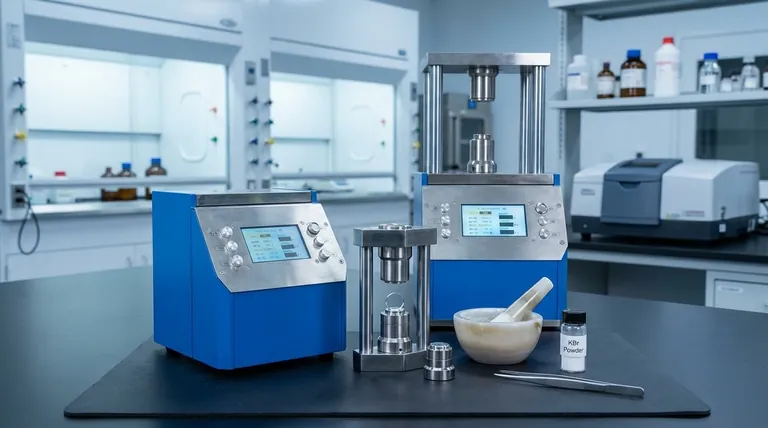
You must have access to a pellet die set, a hydraulic press, and an agate mortar to prevent contamination and ensure proper compression.
Making the Right Choice for Your Goal
The KBr pellet method is not just a "classic" technique; it is a precision tool for specific analytical needs.
- If your primary focus is Quantitative Analysis: Use KBr pellets to ensure a uniform path length and precise, reproducible absorption measurements.
- If your primary focus is Trace Detection: Choose this method to leverage its high sensitivity and ability to resolve minor components in a mixture.
- If your primary focus is Broad Compatibility: Rely on this technique for analyzing diverse solids, from inorganic salts to complex pharmaceuticals, without solvent interference.
Ultimately, use the KBr pellet method when you need the highest possible spectral fidelity and cannot afford the signal attenuation common in reflection-based techniques.
Summary Table:
| Advantage | Key Benefit |
|---|---|
| Superior Spectral Quality | Unobstructed IR transparency for clean, accurate spectra. |
| Enhanced Sensitivity | High trace detection capability for minor components. |
| Quantitative Accuracy | Uniform path length ensures precise, reproducible results. |
| Broad Material Compatibility | Effective for polymers, pharmaceuticals, and inorganics. |
| Safer Preparation | No hazardous solvents required for sample preparation. |
Ready to achieve superior spectral quality and quantitative accuracy in your lab?
The KBr pellet method relies on precise equipment to deliver its renowned advantages. KINTEK specializes in laboratory press machines, including the hydraulic presses and pellet dies essential for creating perfect KBr pellets. Our reliable equipment ensures the uniform compression and consistency your FTIR analysis demands.
Contact us today to discuss your specific application and let our experts help you select the ideal press for your laboratory needs. #ContactForm
Visual Guide
Related Products
- Automatic Laboratory Hydraulic Press for XRF and KBR Pellet Pressing
- Laboratory Hydraulic Pellet Press for XRF KBR FTIR Lab Press
- Laboratory Hydraulic Press 2T Lab Pellet Press for KBR FTIR
- XRF KBR Plastic Ring Lab Powder Pellet Pressing Mold for FTIR
- XRF KBR Steel Ring Lab Powder Pellet Pressing Mold for FTIR
People Also Ask
- Why is pressing powder into a pellet critical before sintering? Ensure Dense, Conductive Solid-State Electrolytes
- What is the role of a laboratory pressure machine and KBr in FTIR? Master Sample Preparation for Flame Retardants
- What are the advantages of using a laboratory automatic hydraulic press for HEA green compact forming?
- What are the advantages of using a lab automatic hydraulic press for HEA green body molding? Ensure Material Integrity
- How does an automatic laboratory hydraulic press improve KBr pellet preparation? Achieve Precision IR Spectroscopy















