
Deciding between a manual and an automatic XRF pellet press fundamentally requires balancing your laboratory's sample throughput against your available budget. While manual presses provide a cost-effective solution for occasional testing, automatic presses are designed to handle high volumes and complex samples with greater consistency and less physical effort.
The optimal choice hinges on the trade-off between upfront capital cost and long-term operational efficiency. Manual presses suit labs with limited budgets and low sample counts, whereas automatic presses are critical for high-throughput environments requiring superior reproducibility and reduced operator fatigue.
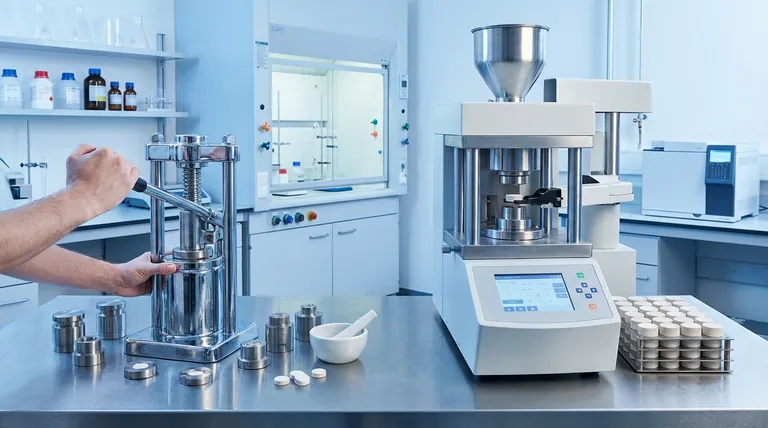
Evaluating Workflow and Throughput
Sample Volume Requirements
The most immediate factor is the number of samples you process daily. Sample throughput dictates whether the speed of automation is a luxury or a necessity.
High-volume laboratories generally require automatic presses to maintain a steady workflow without creating a bottleneck. Conversely, for labs running only a few samples a week, a manual press is often sufficient.
Operator Labor and Ease of Operation
Consider the physical demand placed on your technicians. Manual presses require physical effort to pump the hydraulic system, which can lead to operator fatigue over time.
Automatic presses prioritize ease of operation, allowing technicians to prepare pellets with the push of a button. This frees up personnel to focus on other analytical tasks while the cycle completes.
Technical Specifications and Sample Quality
Pressure Requirements and Force
Different materials require different levels of force to form a stable pellet. Presses typically offer ranges from 15 to over 100 tons of pressure.
You must ensure the press—whether manual or automatic—can achieve the adequate pressing force required for your specific sample matrix. Automatic systems often provide more precise control over this force, ensuring better reproducibility.
Handling Complex Samples
The complexity of the samples being analyzed plays a major role in your decision. Difficult samples may require specific dwell times or pressure release cycles to prevent cracking.
Automatic presses are generally better suiting for these complex needs as they remove the variability of human operation. This ensures that difficult materials are pressed consistently every time.
Operational Logistics
Space Constraints and Form Factor
You must evaluate the available physical space within your laboratory. Presses come in various sizes, ranging from compact benchtop units to larger floor models.
Space constraints often dictate the type of model you can install. While manual presses are often smaller, high-capacity automatic floor models may require dedicated infrastructure.
Contamination and Maintenance
Regardless of automation, material compatibility is vital to prevent cross-contamination. You must check that the die size and contact surfaces are appropriate for your specific analysis.
Consider the ease of cleaning and the durability of the unit for daily use. A press that is difficult to clean will slow down your workflow and risk contaminating sensitive XRF measurements.
Understanding the Trade-offs
The Cost vs. Consistency Balance
The primary trade-off is cost relative to quality. Manual presses have a significantly lower entry price but introduce the variable of human technique.
If different operators use a manual press, the pressure application and dwell time may vary, potentially affecting analytical results. Automatic presses require a higher budget but deliver the durability and consistency needed for rigorous quality control.
Maintenance Considerations
Manual systems are generally simpler mechanically, which can mean higher durability and easier repair.
Automatic systems involve motors and electronics. While they offer superior performance, they introduce more potential points of failure that may require specialized service.
Making the Right Choice for Your Lab
To select the right press, align the machine's capabilities with your lab's primary operational goals.
- If your primary focus is Budget Efficiency: Choose a manual press, provided your sample volume is low enough to avoid technician fatigue.
- If your primary focus is High Throughput: Invest in an automatic press to maximize speed and free up technician time for other tasks.
- If your primary focus is Analytical Precision: Select an automatic press to eliminate operator variability and ensure consistent density across complex samples.
- If your primary focus is Space Economy: Look for a benchtop model that meets your tonnage requirements without consuming valuable floor space.
Ultimately, the right press is the one that meets your pressure requirements while seamlessly fitting into your existing laboratory space and workflow.
Summary Table:
| Factor | Manual Press | Automatic Press |
|---|---|---|
| Best For | Low sample volume, budget-conscious labs | High-throughput, precision-focused labs |
| Key Advantage | Lower upfront cost | Superior consistency & speed |
| Operator Effort | High (can cause fatigue) | Low (push-button operation) |
| Typical Cost | Lower initial investment | Higher initial investment |
Ready to enhance your sample preparation workflow?
KINTEK specializes in laboratory press machines, including automatic lab presses, isostatic presses, and heated lab presses, designed to meet the precise needs of modern laboratories. Whether you require the cost-effectiveness of a manual press or the high-throughput consistency of an automatic system, our experts can help you select the perfect equipment to improve your analytical precision and operational efficiency.
Contact our team today for a personalized consultation and discover the right press for your lab's unique requirements.
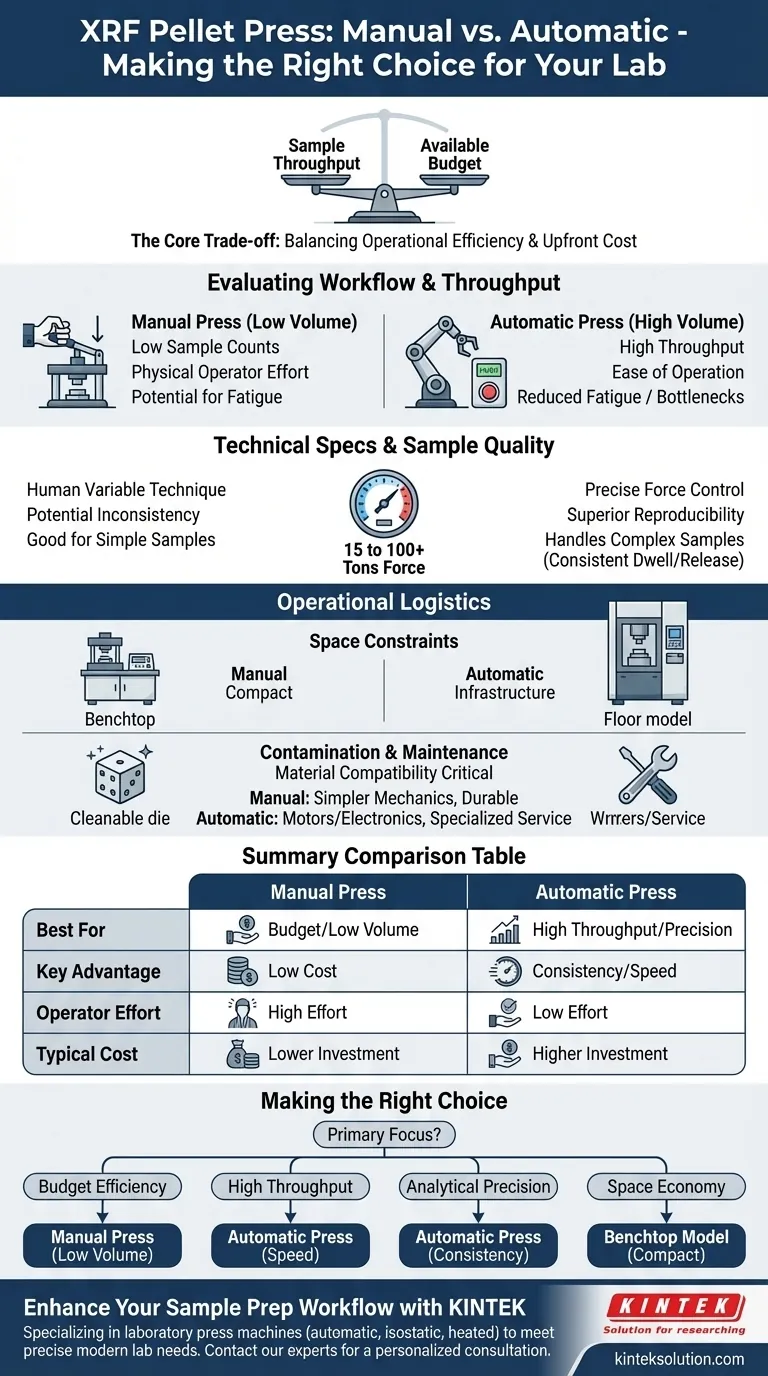
Visual Guide
Related Products
- XRF KBR Plastic Ring Lab Powder Pellet Pressing Mold for FTIR
- Lab XRF Boric Acid Powder Pellet Pressing Mold for Laboratory Use
- XRF KBR Steel Ring Lab Powder Pellet Pressing Mold for FTIR
- Laboratory Hydraulic Pellet Press for XRF KBR FTIR Lab Press
- Automatic Laboratory Hydraulic Press for XRF and KBR Pellet Pressing
People Also Ask
- What is the purpose of making KBr pellets for FTIR? Achieve Precise Molecular Analysis with Solid Samples
- What factors should be considered when choosing a lab press for XRF pellet preparation? Ensure Accurate and Consistent Results
- Why are pellets used in XRF analysis, and what is their limitation? Boost Accuracy and Speed in Your Lab
- How are pellets prepared for XRF analysis and what is a potential drawback? Master XRF Sample Prep and Accuracy
- What should be included in a checklist for making XRF pellets? Ensure Accurate and Repeatable XRF Analysis



















