
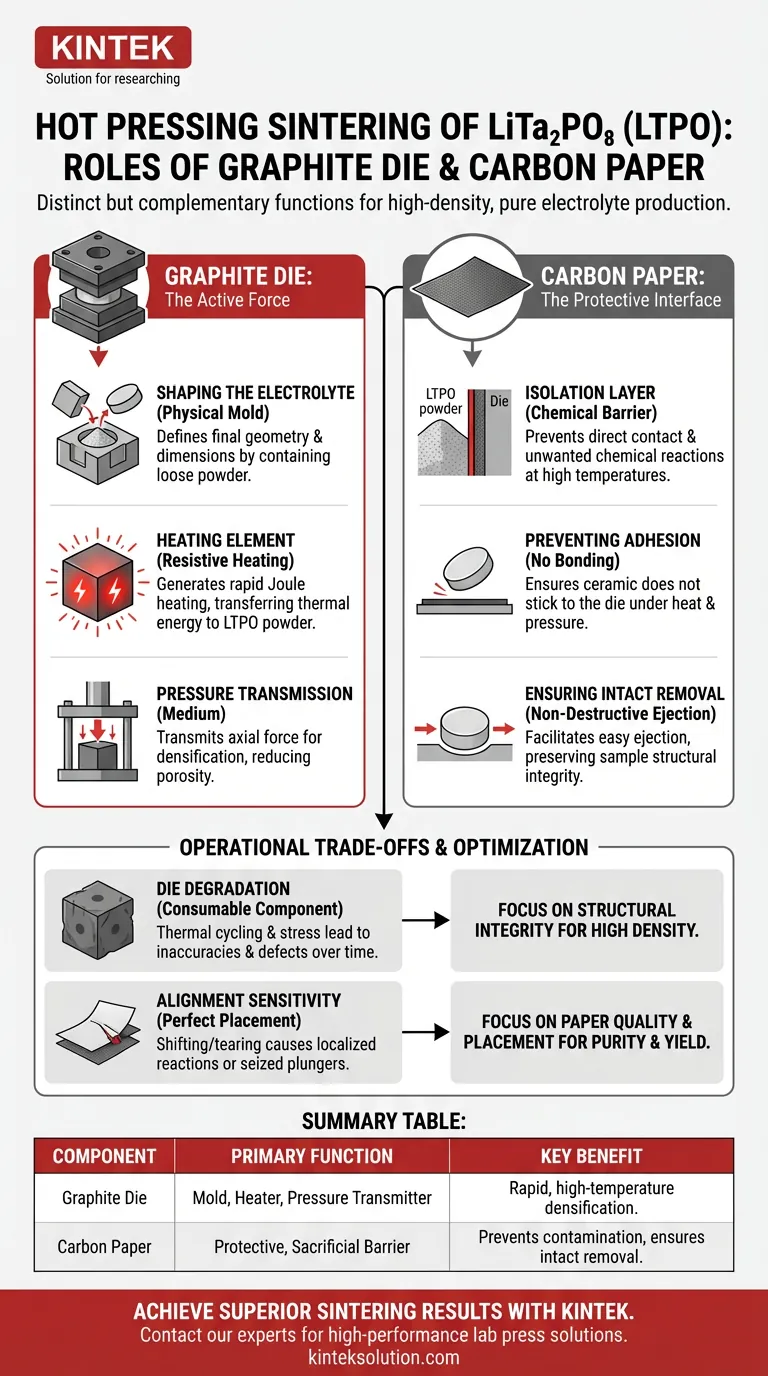
In the hot pressing sintering of LiTa2PO8 (LTPO), the graphite die and carbon paper perform distinct but complementary roles. The graphite die acts as the active vessel responsible for generating heat, shaping the material, and transmitting pressure, while the carbon paper serves as a critical protective interface to prevent contamination and mechanical adhesion.
The graphite die drives the sintering physics by delivering the thermal energy and mechanical load required to densify the ceramic, while the carbon paper ensures process integrity. The paper acts as a sacrificial barrier, guaranteeing the final electrolyte pellet remains chemically pure and physically intact upon removal.
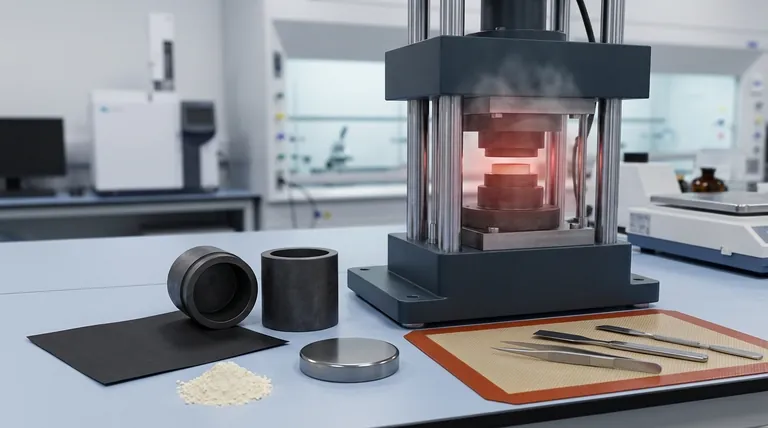
The Multifaceted Role of the Graphite Die
The graphite die is not merely a container; it is an active component in the sintering system, particularly in Spark Plasma Sintering (SPS) and Hot Pressing (HP).
Shaping the Electrolyte
The most fundamental function of the die is serving as the physical mold. It defines the final geometry and dimensions of the LiTa2PO8 pellet by containing the loose powder during the densification process.
Acting as the Heating Element
In processes like SPS, the graphite die serves as a resistive heating element. Because graphite is electrically conductive, high-density pulsed current passes through the die, generating rapid Joule heating that is transferred directly to the LTPO powder.
Transmitting Mechanical Pressure
The die functions as the medium for pressure transmission. It transfers the axial force applied by the press rams directly onto the powder, a critical step for reducing porosity and achieving a high-density ceramic structure.
The Critical Function of Carbon Paper
While the die handles the energy and force, the carbon paper addresses the chemical and mechanical compatibility of the materials.
Acting as an Isolation Layer
Carbon paper is placed between the LTPO powder and the inner walls of the graphite die to serve as a chemical barrier. It prevents direct contact between the sample and the die, mitigating the risk of unwanted chemical reactions at high temperatures.
Preventing Adhesion
The paper prevents the ceramic from bonding to the mold. Under high heat and pressure, materials tend to fuse; the carbon paper ensures the sample does not stick to the die, protecting both the sample and the expensive tooling.
Ensuring Intact Removal
By preventing adhesion, the carbon paper facilitates the non-destructive ejection of the sintered pellet. This ensures the dense ceramic can be removed without cracking or chipping, preserving the sample's structural integrity.
Understanding the Operational Trade-offs
While this setup is standard for advanced ceramics, there are inherent limitations you must manage to ensure consistent results.
Die Degradation
Graphite dies are consumable components. The repeated exposure to extreme thermal cycling and mechanical stress eventually degrades the graphite, leading to dimensional inaccuracies or surface defects over time.
Alignment Sensitivity
The effectiveness of the carbon paper relies on perfect placement. If the paper shifts or tears during loading, the LTPO powder will contact the die directly, leading to localized reaction spots or a seized plunger that can ruin the entire assembly.
Optimizing Your Sintering Setup
To achieve the best results with LiTa2PO8 electrolytes, focus on how these components interact with your specific processing goals.
- If your primary focus is high density: Prioritize the structural integrity of the graphite die; a worn die may not transmit pressure uniformly, leading to density gradients in the pellet.
- If your primary focus is sample purity and yield: Prioritize the quality and placement of the carbon paper; a breach in this layer is the most common cause of surface contamination and sample breakage during ejection.
Success in hot pressing lies in balancing the aggressive application of heat and pressure with the protective measures required to keep the ceramic pure.
Summary Table:
| Component | Primary Function | Key Benefit for LTPO Sintering |
|---|---|---|
| Graphite Die | Acts as mold, heating element, and pressure transmitter. | Enables rapid, high-temperature densification of the electrolyte powder. |
| Carbon Paper | Serves as a protective, sacrificial barrier layer. | Prevents chemical contamination and ensures intact pellet removal. |
Achieve superior results in your ceramic sintering research. KINTEK specializes in high-performance lab press machines, including automatic lab presses, isostatic presses, and heated lab presses, designed to meet the precise demands of advanced materials development. Our expertise ensures your sintering setup is optimized for maximum density and sample purity. Contact our experts today to discuss how our solutions can enhance your laboratory's capabilities.
Visual Guide
Related Products
- Lab Heat Press Special Mold
- Lab Infrared Press Mold for No Demolding
- XRF KBR Plastic Ring Lab Powder Pellet Pressing Mold for FTIR
- Lab XRF Boric Acid Powder Pellet Pressing Mold for Laboratory Use
- Laboratory Hydraulic Split Electric Lab Pellet Press
People Also Ask
- How is a laboratory heat press used to evaluate bio-based aliphatic polyesters? Prepare Reliable Samples for Analysis
- How is a laboratory heat press utilized in MEA preparation? Achieve High-Efficiency Iron-Chromium Redox Flow Batteries
- Why is a laboratory heat press necessary for biodegradable films? Unlock Precision Bonding and Barrier Performance
- What is the purpose of incorporating cartridge heaters into a lab press mold for MLCC block compression? Optimize Results
- Why is a high-precision laboratory heated press essential for MEA fabrication? Unlock Peak Fuel Cell Performance






