
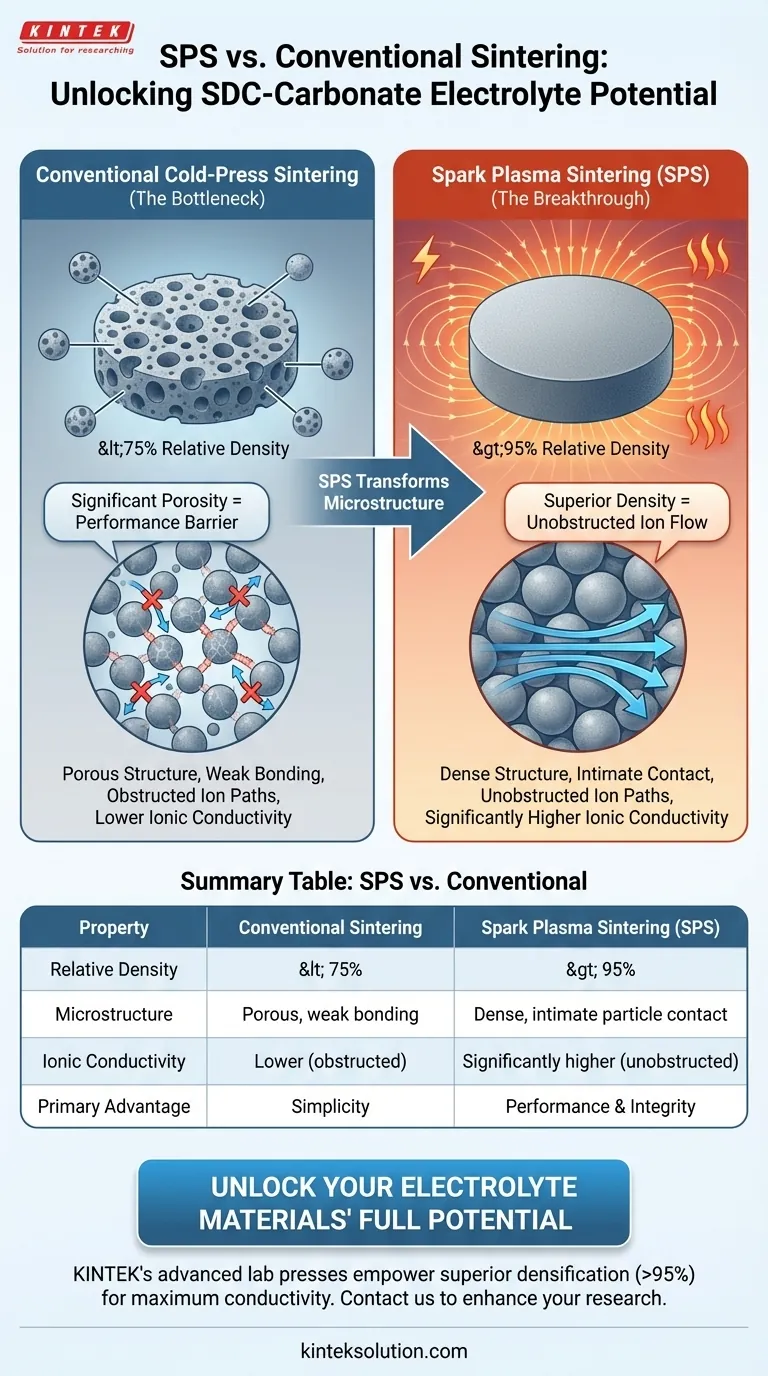
Spark Plasma Sintering (SPS) fundamentally transforms the microstructure of SDC-carbonate electrolytes, offering a dramatic improvement over conventional cold-press methods. Its primary advantage is the ability to achieve a relative density exceeding 95%, whereas conventional sintering typically stagnates below 75%.
The superior density achieved via SPS is not merely a structural metric; it is the critical factor that eliminates porosity and creates unobstructed pathways for ion transport, directly resulting in significantly higher ionic conductivity.

The Density Disparity
Breaking the 75% Barrier
The most immediate physical difference between the two methods is the density of the final pellet. Conventional cold-press sintering often struggles to compact the material fully, leaving the sample with a relative density of less than 75%.
In contrast, SPS applies simultaneous pressure and field-assisted heating to force densification. This process consistently yields electrolyte pellets with a relative density exceeding 95%, approaching the theoretical maximum for the material.
Eliminating Structural Defects
The low density associated with conventional methods implies a structure riddled with voids. These voids act as barriers to performance.
SPS effectively eliminates this porosity. By mechanically and thermally collapsing these voids, the process creates a solid, continuous ceramic body rather than a loosely connected aggregate of particles.
Impact on Electrochemical Performance
Enhancing Particle Contact
For an electrolyte to function efficiently, the microscopic particles comprising it must be in close contact.
SPS facilitates intimate contact between these particles. This tight packing ensures that ions can move freely from one grain to the next without encountering physical gaps or resistive barriers.
Unobstructed Ion Conduction
The direct consequence of eliminating porosity and tightening particle contact is a smoother path for ions.
Because the path is unobstructed, the SDC-carbonate composite electrolyte exhibits significantly improved ionic conductivity. The SPS process removes the microstructural bottlenecks that plague cold-pressed samples.
The Limitations of Conventional Methods
The Porosity Penalty
While conventional cold-press sintering is a standard preparation method, it inherently results in a porous structure for this specific material class.
This porosity acts as a "dead end" for ionic movement. If your application requires high-efficiency conduction, the <75% density ceiling of conventional methods represents a significant performance bottleneck that cannot be overcome without changing the sintering technique.
Weak Inter-Particle Bonding
Beyond simple density, cold-pressing fails to achieve the "intimate" solid-solid interface required for high performance.
Without the assisted densification of SPS, the contact points between particles remain weak, leading to higher internal resistance and lower overall efficacy of the electrolyte.
Making the Right Choice for Your Goal
The choice between SPS and conventional sintering depends entirely on your performance requirements for the SDC-carbonate electrolyte.
- If your primary focus is maximizing ionic conductivity: You must use SPS to achieve the >95% density required for an unobstructed ion path.
- If your primary focus is microstructural integrity: SPS is necessary to eliminate the voids and porosity inherent to the <75% density of cold-pressed samples.
By selecting Spark Plasma Sintering, you are effectively trading the simplicity of cold pressing for the critical density required to unlock the full potential of the electrolyte.
Summary Table:
| Property | Conventional Sintering | Spark Plasma Sintering (SPS) |
|---|---|---|
| Relative Density | < 75% | > 95% |
| Microstructure | Porous, weak bonding | Dense, intimate particle contact |
| Ionic Conductivity | Lower due to obstructed paths | Significantly higher, unobstructed paths |
| Primary Advantage | Simplicity | Performance and microstructural integrity |
Unlock the full potential of your electrolyte materials.
Conventional sintering methods can limit your SDC-carbonate pellets to less than 75% density, creating a performance bottleneck. KINTEK's advanced lab press machines, including our isostatic and heated lab presses, are designed to overcome these challenges. We specialize in providing the precise pressure and temperature control needed for techniques like Spark Plasma Sintering, enabling you to achieve superior densification (>95%) and maximize ionic conductivity for your laboratory research.
Let KINTEK's expertise empower your next breakthrough. Contact our team today to discuss how our sintering solutions can enhance your material performance.
Visual Guide
Related Products
People Also Ask
- Function of a Laboratory Hydraulic Press with Heated Platens in SSE? Enhance Battery Density & Conductivity
- How does a laboratory heated hydraulic press facilitate PBN sample prep for WAXS? Achieve Precise X-Ray Scattering
- What are the requirements for electrode pressing with high-viscosity ionic liquids like EMIM TFSI? Optimize Performance
- What are the industrial applications of heated hydraulic presses? Master Heat & Force for Precision Manufacturing
- Why is a laboratory hydraulic press with heating plates required for PLA/TEC films? Achieve Precise Sample Integrity
