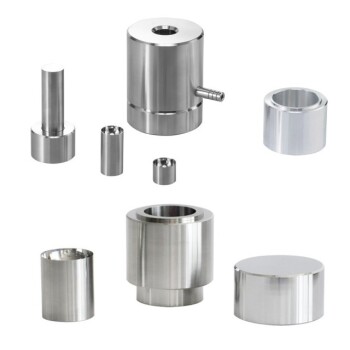
Laboratory compaction equipment offers superior technical fidelity by accurately replicating the vertical impact distribution that track ballast experiences in the real world. Unlike the rotating drum method, which relies on random tumbling to induce wear, compaction creates specific particle splitting and angular wear patterns that mirror actual railway operating conditions.
The core technical advantage lies in the mechanism of force: compaction simulates the directional, vertical loads of a passing train, whereas rotating drums simulate generalized abrasion, making compaction data far more reliable for predicting track maintenance cycles.
The Mechanics of Load Simulation
Replicating Vertical Impact
The primary function of railway ballast is to support vertical loads from train traffic. Laboratory compaction equipment is designed to replicate this specific directional force.
By applying load from above, the equipment mimics the stress distribution a track bed undergoes during actual operation.
The Inaccuracy of Random Tumbling
In contrast, the rotating drum method relies on a tumbling motion. This generates impact and wear from random angles rather than a consistent vertical source.
This randomization fails to account for the specific load paths and stress concentrations present in a settled track bed.
Wear Patterns and Particle Geometry
Inducing Realistic Particle Splitting
Real-world ballast degradation is characterized by particle splitting and angular wear. This occurs when high vertical pressure forces stones against one another, causing them to fracture or chip while maintaining angularity.
Compaction equipment successfully reproduces this specific type of geological failure.
The Deviation of Tumbling Wear
The rotating drum method tends to produce wear through general attrition and tumbling. This often results in a different wear character compared to the crushing and splitting seen under tracks.
Using tumbling to simulate ballast life misses the critical "angular" aspect of wear that affects track stability.
Understanding the Trade-offs
Simulation Fidelity vs. General Abrasion
While rotating drums are effective for testing general material hardness or abrasion resistance, they lack directional fidelity.
Reliability in this context is defined by how closely the lab results match the field results. Because the rotating drum generates wear through a mechanism (tumbling) that does not exist in the track bed, it introduces a fundamental error in the simulation data.
Impact on Maintenance Planning
The most significant trade-off involves predictive accuracy. Data derived from rotating drums may misrepresent how long ballast will last before losing its interlocking capability.
Compaction equipment, by generating realistic angular wear, provides a reliable baseline for predicting maintenance cycles, reducing the risk of premature track failure or unnecessary maintenance interventions.
Making the Right Choice for Your Goal
To ensure your testing methodology aligns with your engineering requirements, consider the following:
- If your primary focus is predicting track maintenance cycles: Prioritize laboratory compaction equipment to generate data based on realistic particle splitting and vertical loading.
- If your primary focus is simulating actual operating conditions: Avoid the rotating drum method, as its random tumbling action does not accurately reflect the directional forces found in railway environments.
Ultimately, the reliability of your lifecycle predictions depends entirely on how accurately your test method mimics the vertical impact distribution of the physical track.
Summary Table:
| Feature | Laboratory Compaction Equipment | Rotating Drum Method |
|---|---|---|
| Load Mechanism | Vertical, directional impact (train simulation) | Random tumbling and general abrasion |
| Wear Character | Realistic particle splitting and angular wear | General attrition and rounding of edges |
| Stress Distribution | Mimics actual track bed stress paths | Randomized impact from all angles |
| Predictive Accuracy | High; reliable for maintenance cycles | Low; misses directional load fidelity |
| Primary Use | Railway engineering and lifecycle prediction | General material hardness and abrasion testing |
Enhance Your Research with Precision Compaction Solutions
Are you looking to achieve higher fidelity in your material testing? KINTEK specializes in comprehensive laboratory pressing solutions designed to meet the rigorous demands of modern research. From manual and automatic models to advanced cold and warm isostatic presses, our equipment ensures your simulations reflect real-world conditions with unmatched accuracy.
Whether you are conducting battery research or simulating heavy infrastructure loads, our multifunctional and glovebox-compatible systems provide the reliability your data deserves. Contact KINTEK today to discuss your specific requirements and let our experts help you select the ideal pressing solution for your lab.
References
- Erika Juhász, Szabolcs Fischer. Testing the fragmentation of railway ballast material by laboratory methods using Proctor compactor. DOI: 10.33271/nvngu/2024-1/058
This article is also based on technical information from Kintek Solution Knowledge Base .
Related Products
- Lab Round Bidirectional Press Mold
- Lab Polygon Press Mold
- Laboratory Hydraulic Press Lab Pellet Press Machine for Glove Box
- Automatic Lab Cold Isostatic Pressing CIP Machine
- Lab Ball Press Mold
People Also Ask
- What is the purpose of incorporating cartridge heaters into a lab press mold for MLCC block compression? Optimize Results
- Why is precise cooling management of the lab press mold necessary? Protect Core Integrity in Thermoforming
- What is the function of a pressing tool in thermoplastic panels? Master Precision Shaping & Fusion Bonding
- Why is a high-performance laboratory molding press critical for in-situ electrolyte formation? Unlock Battery Success
- How do the design and geometric precision of pressing molds and mandrels affect the quality of PTFE composite samples?