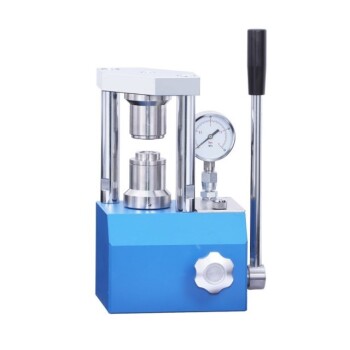
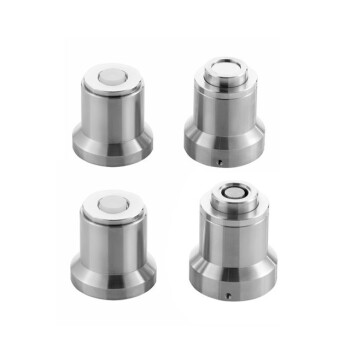
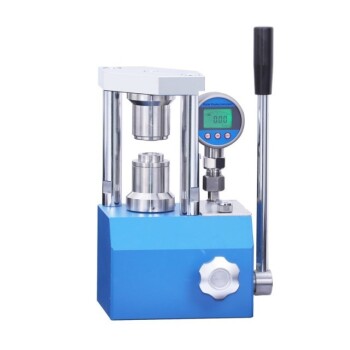
High-pressure battery test fixtures serve as the essential hardware foundation for All-Solid-State Battery (ASSB) research by applying controllable external mechanical constraints to battery cells. These devices simulate real-world stack pressure to maintain tight solid-solid interface contact, which is critical for minimizing resistance. Furthermore, they enable the precise measurement of expansion forces generated during cycling, particularly in materials like silicon-carbon anodes.
High-pressure fixtures bridge the gap between material theory and practical application by simulating realistic stack pressures. They provide the necessary physical constraints to minimize interface resistance and accurately quantify the mechanical expansion inherent in solid-state chemistries.
Simulating Operational Environments
Applying Controllable Constraints
To accurately study ASSBs, researchers cannot rely on unconstrained setups. High-pressure fixtures provide the mechanism to apply precise, controllable external mechanical constraints to the battery cell. This transforms the test environment from a passive holder into an active variable in the experiment.
Emulating Real-World Stack Pressure
In practical commercial applications, battery packs are assembled under significant pressure. These fixtures effectively simulate this "stack pressure" within a laboratory setting. This ensures that the mechanical conditions during testing mirror the physical realities the battery will face in a final product.
Managing Solid-Solid Interfaces
Ensuring Tight Contact
The primary challenge in ASSBs is the interface between solid electrolytes and electrodes. Unlike liquid batteries that wet the surface, solid batteries require physical force to connect. The fixture is critical for maintaining tight solid-solid interface contact throughout the lifespan of the test.
Reducing Interface Resistance
The direct result of maintaining this tight contact is a significant improvement in electrochemical performance. By forcing the layers together, the fixture reduces interface contact resistance. This facilitates more efficient ion transport across the solid boundaries.
Quantifying Mechanical Evolution
Monitoring Expansion Forces
Battery chemistries are dynamic; they change physically during operation. High-pressure fixtures allow for the accurate measurement of expansion forces generated inside the cell.
Analyzing Silicon-Carbon Anodes
This measurement capability is particularly vital for advanced anode materials. Specifically, fixtures are used to capture the expansion behavior of silicon-carbon anodes during cycling, providing data on how these materials physically evolve under load.
Understanding the Trade-offs
Complexity vs. Data Fidelity
Utilizing high-pressure fixtures introduces mechanical complexity to the testing workflow that is not present in standard liquid-electrolyte testing. This requires more robust hardware and precise calibration.
However, the trade-off is necessary. Testing ASSBs without these constraints yields data that fails to account for interface resistance or expansion forces, rendering the results inapplicable to real-world scenarios.
Making the Right Choice for Your Research
To maximize the value of your mechanical property research, align your fixture usage with your specific data requirements.
- If your primary focus is minimizing resistance: Prioritize fixtures that can maintain high, uniform stack pressure to ensure optimal solid-solid contact and ion transport.
- If your primary focus is studying anode materials: Ensure your fixture is capable of dynamically measuring force changes to capture the expansion characteristics of silicon-carbon components.
By utilizing high-pressure fixtures to control the mechanical environment, you transform variable interface conditions into reliable, actionable data for ASSB development.
Summary Table:
| Function | Core Benefit | Impact on Battery Research |
|---|---|---|
| Interface Management | Maintains tight solid-solid contact | Drastically reduces interface resistance for ion transport |
| Stack Pressure Simulation | Emulates real-world pack conditions | Bridges the gap between lab experiments and commercial use |
| Expansion Monitoring | Quantifies dynamic volume changes | Crucial for analyzing silicon-carbon anode evolution |
| Mechanical Constraint | Provides controllable external force | Stabilizes the electrochemical environment during cycling |
Elevate Your ASSB Research with KINTEK Precision
Are you struggling with interface resistance or inconsistent mechanical data in your solid-state battery development? KINTEK specializes in comprehensive laboratory pressing solutions designed for the most demanding research environments. From manual and automatic models to specialized heated, multifunctional, and glovebox-compatible fixtures, our equipment ensures precise stack pressure and reliable data for battery expansion studies.
Whether you are refining silicon-carbon anodes or perfecting solid electrolyte contact, our cold and warm isostatic presses provide the uniform pressure needed to move from theory to application. Contact KINTEK today to find your ideal testing solution and optimize your battery's mechanical and electrochemical performance.
References
- Yefan Sun, Shiqiang Liu. Revealing Stress Evolution Mechanisms in All-Solid-State Batteries: A Non-Invasive Parameter Identification Framework for Battery Design. DOI: 10.2139/ssrn.5801871
This article is also based on technical information from Kintek Solution Knowledge Base .
Related Products
- Lab Button Battery Tablet Press Sealing Mold
- Lab Infrared Press Mold for Laboratory Applications
- Laboratory Hydraulic Press Lab Pellet Press Button Battery Press
- Lab Cylindrical Press Mold for Laboratory Use
- Special Shape Lab Press Mold for Laboratory Applications
People Also Ask
- How does a sealed battery mold facilitate the assembly and testing of asymmetric supercapacitors using VO2?
- Why use standardized CR2032 components & high-precision presses? Ensure reliability in lithium metal battery research.
- Why is a laboratory battery sealing press essential for desolvation energy testing? Ensure Reliable Kinetic Data
- What is the function of specialized battery molds and sealing consumables? Optimize Your In-situ XRD Testing Today
- What role does a laboratory sealing press play in thermal analysis of solid dispersion films? Ensure Data Integrity