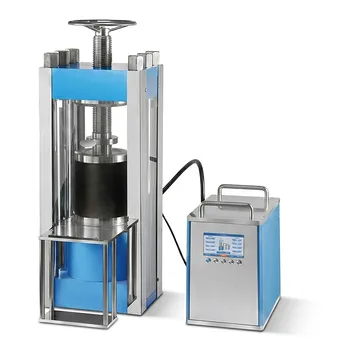
The critical processing conditions provided by a laboratory heated press are the synchronization of high-precision thermal energy and mechanical pressure. Specifically, wood composite molding requires maintaining temperatures (typically around 150°C) and pressure loads (often near 700 kPa) to trigger the rapid cross-linking of adhesives, consolidate material layers, and eliminate internal voids.
A laboratory heated press transforms loose veneers or particles into a unified structural composite by simultaneously managing chemical curing and physical consolidation. This dual-action environment is essential for achieving the density, interfacial bonding, and geometric precision required for high-performance materials.
The Role of Synchronized Heat in Chemical Activation
Triggering Rapid Resin Cross-Linking
The primary function of the heated platens is to provide a uniform thermal field that activates the adhesive system, such as phenolic or urea-formaldehyde resins. This heat triggers a rapid cross-linking reaction, transforming the liquid or powdered resin into a solid, high-strength polymer matrix that binds the wood fibers.
Facilitating Molecular Flow and Wetting
Before the resin cures completely, heat reduces its viscosity, allowing it to flow across the wood surfaces and into the cellular structure. This wetting process is crucial for creating a deep mechanical interlock between the adhesive and the wood, ensuring the final composite does not delaminate under stress.
Mechanical Consolidation and Structural Integrity
Eliminating Surface Irregularities
Wood is naturally inconsistent, and surface irregularities can create "bonding gaps" that weaken the structure. The hydraulic pressure of the lab press forces these layers into tight contact, effectively neutralizing gaps and ensuring the adhesive can bridge the interface between every layer.
Densification and Air Expulsion
Consistent pressure increases the material density by compressing the wood fibers and expelling entrapped air bubbles. By removing these internal voids, the press ensures a dense internal structure that significantly reduces data scatter during subsequent mechanical or fire-safety testing.
Achieving Dimensional Precision
The press acts as a precision mold, ensuring the final specimen has a uniform thickness and smooth surface finish. This geometric consistency is vital for researchers who must meet strict standards for tests like the Limiting Oxygen Index (LOI) or cone calorimetry.
Understanding the Trade-offs and Constraints
The Risk of Internal Density Inconsistency
While high pressure increases strength, uneven application can lead to internal density gradients. If the pressure is not perfectly distributed across the platen, the resulting sample may have "hard" and "soft" spots, leading to interlayer cracking or warping after the material is removed from the press.
Managing Volatiles and Outgassing
High temperatures can cause moisture and volatiles within the wood or resin to vaporize rapidly. If the press is opened too quickly or if the pressure is not managed correctly, these trapped gases can cause internal delamination or "blowouts," ruining the structural integrity of the composite.
How to Apply These Conditions to Your Research
Implementing Precise Process Controls
To achieve reproducible results in wood composite fabrication, your processing strategy must align with your specific material objectives.
- If your primary focus is maximizing bond strength: Prioritize a steady ramp-up to the resin’s peak curing temperature while maintaining maximum pressure to ensure deep mechanical interlocking.
- If your primary focus is dimensional stability: Emphasize the cooling phase by using programmed cooling to regulate the solidification of the matrix, which minimizes internal stresses and warping.
- If your primary focus is reducing experimental data scatter: Use high-precision hydraulic controls to ensure consistent thickness and density across all test specimens.
Mastering the synergy between thermal activation and mechanical consolidation is the definitive factor in producing high-quality, research-grade wood composites.
Summary Table:
| Processing Condition | Primary Function | Research Benefit |
|---|---|---|
| High-Precision Heat | Triggers resin cross-linking and facilitates molecular flow/wetting. | Ensures a strong polymer matrix and deep mechanical interlocking. |
| Mechanical Pressure | Consolidates material layers and expels entrapped air/voids. | Increases density and minimizes data scatter in mechanical testing. |
| Synchronized Control | Manages volatile outgassing and cooling solidification. | Prevents internal delamination and ensures high dimensional precision. |
Elevate your material science research with KINTEK’s industry-leading laboratory pressing solutions. Whether you are developing advanced wood composites or conducting cutting-edge battery research, our comprehensive range of manual, automatic, heated, and multifunctional presses—including specialized glovebox-compatible and isostatic (cold/warm) models—ensures the precision and reproducibility your data demands. Achieve superior densification and perfect thermal activation every time. Contact KINTEK today to find the perfect press for your lab!
References
- Frederick A. Kamke. Densified radiata pine for structural composites. DOI: 10.4067/s0718-221x2006000200002
This article is also based on technical information from Kintek Solution Knowledge Base .
Related Products
- Cylindrical Lab Electric Heating Press Mold for Laboratory Use
- Lab Heat Press Special Mold
- Lab Polygon Press Mold
- Lab Double Plate Heating Mold for Laboratory Use
- Special Shape Lab Press Mold for Laboratory Applications
People Also Ask
- How does a laboratory electric heated press ensure sample quality? Optimize SiR-EPDM vulcanization and molding.
- What role does a laboratory electric heated press play in polymer composite fabrication? Key for Standardized Specimens
- What role does a laboratory electric heating press play in NBR molding? Master Vulcanization & Material Density
- Why is a laboratory electric heating press required for PP/EPDM molding? Achieve Superior Specimen Integrity
- What is the purpose of incorporating cartridge heaters into a lab press mold for MLCC block compression? Optimize Results