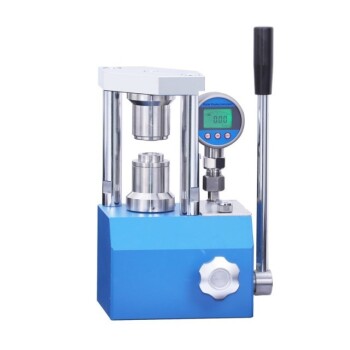
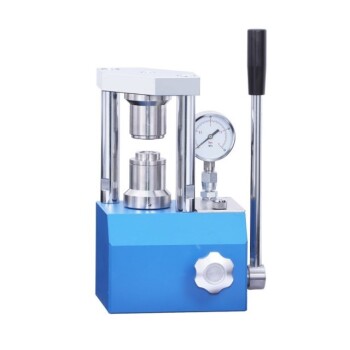
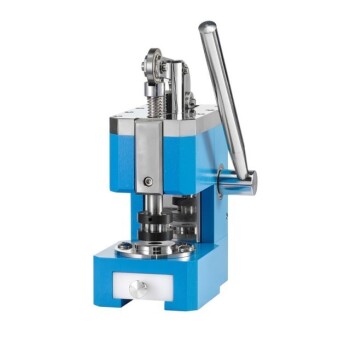
The laboratory press or crimping machine acts as the critical final step in securing the electrochemical environment of a CR2032 coin cell. Its primary function is to apply stable, precise mechanical pressure to hermetically seal the cathode, anode, separator, and electrolyte within the stainless steel casing.
The machine serves a dual purpose: it establishes a hermetic seal to prevent leakage and contamination, while simultaneously compressing internal components to minimize interfacial contact resistance. This ensures that the data collected reflects the true performance of the battery chemistry rather than assembly defects.
The Mechanics of Cell Assembly
Achieving a Hermetic Seal
The most immediate function of the crimper is to permanently deform the coin cell case gasket. This creates an airtight physical seal that isolates the internal chemistry from the outside world.
Without this seal, liquid electrolyte can leak out, posing safety hazards and ruining the cell's capacity. Furthermore, the seal prevents the ingress of atmospheric oxygen and moisture, which causes fatal side reactions in sensitive hybrid battery materials.
Optimizing Internal Contact
Beyond simple closure, the machine forces the internal "stack" (electrodes, separator, spacers, and springs) into tight physical contact. This compression eliminates internal voids between the active materials and the current collectors.
By removing these gaps, the crimper ensures a continuous, low-resistance conductive pathway. This is essential for electron flow and directly impacts the cell's ability to deliver power efficiently.
Impact on Research Data Integrity
Reducing Interfacial Resistance
For researchers, the "why" behind the pressure is often more important than the "how." High interfacial contact resistance is a common source of noisy or inaccurate data.
Proper crimping pressure minimizes this resistance, ensuring that voltage drops observed during testing are due to the material's properties, not poor assembly. This is particularly vital for sensitive measurements like Electrochemical Impedance Spectroscopy (EIS).
Ensuring Long-Term Stability
In hybrid battery research, long-term cycling tests are used to evaluate durability. A consistent, high-quality crimp ensures the cell maintains its structural integrity over hundreds or thousands of cycles.
If the pressure is insufficient or uneven, the internal components may shift or lose contact over time. This leads to artificial capacity fading that misrepresents the actual stability of the electrode materials being tested.
Understanding the Trade-offs
The Danger of Under-Compression
Applying insufficient pressure is a frequent cause of cell failure. It results in a "loose" cell with high internal resistance and a compromised seal, leading to immediate electrolyte leakage or erratic voltage readings.
The Risks of Over-Compression
Conversely, excessive force can be destructive. Over-crimping may crush the separator, causing internal short circuits between the anode and cathode. It can also deform the stainless steel casing, preventing the cell from fitting correctly into battery testing holders.
Consistency vs. Flexibility
While automatic crimpers offer high standardization for reproducibility, manual hydraulic presses provide adjustable pressure. Researchers must balance the need for high throughput with the need to tune pressure for different material thicknesses or quasi-solid-state electrolytes.
Making the Right Choice for Your Goal
To ensure your assembly process supports your specific research objectives, consider these factors:
- If your primary focus is long-term cycling stability: Prioritize a crimping profile that guarantees a perfect hermetic seal to prevent electrolyte dry-out and impurity ingress over time.
- If your primary focus is kinetic studies (e.g., EIS): Ensure your machine applies sufficient, uniform pressure to minimize contact resistance and eliminate internal voids.
- If your primary focus is reproducibility: Utilize an automatic crimper to remove operator variability and ensure every cell experiences the exact same mechanical force.
Ultimately, the laboratory press is not just a packaging tool; it is a precision instrument that defines the boundary conditions for valid electrochemical data.
Summary Table:
| Feature | Role in Assembly | Impact on Research Data |
|---|---|---|
| Hermetic Sealing | Deforms gasket to isolate internal chemistry | Prevents electrolyte leakage and atmospheric contamination |
| Internal Compression | Forces electrodes and spacers into tight contact | Minimizes interfacial resistance for accurate EIS measurements |
| Structural Integrity | Secures the physical "stack" of components | Ensures long-term cycling stability and durability |
| Standardization | Applies repeatable mechanical force | Eliminates operator variability for reproducible results |
Maximize Your Battery Research Precision with KINTEK
At KINTEK, we understand that valid electrochemical data begins with perfect assembly. As specialists in comprehensive laboratory pressing solutions, we offer a range of manual, automatic, and glovebox-compatible crimping machines specifically designed for CR2032 assembly and beyond.
Whether you are conducting high-throughput testing or exploring sensitive hybrid battery materials, our presses—including heated, multifunctional, and isostatic models—provide the precise pressure control needed to eliminate interfacial resistance and ensure hermetic seals.
Ready to elevate your lab's efficiency and data integrity?
Contact KINTEK Today to Find Your Perfect Press Solution
References
- Jihoon Oh, Jang Wook Choi. Lithium‐Ion/Lithium Metal Hybrid Batteries Enabled by Lithio‐Amphiphilic Bilayer Protection. DOI: 10.1002/adfm.202512023
This article is also based on technical information from Kintek Solution Knowledge Base .
Related Products
- Button Battery Sealing Machine for Button Batteries
- Manual Button Battery Sealing Machine for Battery Sealing
- Lab Button Battery Disassembly and Sealing Mold
- Button Battery Sealing Press Machine for Lab
- Lab Button Battery Tablet Press Sealing Mold
People Also Ask
- Why is a laboratory hydraulic press or battery sealing machine essential? Ensure Coin Cell Data Integrity
- Why is a high-pressure manual or automatic coin cell crimper required? Optimize Solid-State Battery Performance
- How does a high-precision lab press or coin cell crimper affect the performance of assembled lithium-metal batteries?
- How does the mechanical pressure provided by a laboratory crimper affect the performance of assembled 2032-type coin cells?
- What role does a coin cell crimper play in solid-state batteries? Essential Pressure for Ionic Conductivity