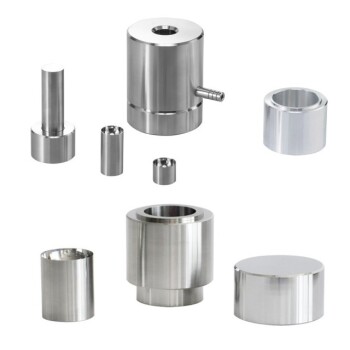
Industrial graphite dies and punches perform three integrated functions during the Spark Plasma Sintering (SPS) of Fe–Al–C nanocrystalline materials: they act as a physical containment mold, a conductive heating source, and a mechanical pressure transmitter.
These components function simultaneously to convert electrical energy into thermal energy while applying a constant axial pressure—specifically 32 MPa—to facilitate the diffusion and densification of the powder particles.
Core Takeaway The graphite die system is not merely a passive container; it is an active component of the sintering engine. By facilitating precise thermal and mechanical coupling, the graphite mold generates Joule heat and transfers pressure directly to the powder, ensuring the uniform temperature distribution required to synthesize high-quality nanocrystalline materials.
The Role of Electro-Thermal Conversion
Acting as a Conductive Heating Element
In the SPS process, the graphite dies and punches serve as active conductive heating elements.
Instead of relying solely on external heating sources, pulsed electrical currents flow directly through the high-strength graphite mold.
Generating Joule Heat
This flow of electricity generates Joule heat within the mold itself due to the material's resistance characteristics.
This mechanism allows for the rapid and efficient conversion of electrical energy into the thermal energy needed for sintering.
Ensuring Uniform Heat Distribution
Graphite is selected for its excellent electrical conductivity and temperature resistance.
These properties ensure that the heat generated is distributed uniformly across the mold, which is critical for consistent processing of the Fe–Al–C material.
Mechanical Containment and Pressure Transmission
Serving as the Powder Container
The most fundamental role of the graphite die is to serve as the container for powder molding.
It physically holds the loose Fe–Al–C nanocrystalline powder in the desired shape prior to and during the sintering process.
Transmitting Constant Pressure
The punches act as the medium for pressure transmission, transferring force directly to the powder sample.
During the sintering of these specific materials, the punches maintain a constant pressure of 32 MPa.
Axial Pressure Transfer
This pressure is applied logically and directly along the axis of the punch.
This mechanical compression forces the particles together, reducing void space and aiding the consolidation process.
Facilitating Material Synthesis
Enabling Diffusion
The combination of generated heat and applied pressure facilitates atomic diffusion between the powder particles.
The pulse current aids this process, helping to overcome the energy barriers required for the particles to bond.
Driving Densification
The ultimate goal of these combined functions is densification.
By maintaining high pressure and uniform heat, the graphite components ensure the Fe–Al–C powder consolidates into a solid, dense nanocrystalline material.
Understanding Operational Dependencies
The Necessity of High-Strength Graphite
The process relies heavily on the quality of the graphite; references specifically highlight the use of high-strength and high-purity graphite.
If the graphite lacks sufficient strength, it cannot sustain the required 32 MPa of pressure without deforming or failing during the process.
The Coupling Requirement
Success depends on precise thermal and mechanical coupling.
The system must balance the generation of heat with the application of pressure; a failure in the graphite's conductivity or structural integrity disrupts this balance, leading to uneven sintering or incomplete densification.
Making the Right Choice for Your Goal
To maximize the quality of your Fe–Al–C nanocrystalline materials, consider how these functions align with your specific objectives:
- If your primary focus is Material Density: Ensure your setup can reliably maintain the referenced 32 MPa pressure throughout the heating cycle to force particle consolidation.
- If your primary focus is Microstructural Uniformity: Prioritize high-purity graphite with consistent electrical conductivity to guarantee uniform Joule heating and prevent hot spots.
The effectiveness of Spark Plasma Sintering relies entirely on the graphite mold's ability to simultaneously act as a furnace and a press.
Summary Table:
| Function Type | Component | Action | Result |
|---|---|---|---|
| Thermal | Graphite Die/Punch | Conducts pulse current & generates Joule heat | Rapid, uniform electro-thermal conversion |
| Mechanical | Graphite Punch | Transmits 32 MPa constant axial pressure | Particle consolidation and reduction of voids |
| Physical | Graphite Die | High-strength powder containment | Defines material shape and structural integrity |
| Synthesis | Integrated System | Enables atomic diffusion and densification | High-quality Fe–Al–C nanocrystalline materials |
Maximize Your Material Density with KINTEK
Achieve precision in your nanocrystalline research with KINTEK’s high-strength graphite solutions. KINTEK specializes in comprehensive laboratory pressing solutions, offering everything from manual and automatic models to advanced cold and warm isostatic presses.
Whether you are synthesizing Fe–Al–C materials or conducting cutting-edge battery research, our heated, multifunctional, and glovebox-compatible systems ensure perfect thermal and mechanical coupling for superior densification.
Ready to elevate your lab's performance? Contact us today to find your perfect pressing solution!
References
- Yuichiro Koizumi, Yoshihira Ohkanda. Densification and Structural Evolution in Spark Plasma Sintering Process of Mechanically Alloyed Nanocrystalline Fe-23Al-6C Powder. DOI: 10.2320/matertrans.44.1604
This article is also based on technical information from Kintek Solution Knowledge Base .
Related Products
- Lab Cylindrical Press Mold for Laboratory Use
- Lab Infrared Press Mold for No Demolding
- Automatic High Temperature Heated Hydraulic Press Machine with Heated Plates for Lab
- Laboratory Hydraulic Split Electric Lab Pellet Press
- Split Automatic Heated Hydraulic Press Machine with Heated Plates
People Also Ask
- What is the purpose of incorporating cartridge heaters into a lab press mold for MLCC block compression? Optimize Results
- Why is precise cooling management of the lab press mold necessary? Protect Core Integrity in Thermoforming
- What is the function of a pressing tool in thermoplastic panels? Master Precision Shaping & Fusion Bonding
- Why is a high-performance laboratory molding press critical for in-situ electrolyte formation? Unlock Battery Success
- How does the geometry of laboratory molds influence mycelium-based composites? Optimize Density and Strength