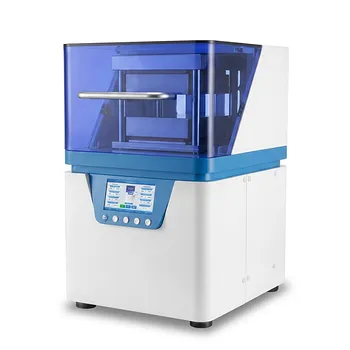
In scientific laboratories, the primary application of a hydraulic press is the preparation of powder samples for analytical testing. Researchers rely on these presses to compress loose powder mixtures into solid, uniform pellets, which are essential for accurate readings in spectroscopic analysis such as X-Ray Fluorescence (XRF) and Fourier Transform Infrared Spectroscopy (FTIR).
Core Takeaway: While hydraulic presses are versatile tools, their most critical role in the lab is standardization. By converting irregular powders into consistent solid discs, they eliminate physical inconsistencies that would otherwise compromise the precision of high-sensitivity analytical instruments.
The Critical Role of Sample Preparation
The validity of spectroscopic data is heavily dependent on the physical state of the sample. Hydraulic presses solve the problem of sample irregularity by applying immense force to create a homogeneous "pellet."
Compacting Powders for Spectroscopy
Analytical techniques like XRF and FTIR require samples to be solid, flat, and dense. Loose powders scatter light and radiation unpredictably, leading to noisy or inaccurate data.
A hydraulic press forces the powder particles together, eliminating air gaps and creating a smooth surface. This allows the analytical instrument to interact with the material continuously, rather than measuring the empty space between particles.
Achieving Homogeneity
For an analysis to be representative, the sample must be uniform throughout. Simply packing powder into a cup often results in density gradients—areas that are packed tighter than others.
Hydraulic presses apply controlled, multidirectional pressure. This ensures the resulting pellet has uniform density from the center to the edge, guaranteeing that the area scanned by the instrument accurately represents the whole sample.
Secondary Application: Material Testing
While sample preparation is the most common use, laboratories also utilize hydraulic presses to study how materials behave under stress.
Evaluating Material Behavior
Researchers use these presses to investigate the effects of high-pressure conditions on various substances. This is critical for understanding phase changes, structural integrity, and deformation characteristics in fundamental physics and chemistry research.
Testing Strength and Durability
In materials science and engineering labs, hydraulic presses measure concrete, ceramics, and metals. By applying crushing force, technicians can determine the compressive strength of a material, verifying if it meets specific quality standards or safety regulations.
Understanding the Trade-offs
Using a hydraulic press effectively requires balancing force with precision. Misapplication can damage samples or equipment.
Pressure Overload vs. Sample Integrity
More pressure is not always better. Applying excessive force to a powder sample can cause capping or lamination, where the pellet cracks horizontally due to trapped air trying to escape. Operators must determine the exact tonnage required for binding without destroying the sample structure.
Manual vs. Automated Systems
Manual presses are cost-effective and sufficient for low-volume labs, but they introduce human error in pressure application and dwell time. Automated presses offer programmable cycles that ensure every pellet is pressed exactly the same way, which is crucial for laboratories requiring high repeatability for quality control.
Making the Right Choice for Your Laboratory
Selecting the right hydraulic press depends entirely on your specific analytical goals and throughput requirements.
- If your primary focus is Spectroscopic Analysis (XRF/FTIR): Prioritize a press with programmable pressure cycles to ensure every sample pellet has identical density for reproducible data.
- If your primary focus is Material Characterization: Look for a system with high tonnage capacity and robust platens capable of destructive testing without losing calibration.
Ultimately, the value of a laboratory hydraulic press lies not just in the force it applies, but in the consistency it provides to your scientific data.
Summary Table:
| Application Category | Primary Lab Function | Key Benefit |
|---|---|---|
| Spectroscopic Analysis | XRF & FTIR Pellet Preparation | Eliminates air gaps for accurate radiation scanning |
| Material Science | Compressive Strength Testing | Determines structural integrity of ceramics and metals |
| Research & Development | High-Pressure Phase Studies | Analyzes material behavior under extreme stress conditions |
| Quality Control | Powder Standardization | Ensures density homogeneity across all test samples |
Elevate Your Analytical Precision with KINTEK
Maximize the accuracy of your spectroscopic data and material testing with KINTEK’s industry-leading laboratory pressing solutions. As specialists in comprehensive lab equipment, KINTEK offers a diverse range of manual, automatic, heated, multifunctional, and glovebox-compatible hydraulic presses, as well as cold and warm isostatic presses specifically designed for cutting-edge battery research and material science.
Whether you need programmable repeatability for high-throughput XRF pelletizing or robust force for destructive testing, our experts are here to help you select the perfect system for your workflow.
Ready to standardize your sample preparation?
Contact KINTEK Today to find the ideal press for your laboratory.
Related Products
- Automatic Hydraulic Hot Press with Large Plate and Precision Temperature Control for Advanced Material Sample Preparation and Industrial Research
- Automatic Hydraulic Heat Press Machine with Multi Stage Programmable Control and Integrated Water Cooling Plate Size 180x180mm
- Automatic High Temperature Heated Hydraulic Press Machine with Heated Plates for Lab
- Automatic Heated Hydraulic Lab Press with Programmable Touch Screen Controls and Precision Temperature Regulation
- Manual Heated Hydraulic Lab Press with Integrated Hot Plates Hydraulic Press Machine
People Also Ask
- What are the specific features and applications of hydraulic hot press machines? Precision Solutions for Modern Labs
- How does an automatic hydraulic press operate? Achieve Precision and Consistency in Lab Pelleting
- What are the advantages and common applications of an automatic hydraulic press? Elevate Your Lab's Precision
- What is the technical significance of setting a precise dwell time? Achieve Peak Material Density and Stability
- When is an automatic hydraulic press more suitable than a manual press? Scale Your Lab with Precision & Speed