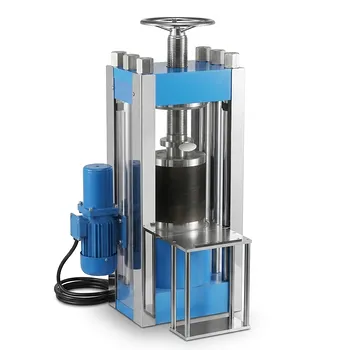
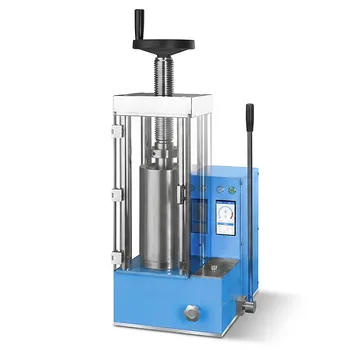
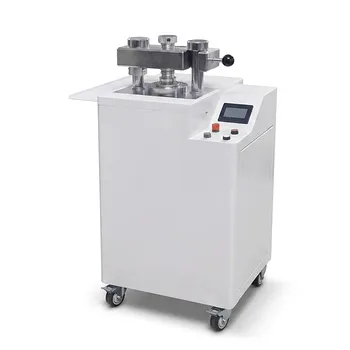
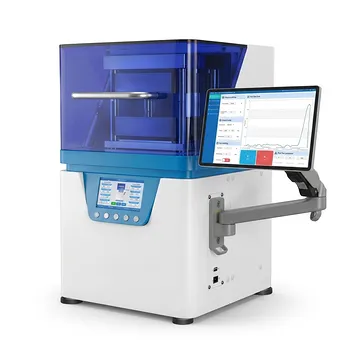
Powder compaction is a high-precision manufacturing process used to transform loose powder materials into solid, shaped composites. By utilizing a hydraulic press, this method applies extreme axial pressure to compress powder within a mold, creating a composite material that is both exceptionally strong and lightweight.
The core objective of powder compaction is to induce plastic deformation and physical rearrangement of particles. This results in a "green compact"—a solid, dense shape with low porosity that is ready for final strengthening processes like sintering.
How the Process Works
To understand powder compaction, you must look beyond simple squeezing. The hydraulic press facilitates a complex physical transformation at the particle level.
Physical Rearrangement
Initially, the applied pressure forces powder particles to move and rotate.
This phase forces fine milled particles into the cavities and internal pores of larger particles, such as sponge titanium. This mechanical interlocking is the first step in reducing volume.
Plastic Deformation
As pressure increases significantly, the particles undergo plastic deformation.
They change shape permanently, flattening and conforming against one another. This eliminates void spaces that simple rearrangement cannot fill.
Creation of the Green Compact
The result of this compression is a cold-pressed green compact.
This object possesses the specific geometric shape and initial structural integrity required to be handled. It serves as the foundational stage for subsequent densification processes.
The Role of Extreme Pressure
The effectiveness of powder compaction is directly dictated by the capacity of the hydraulic press.
Reaching Giga-Pascal Levels
High-pressure laboratory hydraulic presses are capable of exerting immense force.
Some systems can generate axial pressures as high as 1.6 GPa. Even lower pressure applications often utilize substantial forces, such as 230 MPa, to achieve mechanical alloying.
Achieving High Relative Density
The application of this extreme pressure is critical for minimizing porosity.
By forcing particles into every available void, the process can achieve a relative density of 94% to 97.5%. This high density is essential for producing parts that are mechanically sound and durable.
Understanding the Trade-offs
While hydraulic powder compaction is effective, it requires precise control and tooling to be successful.
Dependency on Die Precision
The hydraulic press transmits force, but the mold (or die) defines the outcome.
You must use high-precision dies to ensure the powder is contained and shaped accurately under load. If the die tolerances are loose, the extreme pressure will cause material leakage or geometric failure.
The Necessity of Post-Processing
It is critical to remember that the "green compact" is not the final product.
While the compact has high density and a specific shape, it is typically a precursor. It requires subsequent sintering to bond the particles at a molecular level and achieve final material properties.
Making the Right Choice for Your Goal
When configuring a hydraulic press for powder compaction, align your parameters with your desired material outcome.
- If your primary focus is maximum material density: Prioritize a press capable of extreme pressures (up to 1.6 GPa) to ensure full plastic deformation and pore filling.
- If your primary focus is geometric complexity: Focus on the precision of your dies and ensuring the pressure (e.g., 230 MPa) is sufficient to hold the shape without damaging delicate tooling.
By balancing axial pressure with precise mold design, you can produce composite materials that offer an optimal ratio of strength to weight.
Summary Table:
| Stage | Action | Physical Change |
|---|---|---|
| Rearrangement | Initial Pressure | Particles rotate and fill large cavities |
| Deformation | High Pressure | Plastic change eliminates microscopic voids |
| Green Compact | Consolidation | Creation of a solid shape with 94-97.5% density |
| Sintering | Post-Processing | Molecular bonding for final material strength |
Elevate Your Battery Research with KINTEK Pressing Solutions
Precision in powder compaction is the foundation of material innovation. KINTEK specializes in comprehensive laboratory pressing solutions designed to meet the rigorous demands of modern research. Whether you are developing next-generation energy storage or advanced composites, our range of equipment ensures consistent, high-density results:
- Manual & Automatic Presses: For flexible lab use or high-throughput testing.
- Heated & Multifunctional Models: To explore temperature-dependent material behavior.
- Isostatic Presses (CIP/WIP): For uniform density in complex geometries.
- Glovebox-Compatible Systems: Essential for sensitive battery chemistry research.
Ready to achieve up to 1.6 GPa of precision pressure? Contact our technical experts today to find the perfect pressing solution for your laboratory.
Related Products
- Split Warm Isostatic Lab Press 200 Ton Powder Compaction Chamber for Battery Research and Material Science
- Electric Isostatic Pressing Machine 40 Tons Automatic Laboratory Powder Compacting Press
- Lab Round Bidirectional Press Mold
- Lab Polygon Press Mold
- Laboratory Hydraulic Press Lab Pellet Press Machine for Glove Box
People Also Ask
- Why is Warm Isostatic Pressing suitable for materials that cannot be formed at room temperature? Master Material Density
- How is hydraulic pressure utilized as the pressure medium in warm isostatic pressing? Master Your Material Density
- What is the function of a booster source in the warm isostatic pressing process? Master Precision Fluid Injection
- What is the role of a heat generator in warm isostatic pressing? Master Thermal Precision for Superior WIP Results
- In which industries is Warm Isostatic Pressing (WIP) applied? Optimize High-Performance Material Densification