
Shock compression is a specialized material processing technique that utilizes high-velocity shock waves to consolidate powder materials into solid, dense forms. It is employed as a critical alternative to traditional methods like hot pressing because it can achieve full density without destroying the material's internal nanostructure through excessive heat.
The Core Value Traditional compression methods rely on prolonged heat, which often causes microscopic grains to merge and grow, weakening the material. Shock compression solves this by using extreme pressure and speed to fuse materials instantly, preserving the original high-performance nanostructure.
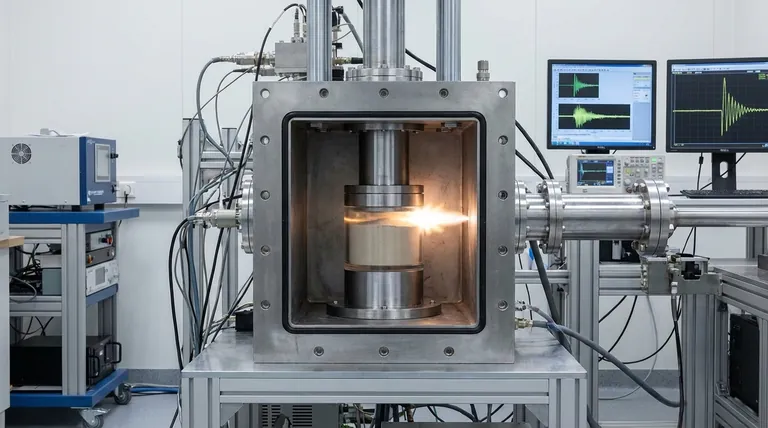
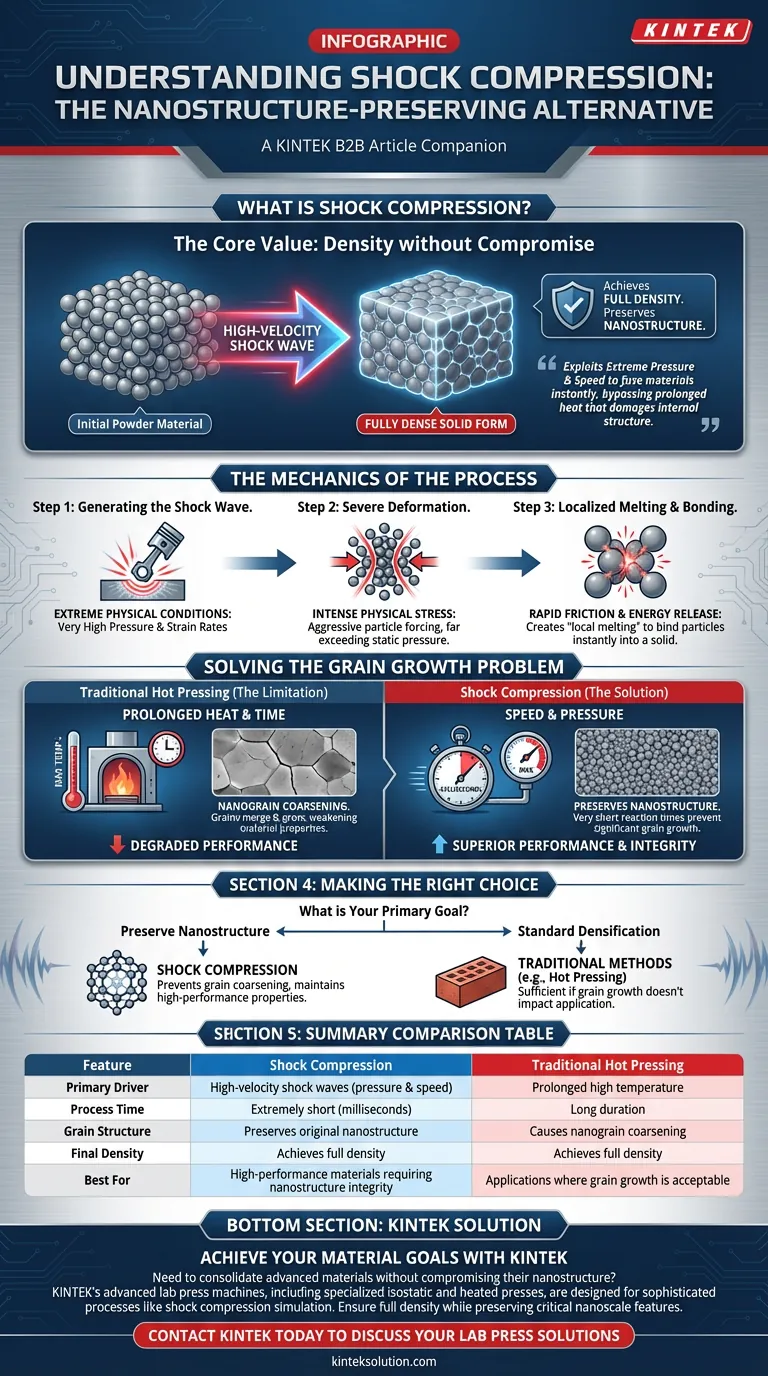
The Mechanics of the Process
Generating the Shock Wave
The fundamental mechanism of this technology is the generation of a shock wave.
This wave is characterized by extreme physical conditions, specifically very high pressures and very high strain rates.
Severe Deformation
As the shock wave passes through the material, it forces the particles to undergo severe deformation.
This physical stress is so intense and rapid that it forces particles together far more aggressively than static pressure.
Localized Melting
The rapid deformation creates friction and energy release, potentially causing local melting at the particle boundaries.
This localized melting acts as a binding agent, fusing the particles together to create a solid, fully dense sample.
Why It Is Used: Solving the Grain Growth Problem
The Limitation of Hot Pressing
Standard consolidation methods, such as hot pressing, rely heavily on high temperatures applied over time.
The major downside of this approach is nanograin coarsening. Under prolonged heat, the tiny grains that make up the material begin to merge and grow larger, which typically degrades the material's strength and unique properties.
The Speed Advantage
Shock compression is characterized by very short reaction times and only "medium" overall temperatures.
Because the process happens so fast, there is simply not enough time for the grains to grow significantly.
Density Without Compromise
The ultimate goal of using shock compression is to produce samples that are fully dense and compacted.
It achieves this high density while ensuring the material retains its fine grain structure, offering a unique combination of structural integrity and material performance.
Understanding the Process Dynamics
The Role of Temperature
While shock compression is distinct from hot pressing, it is not entirely cold; it involves medium temperatures.
However, unlike hot pressing, this temperature is a byproduct of the rapid energy release rather than an external heat source applied for a long duration.
High Strain Rates
The process relies on very high strain rates, meaning the material is deformed incredibly quickly.
This rapid strain is what allows the particles to bond at a microscopic level without requiring the long "soaking" times of thermal processes.
Making the Right Choice for Your Goal
This technology represents a trade-off between speed/pressure and thermal stability. Whether it is the right choice depends on your specific material requirements.
- If your primary focus is preserving nanostructure: Shock compression is the superior choice, as it prevents grain coarsening and maintains high-performance material properties.
- If your primary focus is standard densification: Traditional methods like hot pressing may suffice if grain growth does not negatively impact your specific application.
Shock compression is the definitive solution when you need to achieve maximum density without sacrificing the microscopic integrity of your material.
Summary Table:
| Feature | Shock Compression | Traditional Hot Pressing |
|---|---|---|
| Primary Driver | High-velocity shock waves (pressure & speed) | Prolonged high temperature |
| Process Time | Extremely short (milliseconds) | Long duration |
| Grain Structure | Preserves original nanostructure | Causes nanograin coarsening |
| Final Density | Achieves full density | Achieves full density |
| Best For | High-performance materials requiring nanostructure integrity | Applications where grain growth is acceptable |
Need to consolidate advanced materials without compromising their nanostructure?
KINTEK's advanced lab press machines, including our specialized isostatic and heated presses, are designed to handle sophisticated processes like shock compression simulation. We help laboratories achieve full density while preserving the critical nanoscale features that define material performance.
Our expertise ensures you get the right equipment for your specific material science goals, whether you're researching high-strength alloys, ceramics, or composites.
Contact KINTEK today to discuss how our lab press solutions can enhance your research and development capabilities.
Visual Guide
Related Products
People Also Ask
- What is the purpose of incorporating cartridge heaters into a lab press mold for MLCC block compression? Optimize Results
- What is the function of a pressing tool in thermoplastic panels? Master Precision Shaping & Fusion Bonding
- Why is precise cooling management of the lab press mold necessary? Protect Core Integrity in Thermoforming
- What are the requirements for pressing molds when using SSCG? Key Materials for Complex Single Crystal Production
- How do industrial-grade pressure molds affect zinc metal pouch cells? Maximize Energy Density & Performance
