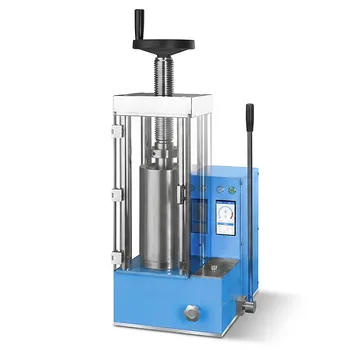
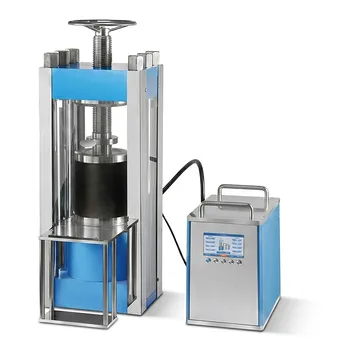
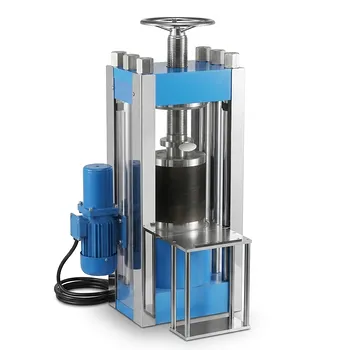
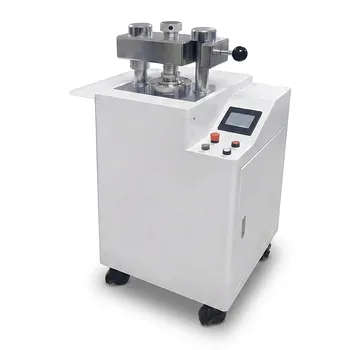
For pellets with a diameter smaller than 8 mm, the definitive best practice is to utilize a smaller, lower-tonnage press. Using equipment that is appropriately scaled to the size of your die is critical for achieving consistent results and protecting your tooling.
Matching the press capacity to the die size is essential for precision; using a massive press for a tiny pellet sacrifices control and significantly increases the risk of damaging your equipment.
The Physics of Control and Feedback
The Necessity of Granular Control
When working with small diameters, the margin for error is incredibly narrow. You need a press that allows you to increase force in small, manageable increments.
A smaller press provides this fine-tuned control, allowing you to reach the exact pressure required without overshooting.
The Role of Tactile Feedback
Precision pressing is often as much about "feel" as it is about reading a gauge. A smaller press offers superior tactile feedback.
This physical resistance allows the operator to sense the compaction process, ensuring the pellet forms correctly before maximum pressure is reached.
The Risks of High-Capacity Presses
The "One Pump" Danger
Using a large industrial press, such as a 40 Ton model, for a die smaller than 8 mm is fraught with risk. The hydraulic mechanisms in these large units are designed to move massive amounts of force quickly.
As a result, a single pump of the handle can generate enough force to instantly exceed the maximum limit of a small die.
Lack of Precision
High-capacity presses are blunt instruments when applied to delicate tasks. They lack the sensitivity required for small surface areas.
Because the force application is so aggressive, it is nearly impossible to stop at the precise moment required for a small pellet, leading to structural failures in the sample or the die itself.
Common Pitfalls to Avoid
The "Universal Tool" Fallacy
A common mistake in laboratories is attempting to use a single, high-tonnage press for every application. While a 40 Ton press is versatile for large samples, it is functionally dangerous for small diameter work.
Ignoring Die Ratings
Every die has a maximum load rating. When using an oversized press, the force gauge often lacks the resolution to show you have passed that rating until it is too late.
Making the Right Choice for Your Goal
To ensure the longevity of your dies and the quality of your pellets, choose your equipment based on the specific diameter of your sample.
- If your primary focus is pellets < 8 mm: Prioritize a low-tonnage press to gain the necessary sensitivity, tactile feedback, and force control.
- If your primary focus is safety and equipment longevity: Avoid using high-capacity (e.g., 40 Ton) presses for small dies, as the risk of accidental overload is unmanageably high.
Precision is not just about power; it is about the controlled application of force.
Summary Table:
| Feature | Smaller/Low-Tonnage Press | High-Capacity (40T+) Press |
|---|---|---|
| Control Resolution | High (Small force increments) | Low (Aggressive force delivery) |
| Tactile Feedback | Superior feel of compaction | Minimal to none |
| Overload Risk | Low; easier to manage | Very High; 'One pump' danger |
| Primary Use | Delicate, small diameter pellets | Large samples, high-load tasks |
| Die Safety | Optimized for small die ratings | High risk of crushing small dies |
Optimize Your Lab Precision with KINTEK Pressing Solutions
Don't risk damaging your delicate tooling with oversized equipment. KINTEK specializes in comprehensive laboratory pressing solutions tailored to your specific research needs. Whether you are conducting advanced battery research or material science studies, we offer a diverse range of manual, automatic, heated, multifunctional, and glovebox-compatible models, alongside high-performance cold and warm isostatic presses.
Our expert team is ready to help you select the perfectly scaled press to ensure consistent pellet quality and maximum equipment longevity.
Upgrade Your Lab Standards – Contact KINTEK Today
Related Products
- Electric Isostatic Pressing Machine 40 Tons Automatic Laboratory Powder Compacting Press
- Split Hot Isostatic Pressing Machine 150 Ton Laboratory Heated Isostatic Press
- Split Warm Isostatic Lab Press 200 Ton Powder Compaction Chamber for Battery Research and Material Science
- Automatic Fluorescence Sample Preparation Press 40 Ton Lab Pellet Press for XRF Analysis
- Automatic Large Format Laboratory Heated Hydraulic Press 400x400mm Plate Capacity
People Also Ask
- What are the key characteristics of the isostatic pressing process? Unlock Uniform Density and Complex Geometries
- Why is vacuum-sealed packaging necessary before isostatic pressing of CuPc thin films? Protect Integrity & Uniformity
- How is pressure applied to the material during isostatic pressing? Master Uniform Density and Complex Geometries
- How does pressure distribute during isostatic pressing of aluminum? Achieve Uniform Density for Your Lab Materials
- What are the applications of isostatic pressing in the automotive industry? Precision Manufacturing for High-Performance Parts