
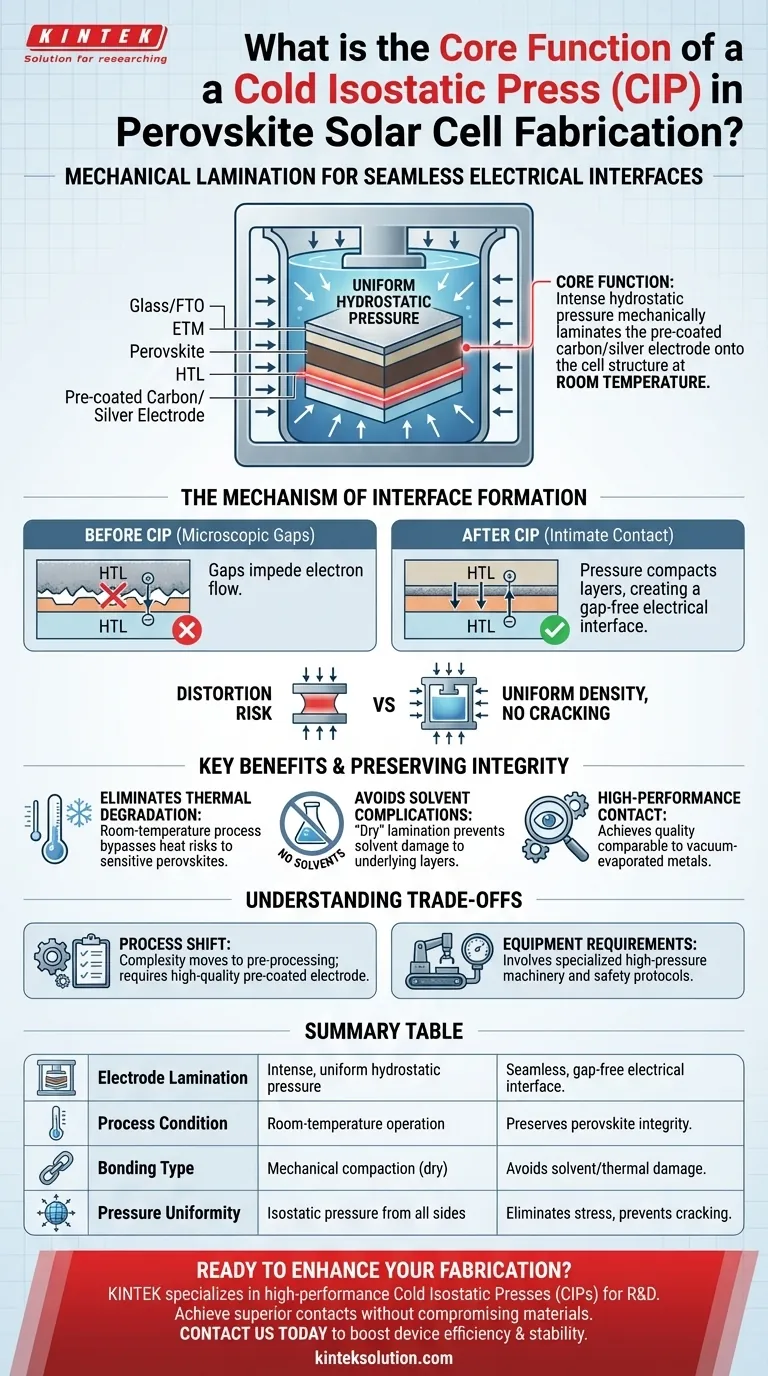
The core function of a Cold Isostatic Press (CIP) in the fabrication of carbon-electrode perovskite solar cells is to mechanically laminate a pre-coated carbon/silver electrode onto the cell structure using intense hydrostatic pressure. Instead of relying on heat or chemical bonding, the CIP utilizes uniform force to physically drive the carbon layer into intimate contact with the underlying hole transport layer (HTL). This creates a seamless electrical interface at room temperature.
Core Takeaway CIP technology solves a critical engineering paradox in perovskite fabrication: it achieves a high-performance, gap-free electrical contact comparable to vacuum-evaporated metals, but does so without applying heat that would degrade the sensitive perovskite materials.
The Mechanism of Interface Formation
Achieving Intimate Electrical Contact
The primary challenge in carbon-electrode solar cells is ensuring the electrode touches the active layers without microscopic gaps, which impede electron flow.
The CIP applies extremely high pressure (potentially up to 150,000 psi in research systems) to the device. This pressure compacts the carbon/silver bilayer, forcing it to conform perfectly to the topography of the Hole Transport Layer (HTL).
Uniformity via Hydrostatic Pressure
Unlike standard mechanical pressing, which applies force from a single direction (uniaxial), CIP applies pressure isostatically—meaning equally from all sides.
This eliminates pressure gradients that could cause the delicate solar cell layers to crack or distort. The result is a uniform density across the entire electrode surface, ensuring consistent electrical performance across the cell.
Preserving Material Integrity
Eliminating Thermal Degradation
Perovskite materials and organic functional layers are highly sensitive to heat; thermal stress can induce rapid degradation and crystal structure collapse.
CIP is distinctively a room-temperature process. By laminating the electrode without heat, it completely bypasses the thermal risks associated with traditional curing or sintering processes.
Avoiding Solvent Complications
Many alternative deposition methods rely on wet chemistry, requiring solvents that must be evaporated. These solvents can sometimes dissolve or damage the underlying perovskite layers.
CIP facilitates a "dry" lamination of a pre-coated electrode. This enhances the versatility of the fabrication process, allowing for the use of materials that would otherwise be incompatible with solvent-based approaches.
Understanding the Trade-offs
Process vs. Pre-Processing
While CIP simplifies the final assembly, it shifts the complexity to the preparation phase. The process requires a pre-coated carbon/silver bilayer electrode. The quality of the final interface is heavily dependent on the quality and uniformity of this pre-coat before it ever enters the press.
Equipment Requirements
Achieving the high pressures necessary for this interface (comparable to those used in forming aerospace components or ceramics) requires specialized, robust machinery.
While research vessels are customizable (2 to 60 inches), the operation involves managing high-pressure fluid dynamics and safety protocols, which is a distinct operational shift from standard vacuum evaporation or spin-coating workflows.
Making the Right Choice for Your Goal
To determine if CIP is the correct solution for your fabrication line, consider your primary constraints:
- If your primary focus is maximizing cell efficiency: CIP allows you to achieve an electrical contact quality comparable to vacuum-evaporated gold or silver, but using cheaper carbon materials.
- If your primary focus is device stability: The room-temperature nature of CIP preserves the initial stoichiometry of the perovskite, preventing the thermal aging that occurs during high-heat electrode deposition.
Summary: CIP transforms the electrode deposition step from a thermal-chemical process into a purely mechanical one, decoupling electrical contact quality from thermal processing limitations.
Summary Table:
| Function | Mechanism | Key Benefit |
|---|---|---|
| Electrode Lamination | Applies intense, uniform hydrostatic pressure | Creates a seamless, gap-free electrical interface |
| Process Condition | Room-temperature operation | Preserves integrity of heat-sensitive perovskite materials |
| Bonding Type | Mechanical compaction (dry lamination) | Avoids solvent damage and thermal degradation |
| Pressure Uniformity | Isostatic pressure from all sides | Eliminates stress gradients and prevents layer cracking |
Ready to enhance your perovskite solar cell fabrication with reliable, room-temperature electrode lamination?
KINTEK specializes in high-performance lab press machines, including advanced Cold Isostatic Presses (CIPs) designed for research and development. Our presses deliver the precise, uniform pressure required to achieve superior electrical contacts without compromising your sensitive materials.
Contact us today to discuss how a KINTEK CIP system can solve your electrode integration challenges and boost your device efficiency and stability.
Visual Guide
Related Products
- Electric Lab Cold Isostatic Press CIP Machine
- Electric Split Lab Cold Isostatic Pressing CIP Machine
- Automatic Lab Cold Isostatic Pressing CIP Machine
- Manual Cold Isostatic Pressing CIP Machine Pellet Press
- Lab Isostatic Pressing Molds for Isostatic Molding
People Also Ask
- What role do electric lab cold isostatic presses play in industrial contexts? Bridge R&D and Manufacturing with Precision
- What are the applications of electric lab cold isostatic presses in research settings? Advance Material R&D with High-Pressure CIPs
- How does electrical Cold Isostatic Pressing (CIP) contribute to cost savings? Unlock Efficiency and Reduce Expenses
- What are some research applications of electric lab CIPs? Unlock Uniform Powder Densification for Advanced Materials
- What are the characteristics of standard off-the-shelf electric lab CIP solutions? Achieve Immediate, Cost-Effective Processing
















