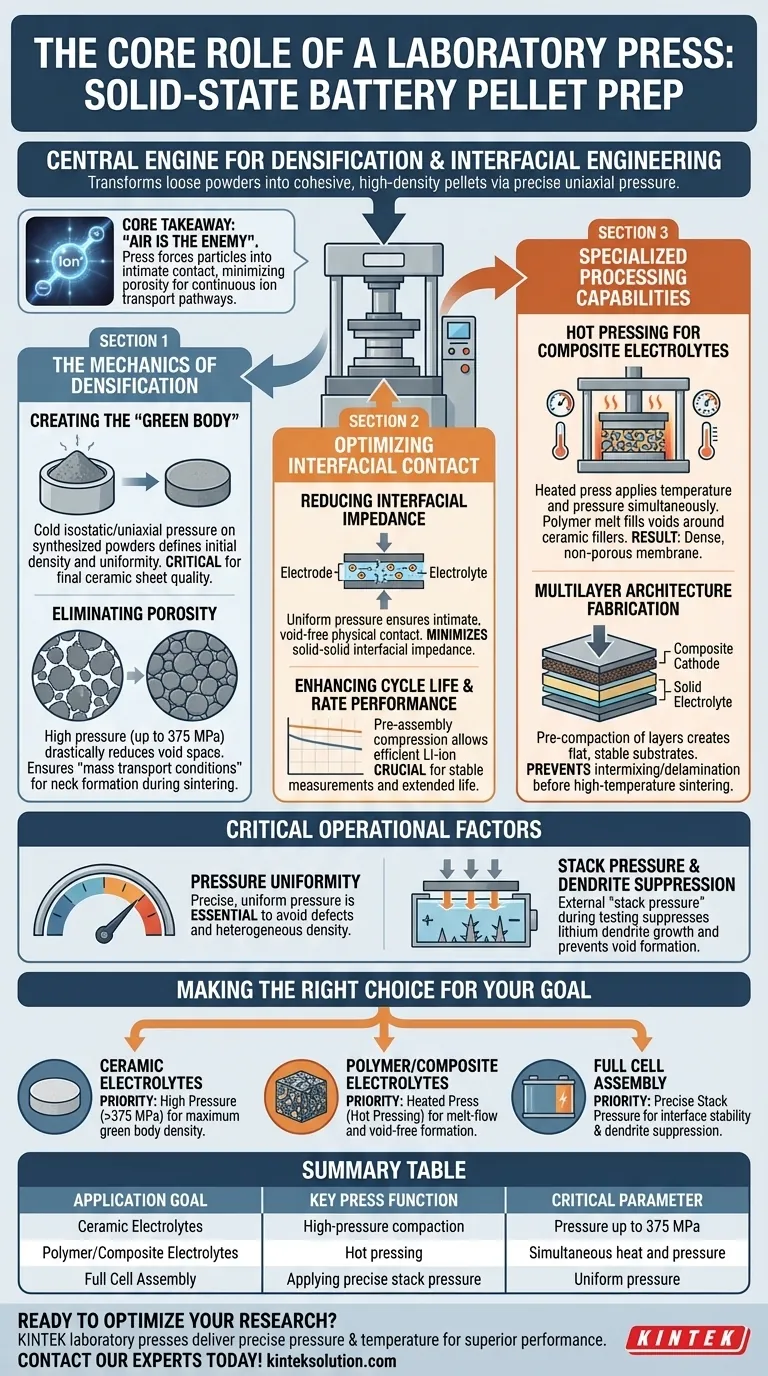
The primary role of a laboratory press in this context is to act as the central engine for densification and interfacial engineering. It transforms loose solid electrolyte or composite electrode powders into cohesive, high-density pellets by applying precise uniaxial pressure (often up to 375 MPa), which is the first essential step in creating a functional solid-state battery.
Core Takeaway In solid-state batteries, "air is the enemy" because ions cannot travel through voids. The laboratory press solves this by mechanically forcing particles into intimate contact, minimizing porosity and impedance to establish the continuous ion transport pathways required for battery operation.
The Mechanics of Densification
Creating the "Green Body"
Before a ceramic electrolyte can be sintered at high temperatures, it must first be formed into a "green body"—a compacted pellet with sufficient mechanical strength.
The laboratory press applies cold isostatic or uniaxial pressure to loose synthesized powders. This compacting step is what defines the initial density and uniformity of the material.
The quality of this green body is a critical prerequisite; it directly dictates whether the final ceramic sheet will be dense and defect-free after sintering.
Eliminating Porosity
The immediate goal of applying high pressure (referenced up to 240 MPa in some specific contexts) is to drastically reduce the void space between particles.
By compressing the material, the press ensures mass transport conditions are met.
This proximity is necessary for "neck formation" between particles during the subsequent heating phases, which ultimately determines the final density of the ceramic layer.
Optimizing Interfacial Contact
Reducing Interfacial Impedance
For a solid-state battery to function, ions must move freely between the electrode and the electrolyte.
A laboratory press applies uniform pressure to ensure intimate, void-free physical contact between these layers (such as between a lithium metal electrode and a solid-state electrolyte).
This physical contact is fundamental for minimizing solid-solid interfacial impedance, which is often the bottleneck in solid-state battery performance.
Enhancing Cycle Life and Rate Performance
By reducing resistance at the interface, the press directly influences the battery's stability.
High-quality contact achieved through controlled pressure allows for efficient lithium-ion transport.
References indicate that this pre-assembly compression is crucial for achieving stable electrochemical measurements, better rate performance, and extended cycle life.
Specialized Processing Capabilities
Hot Pressing for Composite Electrolytes
When working with polymer-based or composite electrolytes, pressure alone is sometimes insufficient.
A heated laboratory press enables hot pressing, where temperature and pressure are applied simultaneously to mixtures like ceramic fillers and PEO (polyethylene oxide) matrices.
The heat creates a melt or flow in the polymer matrix, while the pressure drives it to fill voids around the ceramic particles.
This results in a dense, non-porous membrane that balances mechanical flexibility with high ionic conductivity, achieved in a solvent-free process.
Multilayer Architecture Fabrication
Advanced solid-state batteries often require bilayer structures, such as a composite cathode layered onto a solid electrolyte.
The laboratory press is used for pre-compaction of the first layer to create a flat, mechanically stable substrate.
This step prevents intermixing or delamination when the second layer is added, ensuring a well-defined interface prior to high-temperature sintering.
Critical Operational Factors
The Importance of Pressure Uniformity
Simply applying force is not enough; the pressure must be precise and uniform.
Uneven pressure can lead to defects or heterogeneous density, which compromises the ion transport channels.
Stack Pressure and Dendrite Suppression
Beyond forming the pellet, the press is used to apply external "stack pressure" during testing.
This allows researchers to systematically investigate how mechanical pressure influences the battery's behavior, specifically regarding the suppression of lithium dendrite growth.
Maintaining this pressure is essential for preventing void formation during the stripping and plating of lithium metal.
Making the Right Choice for Your Goal
To select the right approach for your laboratory press, you must align the equipment's capabilities with your specific material requirements.
- If your primary focus is Ceramic Electrolytes: Prioritize a press capable of high pressure (up to 375 MPa) to maximize green body density and reduce porosity before sintering.
- If your primary focus is Polymer/Composite Electrolytes: You require a heated press (hot pressing) to melt the matrix for uniform dispersion and void-free membrane formation.
- If your primary focus is Full Cell Assembly: Focus on the precision of the applied stack pressure to minimize interfacial impedance and suppress dendrite growth during cycling.
Ultimately, the laboratory press is not just a shaping tool; it is the gatekeeper of ionic conductivity, determining the limit of your material's electrochemical performance.
Summary Table:
| Application Goal | Key Press Function | Critical Parameter |
|---|---|---|
| Ceramic Electrolytes | High-pressure compaction for "green body" formation | Pressure up to 375 MPa |
| Polymer/Composite Electrolytes | Hot pressing for uniform, void-free membranes | Simultaneous heat and pressure |
| Full Cell Assembly | Applying precise stack pressure to minimize impedance | Uniform pressure for interface stability |
Ready to optimize your solid-state battery research?
KINTEK's laboratory presses are engineered to deliver the precise pressure and temperature control you need to achieve the high-density, low-porosity pellets and interfaces essential for superior ionic conductivity and battery performance. Whether you are developing ceramic electrolytes, polymer composites, or assembling full cells, our automatic lab presses, isostatic presses, and heated lab presses provide the reliability and precision required for breakthrough results.
Contact our experts today to discuss how a KINTEK press can accelerate your R&D and help you build better batteries.
Visual Guide
Related Products
- Warm Isostatic Press for Solid State Battery Research Warm Isostatic Press
- Lab Cylindrical Press Mold for Laboratory Use
- Laboratory Hydraulic Press Lab Pellet Press Button Battery Press
- Automatic Laboratory Hydraulic Press for XRF and KBR Pellet Pressing
- Laboratory Hydraulic Pellet Press for XRF KBR FTIR Lab Press
People Also Ask
- Why must composite cathodes be sealed in vacuum lamination bags for WIP? Ensure Battery Stability and Density
- What is the function of elastic molds in warm isostatic pressing? Achieve Uniform Density in Composite Particles
- How do sacrificial volume materials (SVM) maintain microchannels in isostatic pressing? Ensure Structural Integrity
- What are the advantages of using a Warm Isostatic Press (WIP) for batteries? Achieve Superior Interface Contact
- What is the significance of temperature control in Warm Isostatic Pressing? Unlock Uniform Densification and Process Stability