
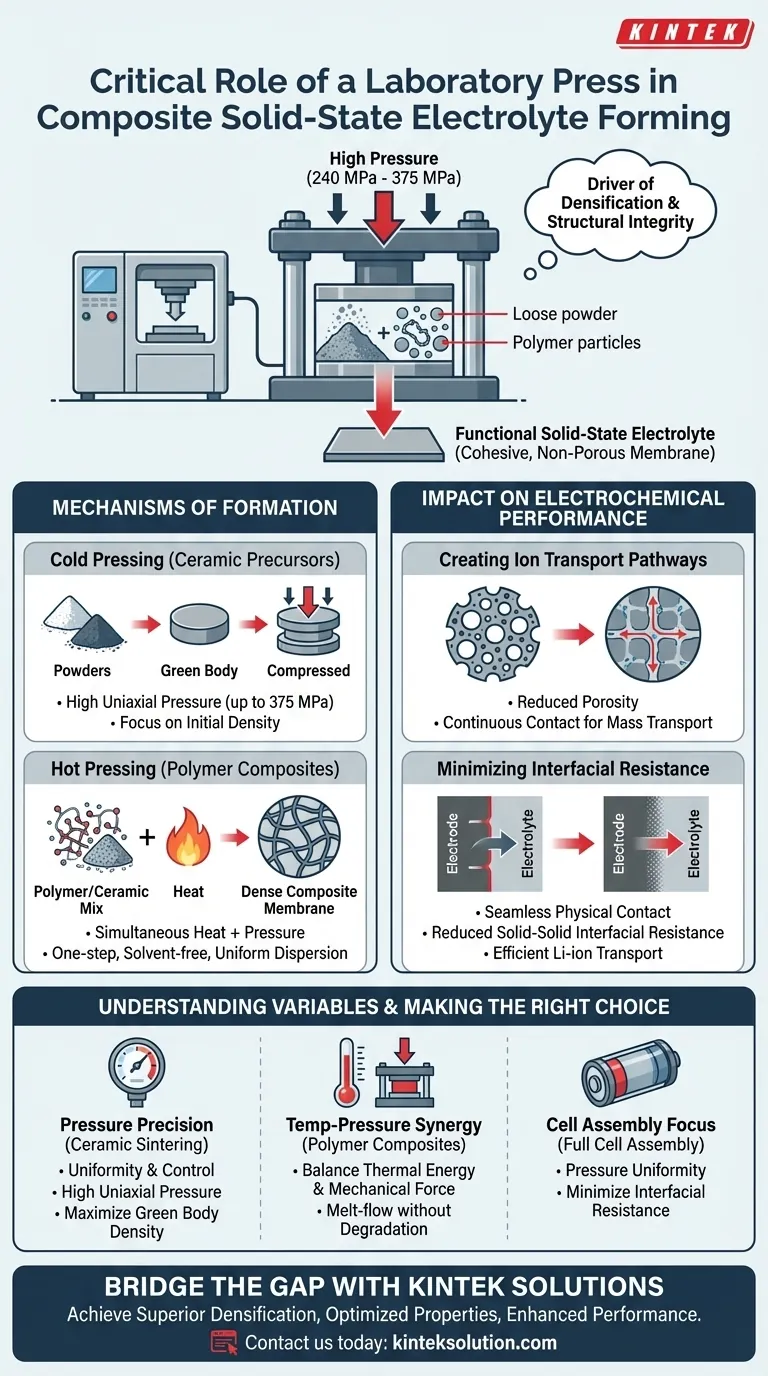
The laboratory press machine acts as the primary driver of densification and structural integrity in the fabrication of composite solid-state electrolytes. By applying high uniaxial or isostatic pressure—often ranging from 240 MPa to 375 MPa—it transforms loose powders or polymer mixtures into cohesive, non-porous membranes essential for effective ion conduction.
The laboratory press does not merely shape the material; it creates the microscopic architecture required for battery function. By eliminating voids and forcing intimate particle-to-particle contact, the press overcomes the high interfacial resistance that typically bottlenecks solid-state battery performance.
Mechanisms of Electrolyte Formation
Cold Pressing for Ceramic Precursors
In traditional ceramic processing, the press is used to compact synthesized electrolyte powders into a "green body."
This is a compressed pellet with sufficient mechanical strength to withstand handling before high-temperature sintering.
The magnitude of pressure and the holding duration directly dictate the initial density and uniformity of this green body, which are prerequisites for achieving a defect-free final ceramic sheet.
Hot Pressing for Polymer Composites
For composite electrolytes involving a polymer matrix (such as PEO) and ceramic fillers, a heated laboratory press is utilized.
This technique applies simultaneous heat and pressure to soften the polymer, allowing it to flow and form a continuous network around the ceramic particles.
This "one-step, solvent-free" preparation eliminates porosity and ensures the filler is uniformly dispersed at a molecular level, resulting in a membrane that balances ionic conductivity with mechanical flexibility.
The Impact on Electrochemical Performance
Creating Ion Transport Pathways
The primary goal of the pressing process is the significant reduction of porosity.
High pressure compacts particles to reduce voids, creating the continuous contact conditions necessary for mass transport.
Without this densification, ions cannot traverse the electrolyte effectively, leading to poor conductivity and battery failure.
Minimizing Interfacial Resistance
In the context of solid-state battery assembly, the press ensures seamless physical contact between the composite electrolyte and the electrodes.
This intimate contact is critical for reducing solid-solid interfacial resistance, which is often the primary limitation in solid-state systems.
By minimizing this resistance, the press directly enables efficient lithium-ion transport, improving both rate performance and cycling stability.
Understanding the Operational Variables
The Necessity of Pressure Precision
Applying pressure is not simply about force; it is about uniformity and control.
Insufficient pressure results in a porous structure with high resistance, while uncontrolled pressure can lead to density gradients or defects.
Precise control (up to 375 MPa) is required to ensure the electrolyte possesses the high density and mechanical strength needed for practical application.
The Temperature-Pressure Synergy
In hot pressing applications, the balance between thermal energy and mechanical force is vital.
Heat is required to melt the polymer matrix (e.g., PEO), while pressure is required to drive the material into a dense state.
Success depends on synchronizing these variables to achieve a non-porous membrane without degrading the polymer components.
Making the Right Choice for Your Goal
To maximize the effectiveness of your laboratory press in electrolyte fabrication, align your approach with your specific material constraints:
- If your primary focus is Ceramic Sintering: Prioritize high uniaxial pressure capabilities (up to 375 MPa) to maximize the density of the green body prior to heat treatment.
- If your primary focus is Polymer Composites: Ensure your equipment offers precise thermal control alongside pressure to facilitate the melt-flow of the matrix without degrading the material.
- If your primary focus is Full Cell Assembly: Focus on pressure uniformity to minimize interfacial resistance between the electrolyte and electrodes during final integration.
Ultimately, the laboratory press bridges the gap between raw chemical potential and a functional, conductive solid-state component.
Summary Table:
| Process Type | Key Function | Target Material | Critical Parameters |
|---|---|---|---|
| Cold Pressing | Compacts powders into a 'green body' for sintering | Ceramic Precursors | High uniaxial pressure (up to 375 MPa) |
| Hot Pressing | Forms dense polymer-ceramic composite membranes | Polymer Composites (e.g., PEO) | Simultaneous heat and pressure for uniform dispersion |
| Cell Assembly | Ensures intimate electrode-electrolyte contact | Full Battery Cell | Uniform pressure to minimize interfacial resistance |
Ready to Bridge the Gap Between Raw Materials and Functional Solid-State Batteries?
The precise pressure and thermal control of your laboratory press are fundamental to creating the dense, non-porous microstructures required for high-performance composite solid-state electrolytes. KINTEK specializes in providing robust and reliable lab press machines—including automatic, isostatic, and heated lab presses—designed to meet the exacting demands of battery research and development.
Let us help you achieve:
- Superior Densification: Eliminate voids and create continuous ion transport pathways.
- Optimized Material Properties: Precisely control pressure (up to 375 MPa) and temperature for your specific ceramic or polymer composite.
- Enhanced Electrochemical Performance: Minimize interfacial resistance and maximize ionic conductivity in your final cell assembly.
Contact us today to discuss how our press solutions can accelerate your solid-state electrolyte development. #ContactForm
Visual Guide
Related Products
- Warm Isostatic Press for Solid State Battery Research Warm Isostatic Press
- Automatic Lab Cold Isostatic Pressing CIP Machine
- Electric Split Lab Cold Isostatic Pressing CIP Machine
- 24T 30T 60T Heated Hydraulic Lab Press Machine with Hot Plates for Laboratory
- Electric Lab Cold Isostatic Press CIP Machine
People Also Ask
- Why must composite cathodes be sealed in vacuum lamination bags for WIP? Ensure Battery Stability and Density
- How do sacrificial volume materials (SVM) maintain microchannels in isostatic pressing? Ensure Structural Integrity
- What is the function of elastic molds in warm isostatic pressing? Achieve Uniform Density in Composite Particles
- What is the process involved in warm isostatic pressing? Mastering Uniform Density with WIP Technology
- What is the significance of temperature control in Warm Isostatic Pressing? Unlock Uniform Densification and Process Stability



















