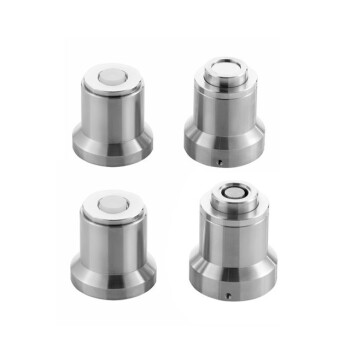
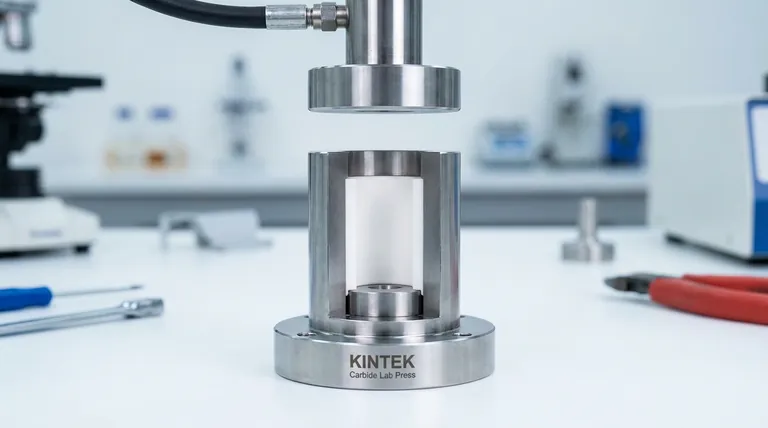
The insulating die serves as the primary safeguard for structural and electrical integrity during solid-state battery assembly. Its most immediate function is to act as a mold, confining the cathode, electrolyte, and anode powders into a specific shape. However, its critical technical role is to provide a robust electrical barrier between the metal pressing plungers; without this insulation, the high pressure required for assembly would force the conductive plungers into contact, causing an immediate internal short circuit.
The insulating die acts as the enabler of high-pressure assembly. It allows you to apply the immense force necessary to eliminate interfacial gaps and lower impedance, while simultaneously preventing the conductive pathways that would destroy the cell's functionality.
The Mechanics of the Insulating Die
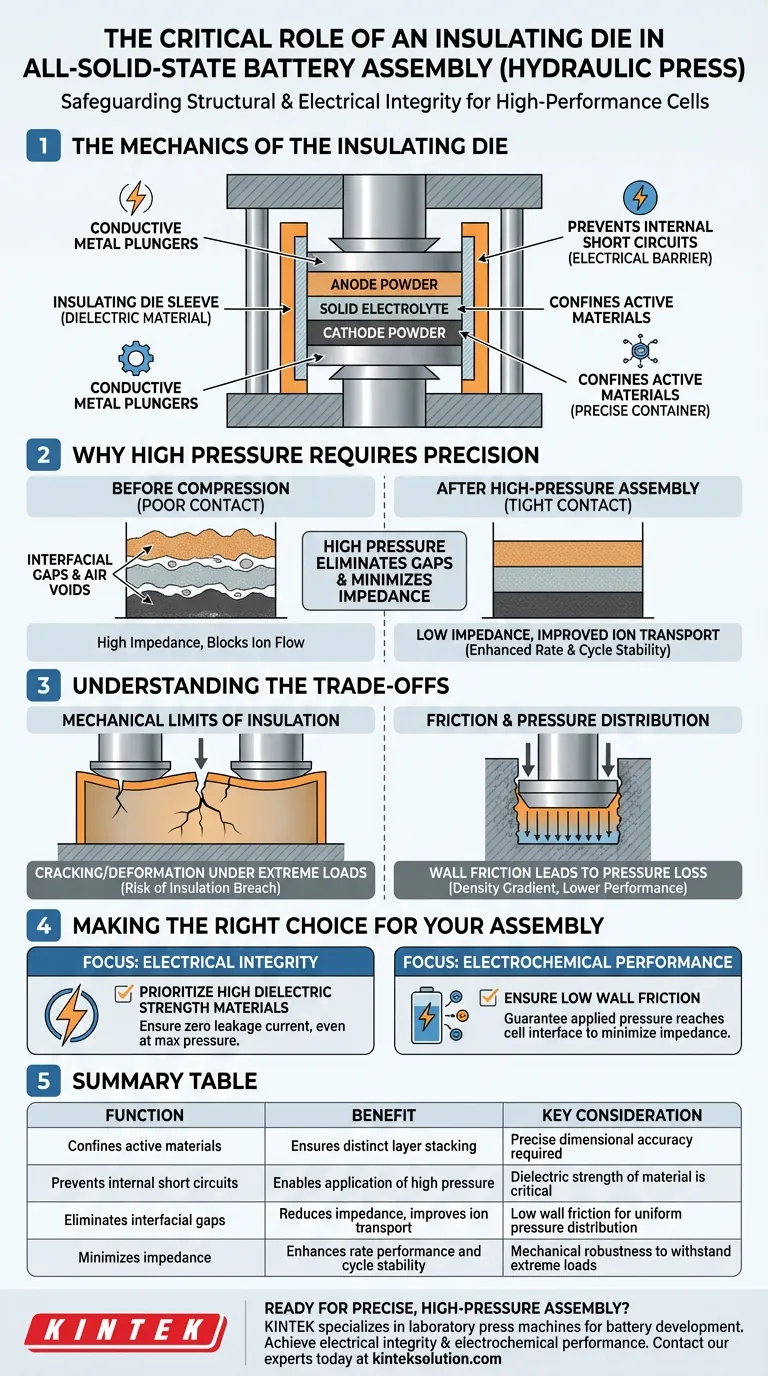
Confining the Active Materials
In the manufacturing of all-solid-state batteries, the components often begin as loose powders. The insulating die functions as a precise container.
It holds the cathode, solid electrolyte, and anode materials in strict confinement. This ensures that the layers remain distinct and properly stacked prior to compression.
preventing Internal Short Circuits
Hydraulic presses utilize metal plungers to transfer force. In a typical setup, these plungers press against the top and bottom of the cell stack.
If these metal plungers were to make electrical contact with the opposing electrode or each other, the cell would short-circuit immediately. The insulating die sleeve surrounds the plungers and the cell stack, physically blocking this conductive path.
Why High Pressure Requires Precision
Eliminating Interfacial Gaps
The underlying goal of using a hydraulic press is to create a dense, unified structure. Solid-state batteries suffer significantly from poor contact between layers.
The die allows the press to apply substantial force to eliminate air voids and gaps. This mechanical compression ensures tight solid-solid contact between the electrode and the electrolyte.
Minimizing Impedance
A stable, uniform interface is a prerequisite for battery performance. Gaps or loose contact points result in high impedance, which blocks the flow of ions.
By enabling high-pressure processing, the insulating die facilitates the creation of a low-impedance interface. This directly improves the efficiency of lithium-ion transport, enhancing both rate performance and cycle stability.
Understanding the Trade-offs
Mechanical Limits of Insulation
While the die must be insulating, it must also be mechanically robust. Materials that are good insulators are often brittle or susceptible to deformation under extreme loads.
If the pressure exceeds the die's mechanical yield strength, the sleeve may crack or expand. This leads to dimensional inaccuracies in the cell or, in worst-case scenarios, a breach in insulation.
Friction and Pressure Distribution
The interaction between the powder, the plungers, and the inner wall of the insulating die creates friction.
If the interior surface of the die is too rough, or if the fit is too tight, significant pressure may be lost to friction rather than applied to the cell. This can result in a density gradient, where the top of the cell is denser than the bottom, negatively affecting performance.
Making the Right Choice for Your Assembly
When selecting or designing an insulating die setup for solid-state battery research, consider your primary objectives:
- If your primary focus is Electrical Integrity: Prioritize die materials with high dielectric strength to ensure zero leakage current between plungers, even at maximum pressure.
- If your primary focus is Electrochemical Performance: Ensure the die assembly has low wall friction to guarantee that the applied hydraulic pressure actually reaches the cell interface to minimize impedance.
The success of a solid-state cell relies not just on the chemistry, but on the precision of the pressure applied to create the solid interface.
Summary Table:
| Function | Benefit | Key Consideration |
|---|---|---|
| Confines active materials | Ensures distinct layer stacking | Precise dimensional accuracy required |
| Prevents internal short circuits | Enables application of high pressure | Dielectric strength of material is critical |
| Eliminates interfacial gaps | Reduces impedance, improves ion transport | Low wall friction for uniform pressure distribution |
| Minimizes impedance | Enhances rate performance and cycle stability | Mechanical robustness to withstand extreme loads |
Ready to achieve precise, high-pressure assembly for your solid-state battery research?
KINTEK specializes in laboratory press machines, including automatic lab presses and isostatic presses, designed to meet the exacting demands of battery development. Our equipment ensures the electrical integrity and electrochemical performance of your cells by enabling controlled, high-pressure processing with the right tooling.
Contact our experts today to discuss how our lab press solutions can help you eliminate interfacial gaps and minimize impedance in your all-solid-state battery prototypes.
Visual Guide
Related Products
- Lab Button Battery Tablet Press Sealing Mold
- Lab Button Battery Disassembly and Sealing Mold
- Warm Isostatic Press for Solid State Battery Research Warm Isostatic Press
People Also Ask
- How does a sealed battery mold facilitate the assembly and testing of asymmetric supercapacitors using VO2?
- Why use standardized CR2032 components & high-precision presses? Ensure reliability in lithium metal battery research.
- Why is a laboratory battery sealing press essential for desolvation energy testing? Ensure Reliable Kinetic Data
- What is the function of specialized battery molds and sealing consumables? Optimize Your In-situ XRD Testing Today
- What role does a laboratory sealing press play in thermal analysis of solid dispersion films? Ensure Data Integrity