
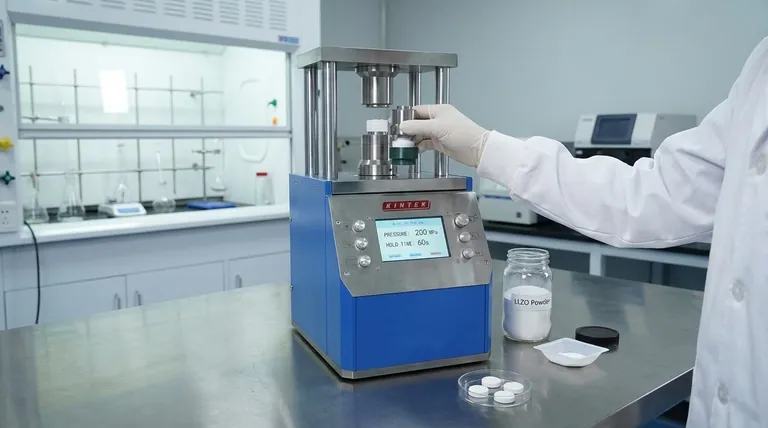
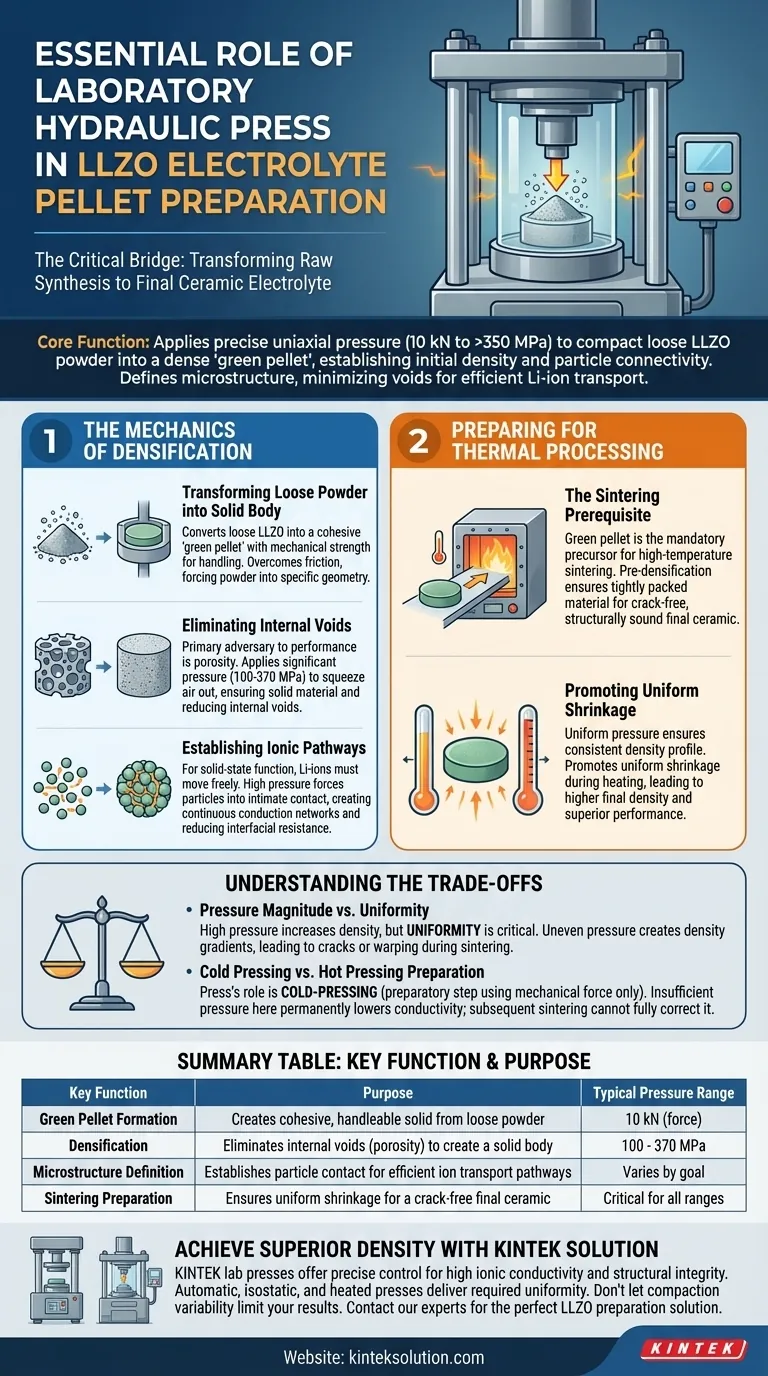
The laboratory hydraulic press acts as the critical bridge between raw chemical synthesis and the final ceramic electrolyte. Its essential role is to apply precise, uniaxial pressure—ranging from 10 kN to over 350 MPa—to compact loose LLZO powder into a dense, solid form known as a "green pellet." This compaction is not merely about shaping; it is the fundamental process that establishes the material's initial density and particle connectivity.
The press does more than shape the material; it defines the pellet's microstructure. By minimizing internal voids and maximizing particle contact, it creates the physical architecture necessary for efficient lithium-ion transport and structural integrity during high-temperature sintering.
The Mechanics of Densification
Transforming Loose Powder into a Solid Body
The immediate function of the press is to convert loose, synthesized LLZO powder into a cohesive unit. This stage creates a "green pellet," a compacted disc that holds its shape but has not yet undergone final sintering.
By applying force uniaxially within a die, the press overcomes the friction between particles. This forces the powder into a specific geometry, providing the mechanical strength required to handle the pellet without it crumbling during transfer to a furnace.
Eliminating Internal Voids
The primary adversary of solid-state battery performance is porosity. Air pockets within the electrolyte act as insulators, blocking the flow of ions.
The hydraulic press applies significant pressure (often between 100 MPa and 370 MPa) to physically squeeze air out of the powder matrix. This drastically reduces the volume of internal voids, ensuring the material is solid rather than porous.
Establishing Ionic Pathways
For a solid-state battery to function, lithium ions must move freely from particle to particle. This requires a continuous conduction network.
High-pressure compaction forces individual LLZO particles into intimate contact. This increased contact area reduces interfacial resistance, creating the efficient pathways necessary for high ionic conductivity.
Preparing for Thermal Processing
The Sintering Prerequisite
You cannot effectively sinter loose powder into a high-quality ceramic. The green pellet formed by the hydraulic press serves as the mandatory precursor for the high-temperature sintering stage.
A well-pressed green pellet ensures that the material is already tightly packed before heat is applied. This pre-densification is critical for obtaining a final ceramic that is crack-free and structurally sound.
Promoting Uniform Shrinkage
During sintering, materials shrink as they densify further. If the initial compaction by the press is uneven, the shrinkage will be uneven.
By applying uniform and controllable pressure, the hydraulic press ensures the green body has a consistent density profile. This promotes uniform shrinkage during heating, leading to a higher final density and superior electrochemical performance.
Understanding the Trade-offs
Pressure Magnitude vs. Uniformity
While high pressure is necessary to increase density, simply applying maximum force is not the only factor. The uniformity of that pressure is equally critical.
If pressure is applied unevenly, the pellet will develop density gradients—areas that are harder than others. This creates internal stress that results in cracks or warping during the sintering phase. The press must offer stability and precision, not just raw force.
Cold Pressing vs. Hot Pressing Preparation
The references highlight the press's role in cold-pressing. While this creates a strong green body, it is distinct from hot-pressing (which applies heat and pressure simultaneously).
Cold-pressing is a preparatory step. It relies entirely on mechanical force to reduce voids. If the pressure is insufficient at this stage, no amount of subsequent sintering can fully correct the lack of particle contact, leading to permanently lower conductivity.
Making the Right Choice for Your Goal
To maximize the utility of your hydraulic press for LLZO preparation, consider your specific experimental objectives:
- If your primary focus is Ionic Conductivity: Prioritize higher pressures (up to ~350-370 MPa) to maximize particle contact area and minimize interfacial resistance.
- If your primary focus is Structural Integrity: Focus on the uniformity and control of the pressure application to prevent density gradients that cause cracking during sintering.
- If your primary focus is Process Scalability: Establish a standardized pressure protocol (e.g., 10kN or 100 MPa) to ensure consistent green pellet formation across multiple batches.
Ultimately, the hydraulic press dictates the potential of your electrolyte: a poorly pressed pellet will never become a high-performance ceramic, regardless of how well it is sintered.
Summary Table:
| Key Function | Purpose | Typical Pressure Range |
|---|---|---|
| Green Pellet Formation | Creates a cohesive, handleable solid from loose powder | 10 kN (force) |
| Densification | Eliminates internal voids (porosity) to create a solid body | 100 - 370 MPa |
| Microstructure Definition | Establishes particle contact for efficient ion transport pathways | Varies by goal |
| Sintering Preparation | Ensures uniform shrinkage for a crack-free final ceramic | Critical for all ranges |
Ready to achieve superior density and performance in your LLZO solid-state electrolyte research?
The precise pressure control of a KINTEK lab press is the foundational step for creating pellets with high ionic conductivity and structural integrity. Our automatic lab presses, isostatic presses, and heated lab presses are engineered to deliver the uniformity and reliability your laboratory demands.
Don't let compaction variability limit your results. Contact our experts today to find the perfect hydraulic press solution for your specific LLZO preparation goals.
Visual Guide
Related Products
- Manual Laboratory Hydraulic Pellet Press Lab Hydraulic Press
- Laboratory Hydraulic Split Electric Lab Pellet Press
- Laboratory Hydraulic Pellet Press for XRF KBR FTIR Lab Press
- Automatic Laboratory Hydraulic Press Lab Pellet Press Machine
- Laboratory Hydraulic Press Lab Pellet Press Machine for Glove Box
People Also Ask
- What is the primary purpose of manual lab hydraulic pellet presses? Achieve High-Precision Sample Preparation for Spectroscopy
- What is the primary purpose of a manual lab hydraulic pellet press? Ensure Accurate Sample Prep for XRF and FTIR
- What is the primary function of a laboratory hydraulic press in evaluating the ionic conductivity of Li6PS5X (LMSX)?
- What is the purpose of initial axial molding using a lab hydraulic press? Optimizing Electrolyte Green Bodies
- What role does a lab hydraulic press play in researching squishy granular matter? Expert Insights into Material Physics



















