
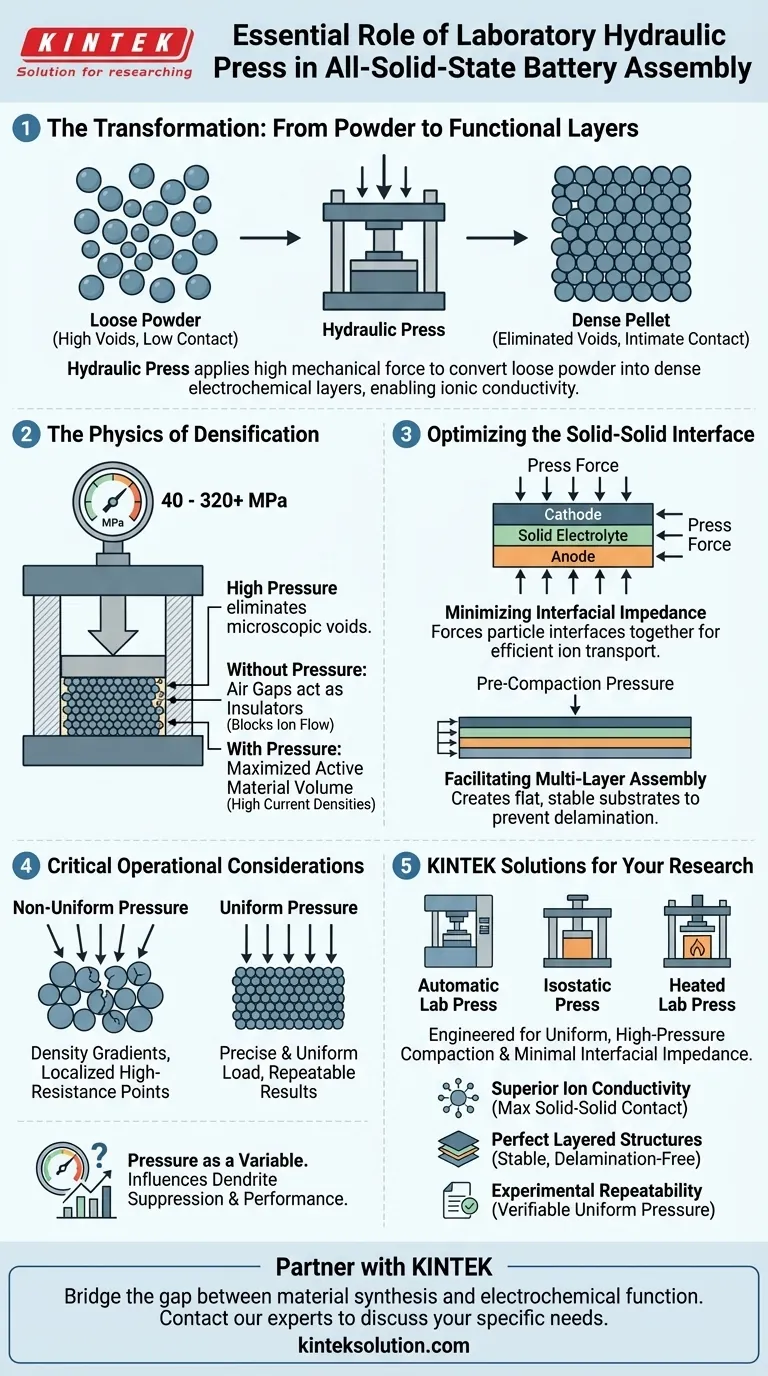
The essential role of a laboratory hydraulic press in all-solid-state battery assembly is to apply high-magnitude, uniform mechanical force to convert loose powder materials into dense, functional electrochemical layers.
By exerting pressures that can exceed 300 MPa, the press physically eliminates microscopic voids between particles. This compaction is the only way to establish the intimate solid-solid contact required to replace the wetting action of liquid electrolytes found in traditional batteries.
Core Takeaway: In the absence of liquid electrolytes, the hydraulic press serves as the primary instrument for enabling ionic conductivity. Its function is not merely structural; it dictates the electrochemical viability of the cell by physically forcing particle interfaces together to minimize impedance.
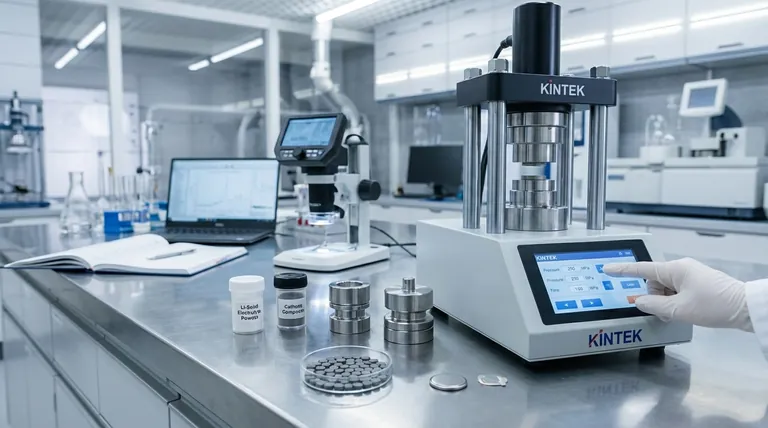
The Physics of Densification
Converting Powder to Solid Pellets
The primary function of the press is to cold-press powdered solid-state electrolyte and cathode composites into dense pellets.
This process typically requires high pressure, ranging from 40 to 320 MPa, depending on the material. This force significantly increases the density of the pellet, ensuring the structural stability required for handling and testing.
Eliminating Voids and Porosity
Loose powders contain air gaps that act as insulators, blocking the flow of ions.
The hydraulic press applies sufficient force to eliminate these internal voids, maximizing the volume of active material. This reduction in porosity is a prerequisite for achieving the high current densities required for modern battery performance.
Optimizing the Solid-Solid Interface
Minimizing Interfacial Impedance
The most critical challenge in solid-state batteries is the "contact problem" between the electrode and the electrolyte.
The press provides the physical basis for low interface resistance by forcing the lithium metal or composite cathode against the solid electrolyte. This intimate contact reduces impedance, enabling efficient lithium-ion or sodium-ion transport across the layers.
Facilitating Multi-Layer Assembly
When fabricating bilayer structures, such as a composite cathode on a solid electrolyte, precision is vital.
The press is used to apply pre-compaction pressure to the first layer, creating a flat, stable substrate. This ensures a well-defined interface and prevents intermixing or delamination when subsequent layers are added or sintered.
Sealing and Structural Integrity
Beyond the internal chemistry, the press ensures the mechanical integrity of the final test cell.
It is used to tightly seal the anode, cathode, separator, and casing under a specific load. This ensures the cell remains airtight and mechanically robust during electrochemical cycling.
Critical Operational Considerations
The Necessity of Uniformity
Applying high pressure is not enough; the pressure must be perfectly uniform across the entire surface area.
Non-uniform pressure leads to density gradients, which cause localized high-resistance points. The references emphasize that the press must deliver a "precise and uniform" load to ensure valid, repeatable experimental results.
Pressure as a Variable
Pressure is not just a manufacturing step; it is an experimental variable that influences performance features like dendrite suppression.
Researchers use the press to systematically investigate how different mechanical pressures influence the growth of lithium dendrites. Therefore, the press must offer precise control to isolate this variable during testing.
Making the Right Choice for Your Goal
To maximize the utility of your laboratory hydraulic press, align your usage with your specific research objectives:
- If your primary focus is Ion Conductivity: Prioritize high-pressure capabilities (up to 300+ MPa) to maximize density and solid-solid contact, which directly lowers interfacial impedance.
- If your primary focus is Layered Structures: Focus on a press with precise low-pressure control for pre-compaction steps to ensure flat, stable interfaces between bilayers without delamination.
- If your primary focus is Repeatability: Ensure the press delivers verifiable, uniform pressure to eliminate mechanical variances when comparing different electrolyte formulations.
The hydraulic press effectively bridges the gap between material synthesis and electrochemical function, transforming raw powders into a conductive, cohesive energy storage system.
Summary Table:
| Role & Function | Key Pressure Range | Primary Outcome |
|---|---|---|
| Powder Densification | 40 - 320 MPa | Converts loose powder into dense, stable pellets |
| Void Elimination | High Pressure (>100 MPa) | Maximizes active material volume, reduces porosity |
| Interface Optimization | Precise Control | Minimizes interfacial impedance for efficient ion transport |
| Multi-Layer Assembly | Low Pressure (Pre-compaction) | Creates flat, stable substrates to prevent delamination |
Ready to transform your solid-state battery research with precision and reliability?
KINTEK's laboratory hydraulic presses are engineered to meet the exacting demands of all-solid-state battery assembly. Our automatic lab presses, isostatic presses, and heated lab presses provide the uniform, high-pressure compaction essential for achieving maximum density and minimal interfacial impedance.
Partner with KINTEK to:
- Achieve Superior Ion Conductivity: Utilize high-pressure capabilities (up to 300+ MPa) to maximize solid-solid contact.
- Build Perfect Layered Structures: Leverage precise low-pressure control for stable, delamination-free interfaces.
- Ensure Experimental Repeatability: Eliminate mechanical variances with verifiable, uniform pressure application.
Let us help you bridge the gap between material synthesis and electrochemical function. Contact our experts today to discuss your specific laboratory needs and discover the perfect press for your research goals.
Visual Guide
Related Products
- Laboratory Hydraulic Press Lab Pellet Press Machine for Glove Box
- Laboratory Hydraulic Press 2T Lab Pellet Press for KBR FTIR
- 24T 30T 60T Heated Hydraulic Lab Press Machine with Hot Plates for Laboratory
- Laboratory Hydraulic Press Lab Pellet Press Button Battery Press
- Laboratory Hydraulic Pellet Press for XRF KBR FTIR Lab Press
People Also Ask
- How does a laboratory hydraulic press contribute to the preparation of Li3-3xScxSb samples? Optimize Ionic Conductivity
- What is the function of a laboratory hydraulic press in FT-IR of curcumin-coated MWCNTs? Achieve Optical Clarity.
- Why is a laboratory hydraulic press required for compression molding boron-siloxane? Solve High-Loading Density Challenges
- What role does a laboratory hydraulic press play in reaction pellets? Optimizing Lunar Soil and Metal Fuel Density
- What role does a laboratory hydraulic press play in the preparation of piezoelectric ceramic discs for DC-PG? | KINTEK



















