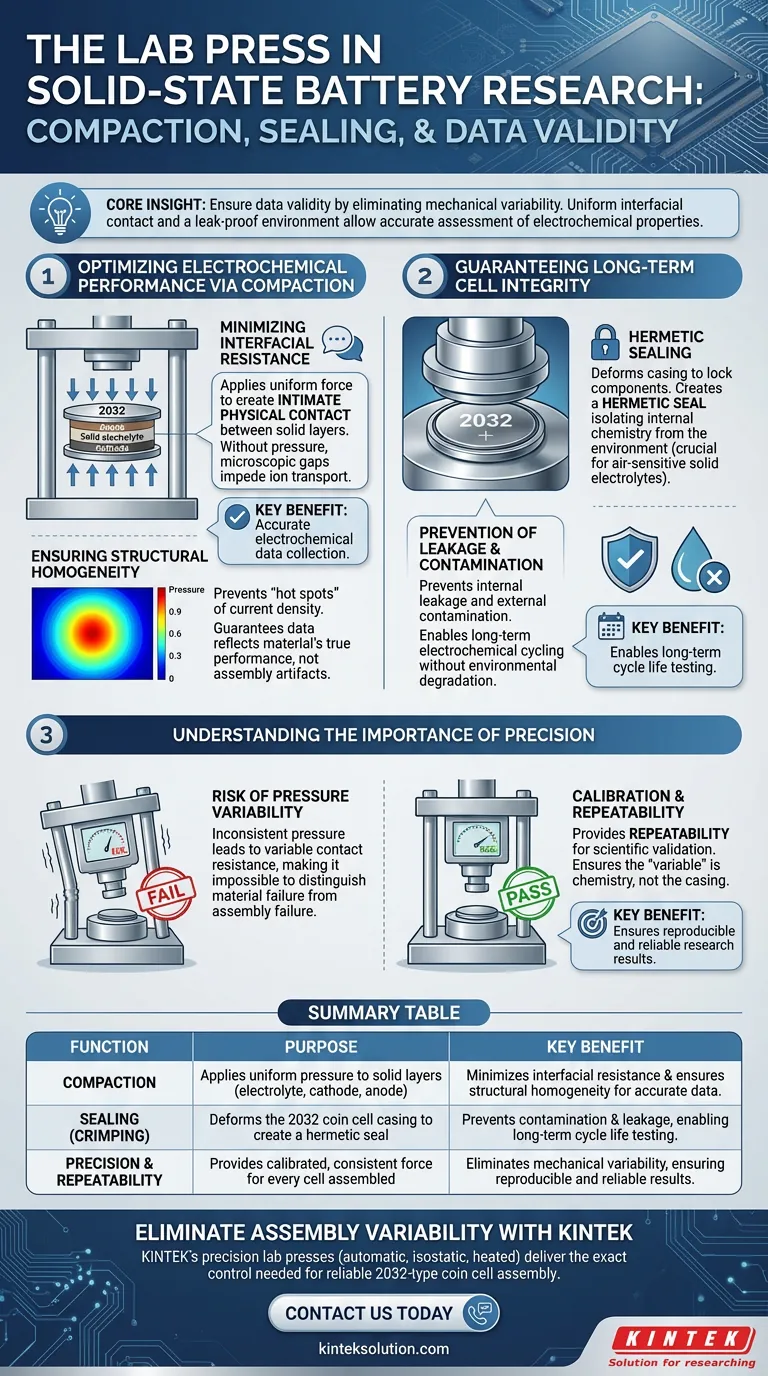
In the context of solid-state battery research, a lab press serves two indispensable roles during the assembly of 2032-type coin cells: compaction and sealing. It applies precise mechanical force to ensure intimate contact between the solid layers, minimizing interfacial resistance, while simultaneously crimping the casing to create a hermetic seal against environmental contaminants.
Core Insight: While the mechanical action is straightforward, the primary value of the lab press lies in ensuring data validity. By guaranteeing uniform interfacial contact and a leak-proof environment, it eliminates mechanical variability as a cause of failure, allowing you to accurately assess the electrochemical properties of your materials.
Optimizing Electrochemical Performance via Compaction
The first critical function of the lab press occurs during the layering of internal components. Unlike liquid electrolyte batteries, solid-state cells require significant mechanical pressure to function.
Minimizing Interfacial Resistance
The press applies uniform force to compact the stack, which consists of the solid-state electrolyte, cathode, and anode.
This compaction creates intimate physical contact between these solid layers. Without this pressure, microscopic gaps would exist between layers, causing high interfacial resistance and blocking ion transport.
Ensuring Structural Homogeneity
A high-quality press ensures the pressure is applied evenly across the entire surface area of the electrode stack.
This uniformity prevents "hot spots" of current density during testing. It guarantees that the electrochemical data collected reflects the material's true performance, rather than artifacts caused by uneven assembly.
Guaranteeing Long-Term Cell Integrity
The second function of the press is mechanical crimping. This final step seals the 2032 coin cell case, which is vital for safety and test duration.
Hermetic Sealing
The press deforms the metal casing to lock the components inside. This creates a hermetic seal that isolates the internal chemistry from the external environment.
This is particularly critical for solid-state batteries, as many high-performance solid electrolytes are highly sensitive to moisture and air.
Prevention of Leakage and Contamination
A properly crimped cell prevents any potential leakage of internal components.
Conversely, it stops external contaminants from entering the cell. This stability is required to run long-term electrochemical cycling tests without degradation caused by environmental exposure.
Understanding the Importance of Precision
While force is necessary, the control of that force is where many assembly processes fail.
The Risk of Pressure Variability
If the press is not calibrated to deliver precise pressure, test results will become unreliable.
Inconsistent pressure leads to variable contact resistance between batches. This makes it impossible to distinguish between a material failure and an assembly failure.
Calibration and Repeatability
The lab press provides the repeatability necessary for scientific validation.
To compare different battery chemistries objectively, the mechanical pressure used to assemble them must be identical. A calibrated press ensures that the "variable" in your experiment is the chemistry, not the casing.
Making the Right Choice for Your Research
To maximize the utility of your lab press, align your usage with your specific testing goals.
- If your primary focus is lowering internal resistance: Ensure your press is calibrated to apply the maximum pressure your solid electrolyte can withstand without fracture to maximize contact.
- If your primary focus is long-term cycle life: Prioritize the precision of the crimping die to ensure a perfect hermetic seal that prevents moisture ingress over weeks of testing.
Ultimately, the lab press acts as the gatekeeper of your research, transforming raw materials into a standardized, testable system capable of yielding reproducible scientific data.
Summary Table:
| Function | Purpose | Key Benefit |
|---|---|---|
| Compaction | Applies uniform pressure to solid layers (electrolyte, cathode, anode) | Minimizes interfacial resistance and ensures structural homogeneity for accurate electrochemical data. |
| Sealing (Crimping) | Deforms the 2032 coin cell casing to create a hermetic seal | Prevents contamination and leakage, enabling long-term cycle life testing. |
| Precision & Repeatability | Provides calibrated, consistent force for every cell assembled | Eliminates mechanical variability, ensuring research results are reproducible and reliable. |
Ready to eliminate assembly variability from your solid-state battery research?
KINTEK's precision lab presses are engineered for researchers like you, providing the exact control needed for reliable 2032-type coin cell assembly. Our automatic lab presses, isostatic presses, and heated lab presses deliver the uniform compaction and hermetic sealing essential for valid, reproducible electrochemical data.
Contact us today via our [#ContactForm] to discuss how our specialized equipment can enhance your laboratory's capabilities and accelerate your battery development projects.
Visual Guide
Related Products
- Assemble Lab Cylindrical Press Mold for Laboratory Use
- Lab Button Battery Tablet Press Sealing Mold
- Assemble Square Lab Press Mold for Laboratory Use
- Button Battery Sealing Press Machine for Lab
- Lab Cylindrical Press Mold for Laboratory Use
People Also Ask
- What is the purpose of incorporating cartridge heaters into a lab press mold for MLCC block compression? Optimize Results
- What is the function of a pressing tool in thermoplastic panels? Master Precision Shaping & Fusion Bonding
- Why is precise cooling management of the lab press mold necessary? Protect Core Integrity in Thermoforming
- Why is a high-performance laboratory molding press critical for in-situ electrolyte formation? Unlock Battery Success
- How does the geometry of laboratory molds influence mycelium-based composites? Optimize Density and Strength