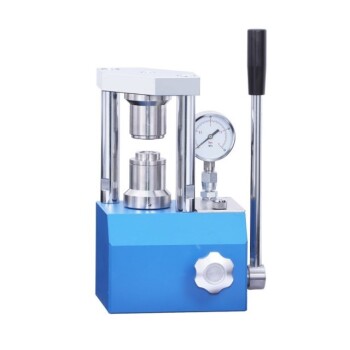
In the final assembly of CR2032 batteries, the lab press functions as the critical encapsulation tool responsible for sealing the cell. It applies precise, stable mechanical pressure to crimp the positive and negative stainless steel casings together, locking the internal components in place.
This process creates a hermetic seal that is essential for isolating the battery's internal chemistry from the external environment.
Core Takeaway A lab press does more than physically close the battery; it establishes the electrochemical integrity of the cell. By ensuring an airtight seal and tight internal contact, it prevents chemical contamination and minimizes resistance, guaranteeing that test data reflects the true performance of the hard carbon material rather than assembly defects.
The Primary Function: Hermetic Encapsulation
Preventing Electrolyte Leakage
The most immediate function of the lab press during final assembly is containing the liquid electrolyte.
The press applies sufficient force to deform the gasket and case, creating a watertight barrier.
Without this precise sealing pressure, electrolyte can leak out during testing, leading to cell failure and corrosion of the testing equipment.
Blocking External Contaminants
Hard carbon materials and sodium-ion electrolytes are highly sensitive to environmental factors.
The press ensures the cell is airtight, preventing the ingress of oxygen and moisture from the atmosphere.
This isolation is vital for maintaining the accuracy of sodium-ion storage performance evaluations, as external impurities can cause side reactions that skew results.
The Secondary Function: Internal Physical Integrity
Reducing Interfacial Contact Resistance
Beyond sealing, the pressure applied during assembly impacts the internal "stack" of the battery.
The press forces the cathode, separator, and anode into tight physical contact.
This proximity minimizes the interfacial resistance between components, which is critical for accurate electrochemical impedance spectroscopy (EIS) data.
Eliminating Internal Voids
Inconsistent assembly can leave microscopic gaps between the electrode coatings and the separator.
The lab press ensures a uniform bond across the internal layers, eliminating voids that leads to poor ionic transport.
This structural uniformity is necessary to ensure that the kinetic data collected corresponds to the material's properties, not poor connectivity.
Common Pitfalls in Pressure Application
The Risk of Under-Pressure
If the lab press does not apply enough force, the crimp will be incomplete.
This results in "dead" cells that leak electrolyte or show erratic voltage readings due to intermittent internal contact.
The Risk of Over-Pressure
Conversely, applying excessive force can physically damage the internal components.
Over-compression may puncture the separator, causing an immediate short circuit.
It can also warp the stainless steel casing, preventing the cell from fitting correctly into battery testers.
Ensuring Data Reliability for Hard Carbon
Validating Long-Term Cycling
Hard carbon testing often involves thousands of charge-discharge cycles to prove durability.
The lab press ensures the seal holds up over time, preventing gradual electrolyte dry-out.
This allows researchers to attribute capacity retention—or fading—strictly to the hard carbon material, rather than a failing seal.
Standardizing Test Conditions
Scientific rigor requires reproducibility.
An automatic or hydraulic lab press provides consistent pressure for every single cell assembled.
This standardization removes "assembly technique" as a variable, ensuring that performance differences are due strictly to material variations.
Making the Right Choice for Your Goal
To maximize the quality of your hard carbon data, consider how you apply pressure during assembly:
- If your primary focus is Long-Term Cycle Life: Ensure your press is calibrated to provide a perfect hermetic seal to prevent electrolyte evaporation over weeks of testing.
- If your primary focus is Rate Capability (Kinetics): Prioritize consistent internal compression to minimize contact resistance, ensuring the cell can handle high current without voltage drops.
Ultimately, the lab press transforms a stack of loose components into a unified, sealed electrochemical system capable of generating reliable scientific data.
Summary Table:
| Function | Key Benefit | Impact on Data |
|---|---|---|
| Hermetic Sealing | Prevents electrolyte leakage and contamination | Ensures long-term cycling stability and purity |
| Internal Compression | Reduces interfacial contact resistance | Accurate rate capability and EIS measurements |
| Structural Uniformity | Eliminates internal voids and gaps | Consistent ionic transport and reproducibility |
| Mechanical Locking | Standardizes crimp pressure | Removes assembly technique as a test variable |
Elevate Your Battery Research with KINTEK Precision
Don't let inconsistent assembly compromise your hard carbon testing. KINTEK specializes in comprehensive laboratory pressing solutions, offering manual, automatic, heated, multifunctional, and glovebox-compatible models, as well as cold and warm isostatic presses.
Whether you are refining battery chemistry or scaling research, our equipment ensures the precise pressure and hermetic sealing required for reliable electrochemical data. Contact us today to find the perfect press for your lab!
References
- Mutiat Oniye, Aishuak Konarov. Effect of pre-treatment conditions on the electrochemical performance of hard carbon derived from bio-waste. DOI: 10.1039/d4ra08029g
This article is also based on technical information from Kintek Solution Knowledge Base .
Related Products
- Button Battery Sealing Press Machine for Lab
- Lab Button Battery Tablet Press Sealing Mold
- Laboratory Hydraulic Press Lab Pellet Press Button Battery Press
- Carbide Lab Press Mold for Laboratory Sample Preparation
- Lab Infrared Press Mold for Laboratory Applications
People Also Ask
- Why use standardized CR2032 components & high-precision presses? Ensure reliability in lithium metal battery research.
- Why is a laboratory battery sealing press essential for desolvation energy testing? Ensure Reliable Kinetic Data
- Why is a laboratory hydraulic press or battery sealing machine essential? Ensure Coin Cell Data Integrity
- How do laboratory battery sealing machines ensure performance consistency? Master Your Lithium and LFP Battery Assembly
- What role does a laboratory sealing press play in thermal analysis of solid dispersion films? Ensure Data Integrity