
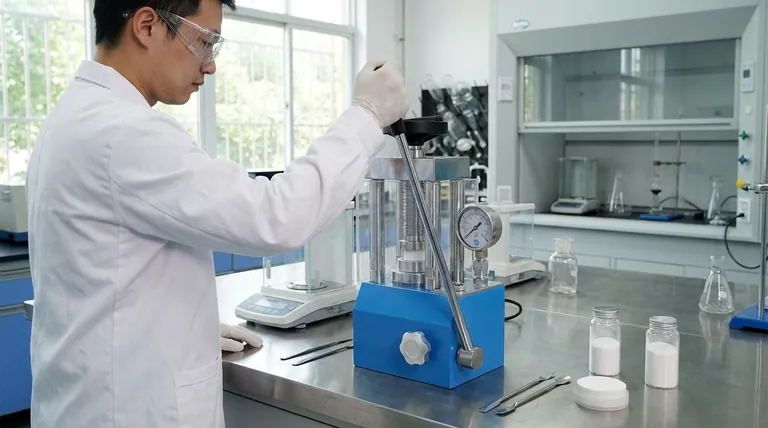
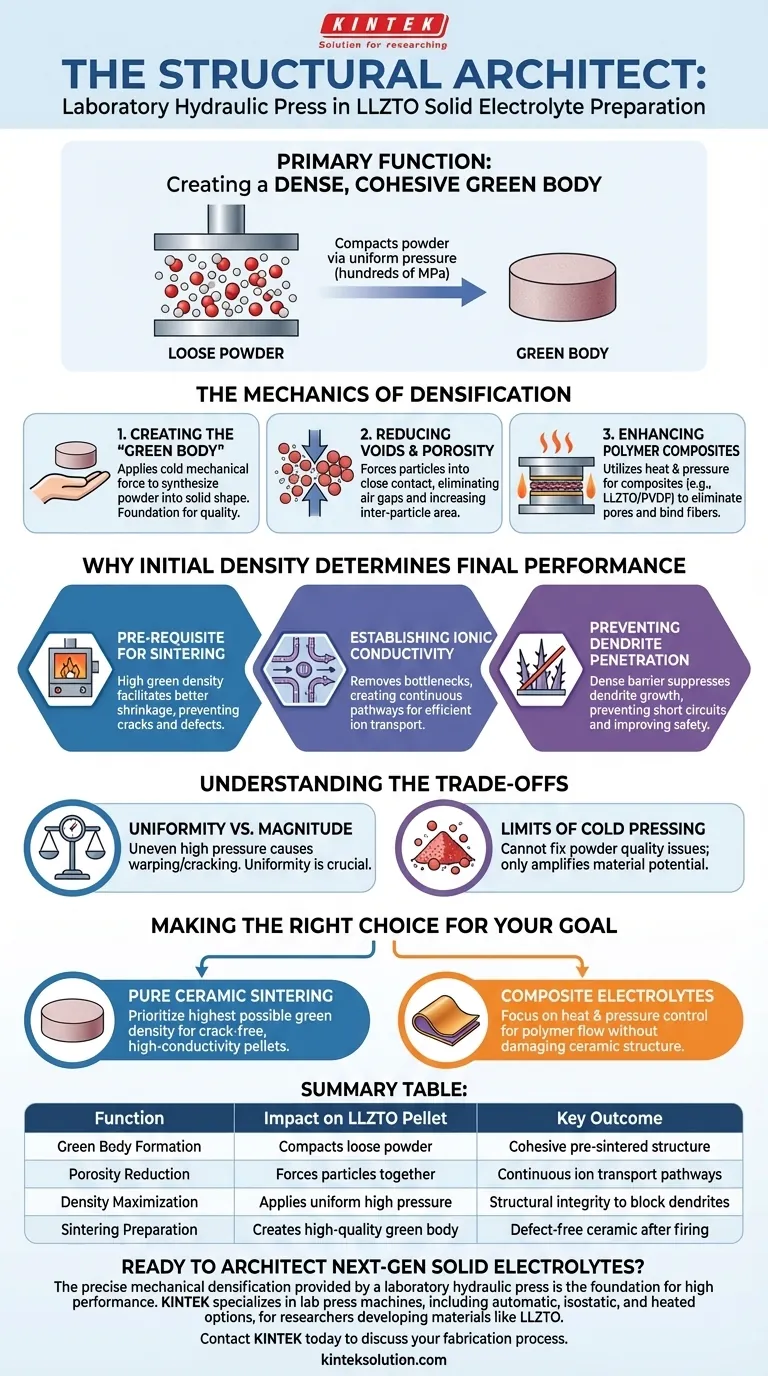
The primary function of a laboratory hydraulic press in preparing garnet-type electrolytes like LLZTO is to compact loose ceramic powder into a dense, cohesive shape known as a "green body." By applying uniform pressure—often reaching hundreds of megapascals (MPa)—the press forces particles into close physical contact and significantly reduces internal voids. This mechanical densification is a mandatory prerequisite for successful high-temperature sintering and achieving high ionic conductivity.
Core Insight: The hydraulic press does not merely shape the material; it defines the pellet's internal architecture. By maximizing particle contact density at the "green" stage, the press creates the continuous pathways required for lithium-ion transport and establishes the structural integrity needed to block lithium dendrites.
The Mechanics of Densification
Creating the "Green Body"
Before ceramic electrolytes can be sintered (heated), they must be formed into a solid shape. The hydraulic press creates this green body by applying cold mechanical force to synthesized LLZTO powder within a die. The mechanical strength and uniformity achieved during this stage directly correlate to the quality of the final product.
Reducing Voids and Porosity
The most critical task of the press is minimizing free space between particles. Loose powder contains significant air gaps that interrupt the flow of ions. High-pressure compaction forces the ceramic particles tightly together, eliminating large pores and increasing the inter-particle contact area.
Enhancing Polymer Composites
For non-sintered applications, such as LLZTO/PVDF composite electrolytes, the press often utilizes heat alongside pressure. This dual action eliminates pores left by solvent evaporation and induces the polymer to flow. The result is a monolithic structure where the polymer binds the ceramic fillers tightly without the need for high-temperature sintering.
Why Initial Density Determines Final Performance
Pre-requisite for Sintering
A high-quality green pellet facilitates better shrinkage behavior during the subsequent high-temperature sintering process. If the initial green density is too low or uneven, the final ceramic pellet will likely suffer from cracks, defects, or low relative density. The press ensures the material is sufficiently packed to sinter into a defect-free ceramic.
Establishing Ionic Conductivity
Conductivity in solid electrolytes relies on continuous pathways for lithium ions to move. By densifying the material, the press ensures that particle-to-particle bottlenecks are removed. This structural continuity is the foundation for achieving the high ionic conductivity required for effective battery cycling.
Preventing Dendrite Penetration
A porous electrolyte is vulnerable to short circuits caused by lithium dendrites growing through the material. A laboratory press helps create a sufficiently dense barrier. By maximizing the relative density of the green body, the final pellet becomes mechanically robust enough to suppress dendrite growth and improve safety.
Understanding the Trade-offs
Uniformity vs. Magnitude
While high pressure is necessary, the uniformity of that pressure is equally vital. Applying massive pressure unevenly can result in density gradients within the pellet. These gradients often lead to warping or cracking during the sintering phase, rendering the electrolyte useless regardless of how high the pressure was.
The Limits of Cold Pressing
Ideally, a press maximizes density, but it cannot fix issues with powder synthesis or particle size distribution. Relying solely on the press to compensate for poor powder quality is a common pitfall. The press amplifies the potential of the material; it does not create material properties that do not exist in the chemistry.
Making the Right Choice for Your Goal
The role of the hydraulic press shifts slightly depending on your specific fabrication route.
- If your primary focus is Pure Ceramic Sintering: Prioritize achieving the highest possible green density to ensure the final pellet is crack-free and possesses high relative density for maximum conductivity.
- If your primary focus is Composite Electrolytes: Focus on the control of both heat and pressure to ensure the polymer matrix flows correctly to eliminate voids without damaging the ceramic structure.
Summary: The laboratory hydraulic press serves as the structural architect of the electrolyte, transforming loose potential into a dense, conductive reality essential for high-performance solid-state batteries.
Summary Table:
| Function | Impact on LLZTO Pellet | Key Outcome |
|---|---|---|
| Green Body Formation | Compacts loose powder into a solid shape | Creates a cohesive pre-sintered structure |
| Porosity Reduction | Forces particles together, eliminating voids | Establishes continuous pathways for ion transport |
| Density Maximization | Applies uniform, high pressure (hundreds of MPa) | Provides structural integrity to block lithium dendrites |
| Sintering Preparation | Creates a high-quality, uniform green body | Enables defect-free ceramic after high-temperature firing |
Ready to Architect Your Next-Generation Solid Electrolytes?
The precise mechanical densification provided by a laboratory hydraulic press is not just a step in your process—it's the foundation for achieving the high ionic conductivity and safety your solid-state battery research demands. KINTEK specializes in lab press machines, including automatic, isostatic, and heated lab presses, designed to meet the exacting needs of laboratory researchers developing materials like LLZTO.
Let us help you transform your ceramic powders into dense, high-performance pellets. Contact KINTEK today to discuss how our presses can enhance your solid electrolyte fabrication process.
Visual Guide
Related Products
- Automatic Laboratory Hydraulic Press Lab Pellet Press Machine
- Manual Laboratory Hydraulic Pellet Press Lab Hydraulic Press
- Laboratory Hydraulic Press Lab Pellet Press Button Battery Press
- Laboratory Hydraulic Press Lab Pellet Press Machine for Glove Box
- Manual Laboratory Hydraulic Press Lab Pellet Press
People Also Ask
- What is the primary purpose of a manual lab hydraulic pellet press? Ensure Accurate Sample Prep for XRF and FTIR
- What is the primary purpose of manual lab hydraulic pellet presses? Achieve High-Precision Sample Preparation for Spectroscopy
- Why are high-precision automatic hydraulic presses required for Martian ISRU? Ensure Reliable Regolith Forming
- How does an automatic laboratory hydraulic press improve KBr pellet preparation? Achieve Precision IR Spectroscopy
- What are the advantages of using an automatic laboratory hydraulic press? Enhance Precision in Sample Preparation



















