
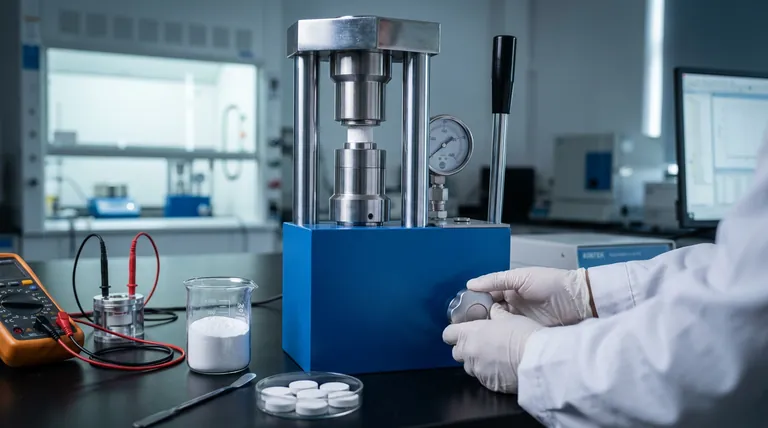
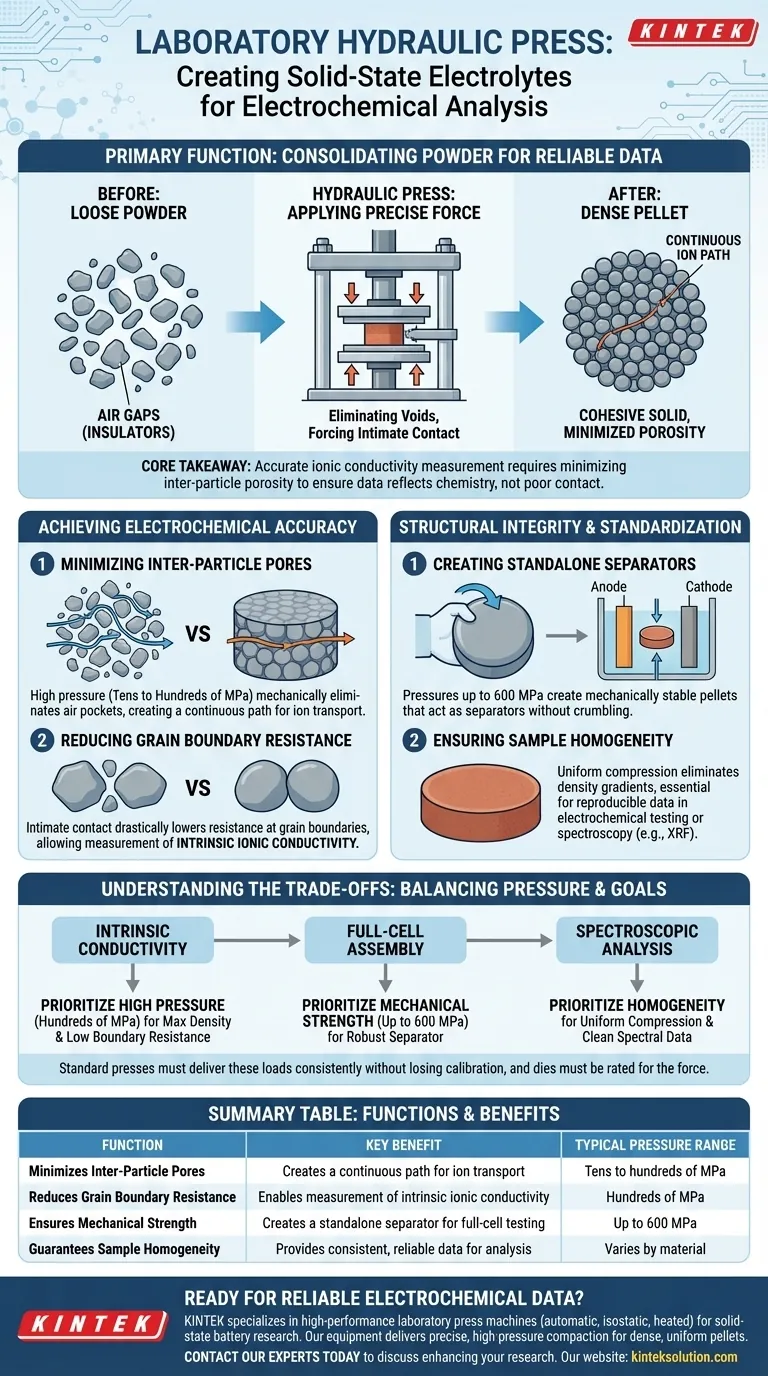
The primary function of a laboratory hydraulic press in this context is to consolidate loose solid-state electrolyte powder into a dense, geometrically uniform pellet through the application of precise mechanical force. By eliminating voids and forcing particles into intimate contact, the press transforms a loose powder into a cohesive solid suitable for reliable electrochemical characterization.
Core Takeaway Accurate measurement of a material's intrinsic ionic conductivity is impossible if the sample is full of air gaps. The hydraulic press solves this by minimizing inter-particle porosity, ensuring that measured resistance reflects the material's chemistry rather than poor physical contact.
Achieving Electrochemical Accuracy
The transition from loose powder to a functional solid electrolyte is critical for obtaining valid data. The press facilitates this through two main physical mechanisms.
Minimizing Inter-Particle Pores
Loose powders naturally contain significant void space, or air pockets, between grains. These voids act as insulators that block the flow of ions.
By applying high pressure—often ranging from tens to hundreds of megapascals—the press mechanically eliminates these pores. This densification creates a continuous path for ion transport.
Reducing Grain Boundary Resistance
In solid-state electrolytes, resistance occurs not just within the crystal lattice, but at the "boundaries" where particles meet.
High-pressure compaction ensures intimate physical contact between these grains. This drastically lowers grain boundary resistance, allowing researchers to measure the material's intrinsic ionic conductivity rather than artifacts of sample preparation.
Structural Integrity and Standardization
Beyond electrochemical performance, the hydraulic press is essential for creating samples that are mechanically stable and consistent.
Creating Standalone Separators
For many experiments, the electrolyte must serve as a physical separator between the anode and cathode.
Reference data indicates that pressures up to 600 MPa are used to create pellets with sufficient mechanical strength to stand alone. This allows the pellet to be handled, stacked, and assembled into all-solid-state test cells without crumbling.
Ensuring Sample Homogeneity
Consistency is vital for reproducible science. A hydraulic press applies uniform compression across the entire surface of the sample.
This uniformity eliminates density gradients or structural inconsistencies that could skew analytical results. Whether for electrochemical testing or spectroscopic analysis (like XRF), a homogenous surface is a prerequisite for high-quality data.
Understanding the Trade-offs
While hydraulic pressing is standard, it is not a "one-size-fits-all" operation. The application of pressure requires careful calibration based on your specific research goals.
The Variance in Pressure Requirements
The necessary pressure varies significantly depending on the material and the stage of testing.
Some contexts call for moderate pressures (around 10 MPa) to form basic shapes, while others require extreme forces (up to 600 MPa) to achieve the density needed for functional separators. You must match the pressure capability of your press to the hardness and densification requirements of your specific electrolyte chemistry.
Balancing Density with Equipment Limits
Achieving the theoretical maximum density is ideal for conductivity, but it requires heavy-duty equipment.
Standard laboratory presses must be capable of delivering these high loads consistently without losing calibration. Furthermore, the die set used to hold the powder must be rated for these extreme forces to avoid deformation or failure during the pressing cycle.
Making the Right Choice for Your Goal
The way you utilize the hydraulic press should be dictated by the specific metric you are trying to isolate.
- If your primary focus is measuring intrinsic ionic conductivity: Prioritize applying high pressure (often hundreds of MPa) to minimize grain boundary resistance and maximize density.
- If your primary focus is full-cell assembly: Focus on producing a pellet with high mechanical strength to ensure it acts as a robust separator between the cathode and anode.
- If your primary focus is spectroscopic analysis (e.g., XRF): Prioritize surface homogeneity and uniform compression to prevent physical inconsistencies from creating noise in your spectral data.
Mastering the hydraulic press allows you to eliminate physical variables, ensuring your data reflects the true chemical potential of your solid-state electrolyte.
Summary Table:
| Function | Key Benefit | Typical Pressure Range |
|---|---|---|
| Minimizes Inter-Particle Pores | Creates a continuous path for ion transport | Tens to hundreds of MPa |
| Reduces Grain Boundary Resistance | Enables measurement of intrinsic ionic conductivity | Hundreds of MPa |
| Ensures Mechanical Strength | Creates a standalone separator for full-cell testing | Up to 600 MPa |
| Guarantees Sample Homogeneity | Provides consistent, reliable data for analysis | Varies by material |
Ready to eliminate sample preparation variables and obtain reliable electrochemical data?
KINTEK specializes in high-performance laboratory press machines, including automatic lab presses, isostatic presses, and heated lab presses, designed to meet the rigorous demands of solid-state battery research. Our equipment delivers the precise, high-pressure compaction you need to create dense, uniform pellets for accurate ionic conductivity measurement.
Contact our experts today to discuss how our lab presses can enhance your research and ensure your data reflects the true potential of your materials.
Visual Guide
Related Products
- Laboratory Hydraulic Press Lab Pellet Press Machine for Glove Box
- Laboratory Hydraulic Press 2T Lab Pellet Press for KBR FTIR
- 24T 30T 60T Heated Hydraulic Lab Press Machine with Hot Plates for Laboratory
- Laboratory Hydraulic Press Lab Pellet Press Button Battery Press
- Laboratory Hydraulic Pellet Press for XRF KBR FTIR Lab Press
People Also Ask
- How does a laboratory hydraulic press contribute to the preparation of Li3-3xScxSb samples? Optimize Ionic Conductivity
- What is the function of a laboratory hydraulic press in FT-IR of curcumin-coated MWCNTs? Achieve Optical Clarity.
- Why is a laboratory hydraulic press required for compression molding boron-siloxane? Solve High-Loading Density Challenges
- What role does a laboratory hydraulic press play in reaction pellets? Optimizing Lunar Soil and Metal Fuel Density
- What role does a laboratory hydraulic press play in the preparation of piezoelectric ceramic discs for DC-PG? | KINTEK



















