
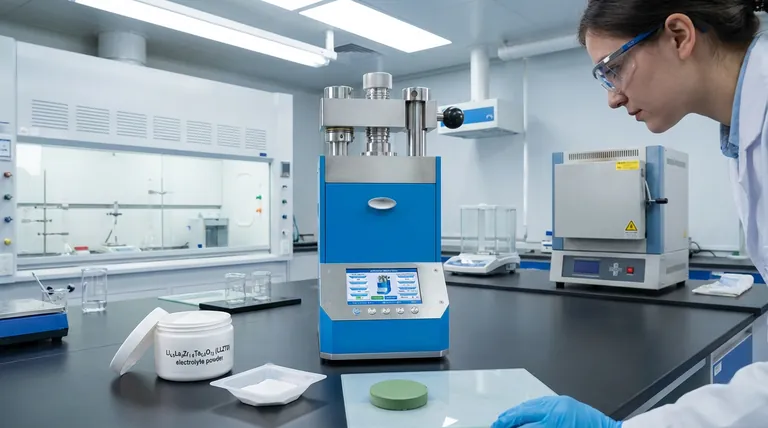
The primary function of a laboratory press machine in processing Li₆.₅La₃Zr₁.₅Ta₀.₅O₁₂ (LLZTO) is to consolidate loose, calcined powder into a solid, cohesive shape known as a "green pellet."
By applying precise, uniaxial pressure—typically via a hydraulic mechanism—the machine forces the powder particles into a specific geometric form. This step transforms the material from a flowable powder into a mechanically stable body that can be handled and processed further.
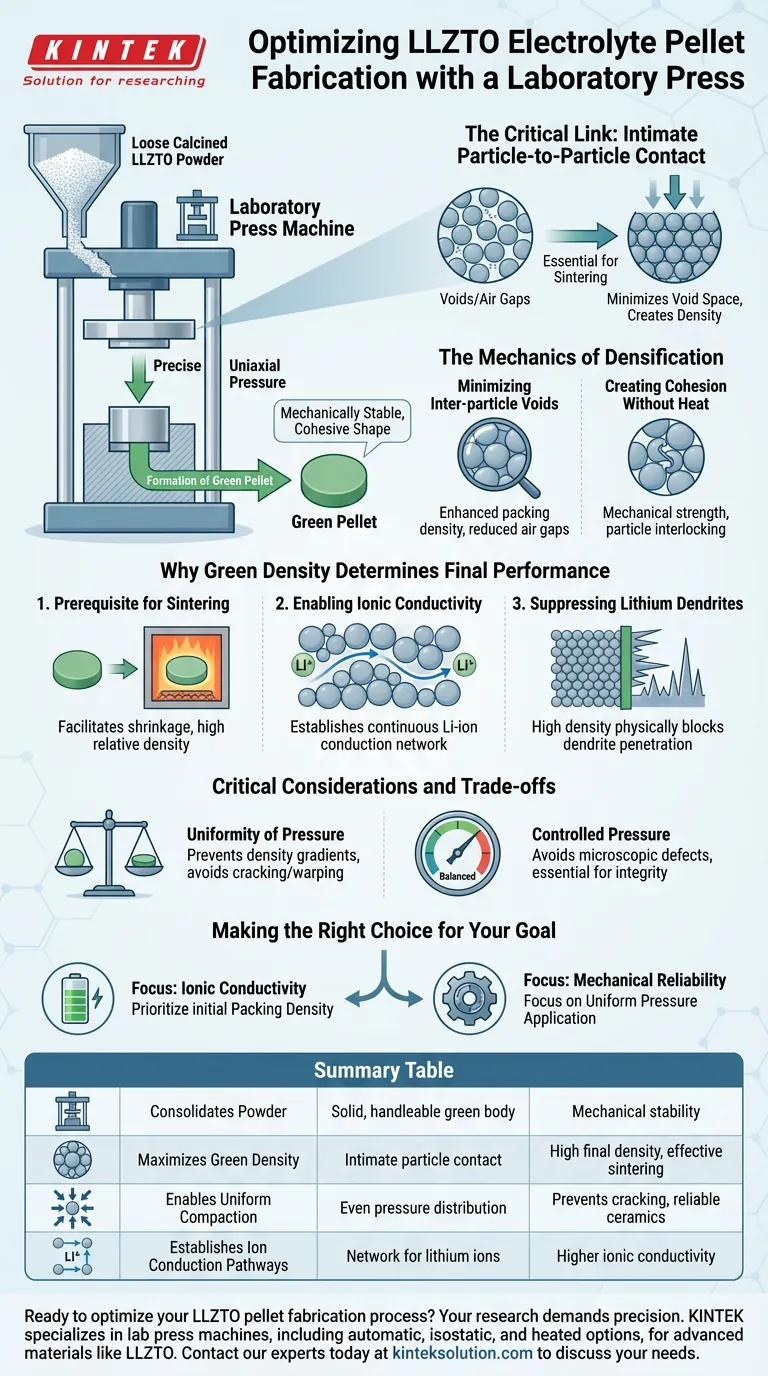
The Critical Link: While shaping the material is the visible output, the press's true value lies in establishing intimate particle-to-particle contact. This initial compaction minimizes void space and creates the necessary physical density required for successful diffusion during the high-temperature sintering stage.
The Mechanics of Densification
Minimizing Inter-particle Voids
The immediate physical effect of the laboratory press is the reduction of porosity.
As pressure is applied within the die, the loose LLZTO particles are rearranged and forced closer together.
This significantly enhances the packing density, reducing the volume of air gaps (voids) trapped between particles.
Creating Cohesion Without Heat
The press generates a "green body"—a term for the ceramic pellet before it is fired.
This pellet must possess sufficient mechanical strength to maintain its shape during transfer to a furnace.
The pressure creates mechanical interlocking and adhesion between the powder granules, ensuring the pellet does not disintegrate prior to sintering.
Why Green Density Determines Final Performance
Prerequisite for Sintering
The quality of the final ceramic electrolyte is almost entirely dependent on the quality of the green pellet.
Sintering is a diffusion process; particles must be touching to fuse together.
A denser green body facilitates superior shrinkage behavior, leading to a final ceramic with high relative density and structural integrity.
Enabling Ionic Conductivity
The ultimate goal of LLZTO is to conduct lithium ions.
The press plays a vital role in establishing a continuous lithium-ion conduction network.
By forcing particles into close contact, the machine creates the pathways necessary for ions to move through the material once the grain boundaries fuse during sintering.
Suppressing Lithium Dendrites
A critical safety function of solid-state electrolytes is blocking the growth of lithium dendrites (metal filaments that cause short circuits).
The laboratory press helps achieve the high final density required to physically block these dendrites.
Reference data indicates that a denser green body directly correlates to a final pellet capable of preventing dendrite penetration.
Critical Considerations and Trade-offs
The Necessity of Uniformity
Applying pressure is not simply about force; it is about uniformity.
If the press applies uneven pressure, the green pellet will have density gradients (some parts denser than others).
This leads to uneven shrinkage during sintering, causing the final ceramic to crack, warp, or deform.
Balancing Pressure and Integrity
While high pressure is needed for density, it must be controllable.
Excessive or uncontrolled pressure can introduce microscopic defects or laminations within the green body.
References highlight that precise pressure control (often tens to hundreds of MPa) is essential to avoid macroscopic defects that would ruin the electrolyte's performance.
Making the Right Choice for Your Goal
To maximize the effectiveness of your laboratory press for LLZTO fabrication, consider your specific performance targets:
- If your primary focus is Ionic Conductivity: Prioritize maximizing the initial packing density to ensure intimate particle contact, as this is the prerequisite for forming robust ion-conductive channels.
- If your primary focus is Mechanical Reliability: Focus on the uniformity of pressure application to prevent density gradients, which is the leading cause of cracking and deformation during the sintering phase.
The laboratory press is not merely a shaping tool; it is the instrument that defines the potential density and efficiency of your final solid-state electrolyte.
Summary Table:
| Function | Benefit for LLZTO Pellet | Key Outcome |
|---|---|---|
| Consolidates Powder | Transforms loose powder into a solid, handleable green body. | Mechanical stability for handling and transfer. |
| Maximizes Green Density | Minimizes inter-particle voids, creating intimate particle contact. | Prerequisite for high final density and effective sintering. |
| Enables Uniform Compaction | Applies precise, uniaxial pressure evenly across the pellet. | Prevents cracking and warping during sintering for reliable ceramics. |
| Establishes Ion Conduction Pathways | Forces particles together to create a network for lithium ions. | Higher ionic conductivity in the final solid electrolyte. |
Ready to optimize your LLZTO pellet fabrication process?
Your research into solid-state electrolytes demands precision and reliability. The initial compaction step with a laboratory press is critical for achieving the high-density green pellets necessary for superior ionic conductivity and mechanical strength in your final product.
KINTEK specializes in lab press machines—including automatic, isostatic, and heated lab presses—designed specifically for the exacting needs of advanced materials research, like processing LLZTO electrolyte powder. Our presses provide the precise, uniform pressure control required to create defect-free green bodies, setting the stage for successful sintering and high-performance battery components.
Let us help you build a better battery. Contact our experts today to discuss your specific lab press requirements and how KINTEK can support your innovation.
Visual Guide
Related Products
- Manual Laboratory Hydraulic Pellet Press Lab Hydraulic Press
- Laboratory Hydraulic Split Electric Lab Pellet Press
- Automatic Laboratory Hydraulic Press Lab Pellet Press Machine
- Laboratory Hydraulic Press Lab Pellet Press Machine for Glove Box
- Laboratory Hydraulic Pellet Press for XRF KBR FTIR Lab Press
People Also Ask
- What is the primary purpose of a manual lab hydraulic pellet press? Ensure Accurate Sample Prep for XRF and FTIR
- What is the primary purpose of manual lab hydraulic pellet presses? Achieve High-Precision Sample Preparation for Spectroscopy
- What role does a lab hydraulic press play in researching squishy granular matter? Expert Insights into Material Physics
- What is the primary function of a laboratory hydraulic press in evaluating the ionic conductivity of Li6PS5X (LMSX)?
- What is the purpose of initial axial molding using a lab hydraulic press? Optimizing Electrolyte Green Bodies














