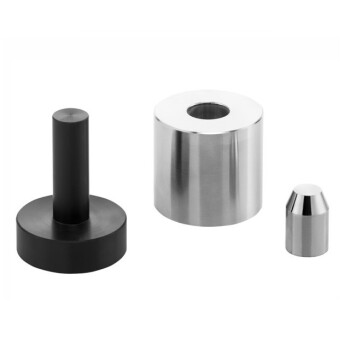
A laboratory press machine acts as the critical bridge between component fabrication and electrochemical functionality. Its primary function is to apply uniform and precise pressure to the interface between the electrode and the solid-state electrolyte membrane prior to battery encapsulation. This mechanical intervention is strictly necessary to reduce interfacial impedance and ensure atomic-level contact for efficient ion transmission.
The laboratory press does more than simply push parts together; it eliminates physical gaps to create a cohesive electrochemical system. By optimizing the contact interface, the machine directly lowers resistance and stabilizes the battery against failure mechanisms common in high-voltage lithium metal applications.
Optimizing the Electrochemical Interface
The performance of a high-voltage lithium metal battery is dictated by the quality of the contact between its layers.
Reducing Interfacial Impedance
The primary obstacle in battery assembly is the natural resistance found at the boundary between materials. A laboratory press applies specific pressure to the electrode-electrolyte interface to mechanically bridge these boundaries. By forcing these layers together, the machine significantly lowers the impedance (resistance) that would otherwise impede the flow of ions.
Achieving Atomic-Level Contact
Surface roughness on electrodes or electrolytes can create microscopic voids. The press ensures tight, atomic-level contact between the active materials and the solid-state electrolyte membrane. This intimacy is required for efficient ion transmission during charging and discharging, as ions cannot easily jump across physical air gaps.
Enhancing Structural Integrity and Density
Beyond the interface, the press modifies the physical properties of the materials themselves.
Increasing Compaction Density
During electrode preparation, the press is used for rolling or flat-pressing coated active materials. This process increases the compaction density of the electrode, optimizing internal porosity. Higher density translates directly to improved volumetric energy density, which is critical for high-voltage applications.
Eliminating Internal Physical Gaps
Assembly requires the elimination of "dead space" within the cell stack. The press provides the force necessary to remove physical voids between the lithium metal foil, the separator, and the cathode. Removing these gaps is essential for ensuring the structural integrity of the test cell and simulating real-world stack pressure.
Preventing Failure Mechanisms
The uniformity of the pressure applied is just as important as the amount of force.
Suppressing Lithium Dendrite Growth
In lithium metal batteries, uneven contact leads to localized current hotspots. These hotspots foster the growth of lithium dendrites—needle-like structures that can puncture separators and cause short circuits. By applying uniform pressure, the press ensures even current distribution, effectively suppressing dendrite formation and extending cycle life.
Preventing Localized Overpressure
A high-precision press distributes force evenly across the entire active area. This prevents localized current concentration which can degrade specific areas of the battery faster than others. Uniform distribution is vital for maintaining electrochemical stability during the stress of high-voltage cycling.
Understanding the Trade-offs
While pressure is essential, it must be calibrated with extreme precision to avoid damaging sensitive components.
The Risk of Component Damage
Applying excessive force can be detrimental to the battery's architecture. Localized overpressure can physically damage the solid-state electrolyte membrane or crush the porous structure of the separator. A laboratory press must offer fine-grain control to apply sufficient force for contact without compromising the mechanical limits of the materials.
The Consequence of Insufficient Pressure
Conversely, under-pressing the assembly leaves microscopic voids at the interface. These voids result in high interfacial charge transfer resistance, leading to poor battery performance. Insufficient pressure also fails to contain the volume expansion of lithium metal, increasing the risk of mechanical delamination during cycling.
Making the Right Choice for Your Assembly Process
Selecting and utilizing a laboratory press requires aligning the machine's capabilities with your specific research targets.
- If your primary focus is Ion Transmission Efficiency: Prioritize a press that guarantees uniform pressure distribution to minimize interfacial impedance at the electrolyte boundary.
- If your primary focus is Volumetric Energy Density: Utilize the press during electrode preparation to maximize compaction density and reduce internal porosity.
- If your primary focus is Cycle Life and Safety: Ensure the press can simulate constant stack pressure to suppress lithium dendrite growth and prevent internal short circuits.
The laboratory press is not merely a tool for assembly; it is a precision instrument that defines the electrochemical boundary conditions necessary for a high-voltage battery to function.
Summary Table:
| Key Function | Primary Benefit | Role in Battery Performance |
|---|---|---|
| Interfacial Compression | Reduces impedance | Ensures efficient ion transmission and atomic-level contact. |
| Compaction Density | Increases energy density | Optimizes internal porosity and volumetric capacity. |
| Uniform Pressure | Suppresses dendrites | Prevents short circuits and extends cycle life by evening current. |
| Structural Sealing | Eliminates gaps | Ensures integrity and simulates real-world stack pressure. |
Elevate Your Battery Research with KINTEK
Precision at the interface is the difference between a prototype and a breakthrough. KINTEK specializes in comprehensive laboratory pressing solutions tailored for high-voltage lithium research. Our range of manual, automatic, heated, multifunctional, and glovebox-compatible models, along with cold and warm isostatic presses, provides the exact control needed to eliminate voids and suppress dendrite growth.
Ready to optimize your battery assembly? Contact us today to find the perfect press for your lab's needs!
References
- Xiaosa Xu. Upgrading Ion Migration and Interface Chemistry via a Cyano-Containing COF in a Single-Ion Conductive Polymer toward High-Voltage Lithium–Metal Batteries. DOI: 10.1021/jacs.5c08267
This article is also based on technical information from Kintek Solution Knowledge Base .
Related Products
- Button Battery Sealing Press Machine for Lab
- Laboratory Hydraulic Press Lab Pellet Press Button Battery Press
- 24T 30T 60T Heated Hydraulic Lab Press Machine with Hot Plates for Laboratory
- Lab Infrared Press Mold for Laboratory Applications
- Automatic Heated Hydraulic Press Machine with Heated Plates for Laboratory
People Also Ask
- Why use standardized CR2032 components & high-precision presses? Ensure reliability in lithium metal battery research.
- Why is a laboratory battery sealing press essential for desolvation energy testing? Ensure Reliable Kinetic Data
- Why is a laboratory hydraulic press or battery sealing machine essential? Ensure Coin Cell Data Integrity
- How do laboratory battery sealing machines ensure performance consistency? Master Your Lithium and LFP Battery Assembly
- What role does a laboratory sealing press play in thermal analysis of solid dispersion films? Ensure Data Integrity