
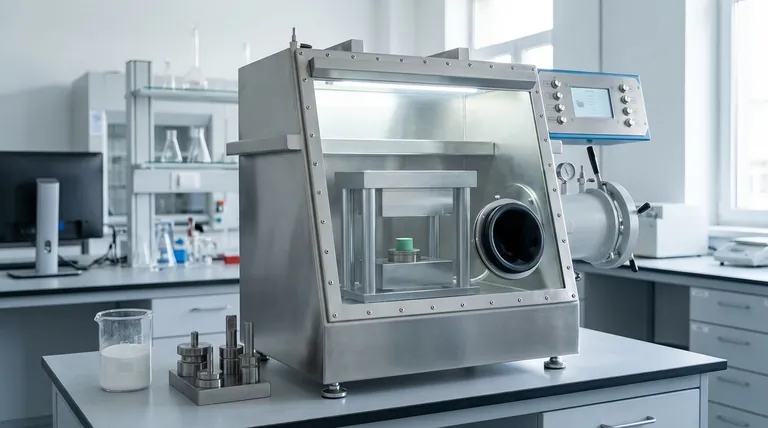
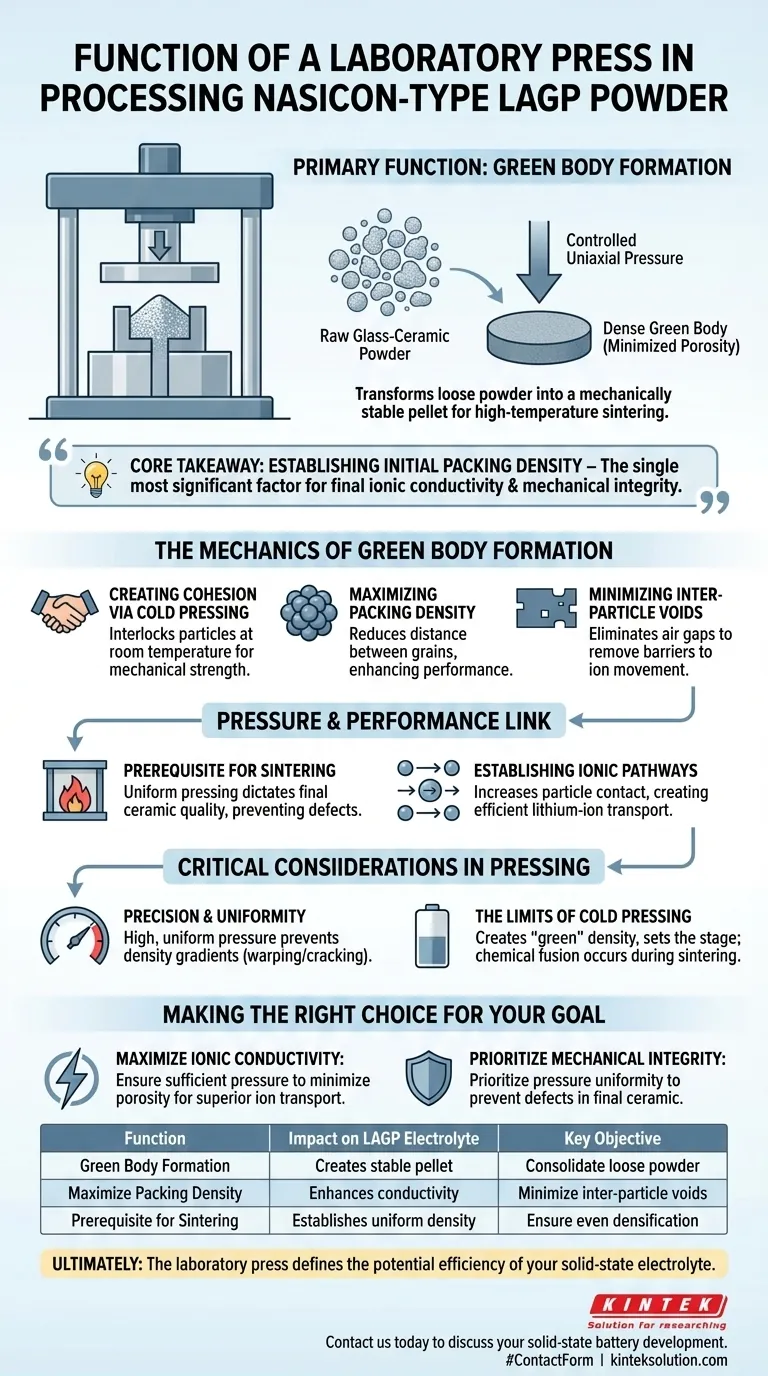
The primary function of a laboratory press machine in processing NASICON-type LAGP powder is to apply controlled uniaxial pressure to consolidate loose particles into a dense, cohesive solid known as a "green body." This cold-pressing step is the foundational stage of fabrication, transforming the raw glass-ceramic powder into a mechanically stable pellet with minimized porosity, making it ready for the critical high-temperature sintering process.
Core Takeaway While the machine physically compresses the powder, its true value lies in establishing the initial packing density of the material. This pre-sintering densification is the single most significant factor in determining the final ionic conductivity and mechanical integrity of the solid-state electrolyte.
The Mechanics of Green Body Formation
Creating Cohesion via Cold Pressing
The laboratory press typically operates at room temperature to perform "cold pressing." It applies force to the LAGP powder within a die set to interlock the particles. This converts the loose powder into a shaped pellet that possesses sufficient mechanical strength to be handled without crumbling.
Maximizing Packing Density
The press is utilized to significantly enhance the packing density of the Li1.5Al0.5Ge1.5(PO4)3 (LAGP) powder. By applying precise force, the machine reduces the distance between individual grains. This creates a compact arrangement that is essential for the material's performance.
Minimizing Inter-particle Voids
A critical objective of the press is to eliminate air gaps and voids between powder particles. Reducing these internal spaces is vital because porosity acts as a barrier to ion movement. The press ensures the starting material is as solid as possible before heat is ever applied.
The Link Between Pressure and Performance
Prerequisite for Sintering
The "green pellet" formed by the press is not the final product; it is a precursor to sintering. However, the uniformity achieved by the press directly dictates the quality of the final ceramic. A poorly pressed pellet will result in uneven densification and structural defects after firing.
Establishing Ionic Pathways
By compacting the powder, the press increases the physical contact area between electrolyte particles. This close contact creates efficient pathways for lithium-ion transport. Without this high-pressure compaction, the final electrolyte would suffer from high resistance and poor conductivity.
Critical Considerations in Pressing
Precision and Uniformity
The application of pressure must be both high (often hundreds of MPa) and strictly uniform. Uniaxial presses are designed to deliver this force evenly across the entire surface of the die. Non-uniform pressure leads to density gradients, which can cause warping or cracking during the subsequent sintering phase.
The Limits of Cold Pressing
It is important to understand that the press creates a "green" density, not the final theoretical density. While it minimizes voids, it does not fuse the particles chemically. The press merely sets the stage; the actual grain growth and ceramic fusion occur later during sintering.
Making the Right Choice for Your Goal
To maximize the effectiveness of your laboratory press when working with LAGP, focus on these objectives:
- If your primary focus is Ionic Conductivity: Ensure your press can deliver sufficient pressure to minimize internal porosity, as denser green bodies yield superior ion transport pathways after sintering.
- If your primary focus is Mechanical Integrity: Prioritize the uniformity of the applied pressure to prevent density gradients that lead to cracks or defects in the final ceramic pellet.
Ultimately, the laboratory press is not just a shaping tool, but the instrument that defines the potential efficiency of your solid-state electrolyte.
Summary Table:
| Function | Impact on LAGP Electrolyte | Key Objective |
|---|---|---|
| Green Body Formation | Creates a mechanically stable pellet for handling and sintering. | Consolidate loose powder. |
| Maximize Packing Density | Reduces distance between particles, enhancing final conductivity. | Minimize inter-particle voids. |
| Prerequisite for Sintering | Establishes uniform density for high-quality ceramic fusion. | Ensure even densification. |
Ready to define the potential of your solid-state electrolyte research?
The initial densification achieved by a laboratory press is the foundational step for creating high-performance NASICON-type LAGP pellets. KINTEK specializes in precision lab press machines—including automatic, isostatic, and heated presses—designed to deliver the high, uniform pressure essential for maximizing ionic conductivity and mechanical integrity in your laboratory's materials.
Contact us today to discuss how our expertise can help you achieve superior results in your solid-state battery development. Let's build the foundation for your next breakthrough together.
Visual Guide
Related Products
- Warm Isostatic Press for Solid State Battery Research Warm Isostatic Press
- Laboratory Hydraulic Press Lab Pellet Press Machine for Glove Box
- Automatic Laboratory Hydraulic Press Lab Pellet Press Machine
- Manual Laboratory Hydraulic Pellet Press Lab Hydraulic Press
- Laboratory Hydraulic Split Electric Lab Pellet Press
People Also Ask
- Why must composite cathodes be sealed in vacuum lamination bags for WIP? Ensure Battery Stability and Density
- How do sacrificial volume materials (SVM) maintain microchannels in isostatic pressing? Ensure Structural Integrity
- What is the function of elastic molds in warm isostatic pressing? Achieve Uniform Density in Composite Particles
- What is the process involved in warm isostatic pressing? Mastering Uniform Density with WIP Technology
- What is the mechanism of a Warm Isostatic Press (WIP) on cheese? Master Cold Pasteurization for Superior Safety














