
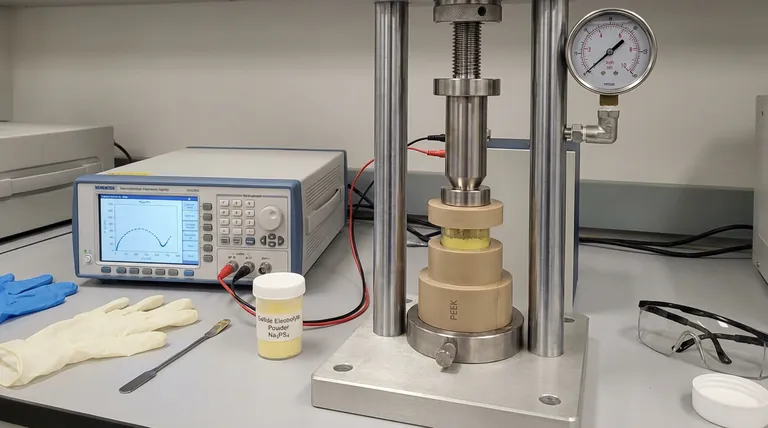
The primary function of a PEEK die in this context is to act as a chemically inert, high-strength mold that enables the simultaneous densification and electrochemical testing of Na3PS4 powder. It serves as a containment vessel that withstands high forming pressures while electrically isolating the sample, allowing for immediate impedance spectroscopy without moving the delicate pellet.
By using a PEEK die, researchers can compress reactive sulfide electrolytes into dense pellets and perform electrochemical measurements in a single setup, eliminating the risk of sample contamination or damage associated with transferring the material between a press and a test cell.
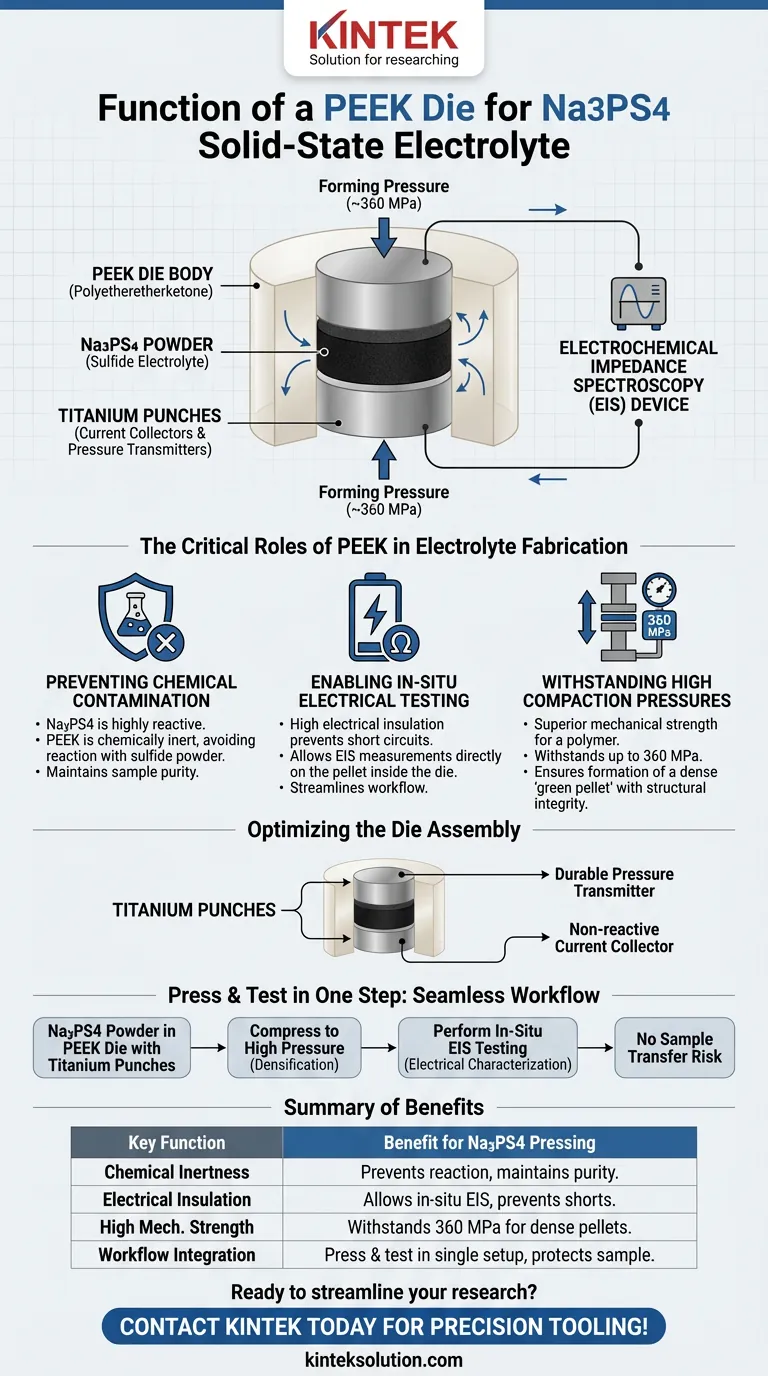
The Critical Roles of PEEK in Electrolyte Fabrication
The choice of Polyetheretherketone (PEEK) over standard metal dies is driven by three specific requirements of solid-state electrolyte research.
preventing Chemical Contamination
Na3PS4 is a sulfide-based electrolyte known for being highly reactive. Standard metal dies can react with the powder, degrading the sample before testing begins.
PEEK provides exceptional chemical stability. It is chemically inert regarding sulfide electrolytes, ensuring the purity of the Na3PS4 pellet is maintained throughout the pressing process.
Enabling In-Situ Electrical Testing
A major advantage of the PEEK die is its high electrical insulation. This property is critical for performing Electrochemical Impedance Spectroscopy (EIS).
Because the die body is non-conductive, it prevents short circuits between the plungers (punches). This allows researchers to run electrical tests directly on the pellet while it remains inside the die, streamlining the workflow.
Withstanding High Compaction Pressures
To function effectively, solid-state electrolytes must be compressed into a dense "green pellet" with sufficient mechanical integrity.
PEEK offers superior mechanical strength for a polymer. It can withstand forming pressures as high as 360 MPa without deforming, ensuring the powder is adequately compacted into its final circular form.
Optimizing the Die Assembly
While PEEK forms the non-conductive body of the die, the system requires compatible components to function as both pressure transmitters and electrical contacts.
The Necessity of Titanium Punches
The references highlight that PEEK dies are typically paired with titanium punches. These punches provide the durability needed to transmit pressure effectively to the powder.
Crucially, these punches act as non-reactive current collectors. Because the PEEK body insulates the sides, the titanium punches conduct the current through the pellet, facilitating the immediate electrochemical testing mentioned above.
Making the Right Choice for Your Goal
Using a PEEK die is a strategic decision to balance mechanical requirements with electrochemical fidelity.
- If your primary focus is Data Accuracy: Rely on PEEK to provide the electrical insulation required to prevent short circuits during sensitive EIS measurements.
- If your primary focus is Sample Purity: Use PEEK to ensure the highly reactive Na3PS4 sulfide electrolyte does not degrade through contact with the die walls.
- If your primary focus is Workflow Efficiency: Leverage the PEEK and titanium assembly to press the powder and test conductivity in one step, avoiding the need to handle fragile green pellets.
The PEEK die transforms a standard pressing procedure into a seamless fabrication-and-testing workflow, preserving the integrity of your sulfide electrolyte.
Summary Table:
| Key Function | Benefit for Na3PS4 Pressing |
|---|---|
| Chemical Inertness | Prevents reaction with the reactive sulfide powder, maintaining sample purity. |
| Electrical Insulation | Allows for in-situ Electrochemical Impedance Spectroscopy (EIS) by preventing short circuits. |
| High Mechanical Strength | Withstands pressures up to 360 MPa to form dense, robust pellets. |
| Workflow Integration | Enables pressing and testing in a single setup, protecting fragile pellets. |
Ready to streamline your solid-state electrolyte research with precision tooling?
KINTEK specializes in high-performance lab press solutions, including custom die assemblies. Our expertise ensures you get the right setup—like a PEEK die with titanium punches—for contamination-free pressing and accurate in-situ electrochemical testing of sensitive materials like Na3PS4.
Contact our experts today to discuss how we can optimize your lab's fabrication and testing workflow.
Visual Guide
Related Products
People Also Ask
- What is the purpose of incorporating cartridge heaters into a lab press mold for MLCC block compression? Optimize Results
- What is the function of a pressing tool in thermoplastic panels? Master Precision Shaping & Fusion Bonding
- Why is precise cooling management of the lab press mold necessary? Protect Core Integrity in Thermoforming
- What role do precision positioning and pressure molds play in single-lap joints? Ensure 100% Data Integrity
- Why is a lab press used for KBr pellet preparation in polyurethane FTIR? Achieve High-Resolution Spectral Data

