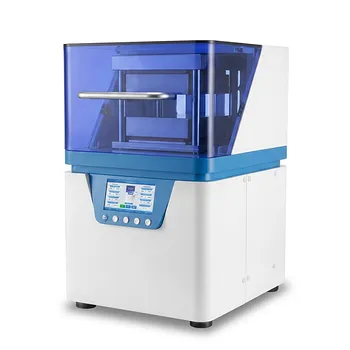
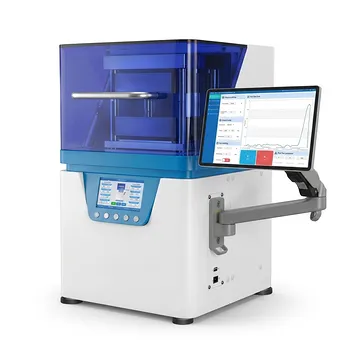
The electric heating plate vulcanizing press acts as the primary catalyst for the chemical and physical transformation of EVM/NBR composites. It provides a highly controlled environment of elevated temperature (typically 160°C) and intense pressure to initiate peroxide-driven cross-linking. This process effectively converts raw, linear macromolecules into a stable three-dimensional network, while simultaneously molding the compound into a dense, dimensionally accurate vulcanized sheet.
The vulcanizing press is essential for bridging the gap between a raw rubber mixture and a finished elastomer; it supplies the thermal energy required for chemical bonding and the mechanical force necessary for structural uniformity and air elimination.
Driving the Molecular Transformation
The press is not merely a heater but a reactor that governs the internal chemistry of the EVM/NBR blend.
Initiation of Peroxide Cross-linking
The primary function of the electric heating plates is to provide the precise thermal energy required to trigger peroxide-initiated reactions. In EVM/NBR composites, this heat breaks down curing agents like dicumyl peroxide (DCP), which then facilitate the formation of bridges between molecular chains.
Transition from Plastic to Elastic States
Before vulcanization, the rubber compound is in a "plastic" state, meaning it deforms permanently under stress. The press manages the transition to an elastomeric state, where the material gains a three-dimensional network structure that allows it to recover its shape after deformation.
Achievement of Optimal Cross-link Density
Precise temperature control ensures the material reaches its optimal vulcanization time (t90). This ensures the highest possible cross-link density, which directly correlates to the mechanical strength, elasticity, and durability of the final EVM/NBR part.
Ensuring Physical and Structural Integrity
Beyond chemistry, the press applies mechanical forces that define the physical characteristics of the composite.
High-Pressure Densification
The press applies significant force (often up to 14 MPa or 150 kgf) to the steel molds containing the rubber. This high-pressure environment is critical for excluding internal air bubbles and ensuring the rubber compound fully fills every cavity of the mold.
Material Uniformity and Low Surface Roughness
Continuous, stable pressure ensures that the resulting rubber sheets have a high structural density and consistent thickness. This is vital for producing standardized test samples that require low surface roughness and uniform internal properties.
Enhancement of Interfacial Bonding
In specialized composites, the pressure from the press forces the rubber matrix into intimate contact with fillers or reinforcements, such as polyester fabric fibers. This mechanical "wetting" promotes stronger chemical bonds and physical interactions, significantly increasing the interfacial peel strength.
Understanding the Trade-offs and Pitfalls
While the vulcanizing press is essential, improper calibration can lead to significant material failure.
The Risk of Thermal Gradient Errors
If the heating plates do not provide a uniform temperature distribution, different areas of the rubber sheet will vulcanize at different rates. This results in "under-cured" spots that are soft and "over-cured" spots that are brittle, compromising the entire specimen.
Pressure-Induced Material Stress
Applying excessive pressure can lead to internal material stresses or "flash" (excess rubber leaking from the mold), which wastes material and creates dimensional inaccuracies. Conversely, insufficient pressure leads to porosity and poor mechanical performance due to trapped gases.
How to Optimize Your Vulcanization Process
To achieve the best results with EVM/NBR composites, your approach must align with your specific material requirements.
- If your primary focus is Maximum Mechanical Strength: Ensure the press is calibrated to the exact t90 time and temperature (e.g., 160°C) specified by a moving die rheometer to reach peak cross-link density.
- If your primary focus is Surface Quality and Precision: Prioritize the pressure compensation features of the hydraulic system to maintain a constant 14 MPa, ensuring all air is evacuated and the mold is perfectly filled.
- If your primary focus is Composite Adhesion: Use the highest recommended pressure during the initial heating phase to force the NBR matrix into the pores of the reinforcement material before the cross-linking reaction limits flow.
By precisely balancing thermal energy and mechanical force, the electric heating plate vulcanizing press transforms raw chemical mixtures into high-performance engineering materials.
Summary Table:
| Key Function | Mechanism | Impact on Composite |
|---|---|---|
| Thermal Activation | Provides 160°C heat for peroxide breakdown | Initiates molecular cross-linking (t90) |
| Phase Transition | Manages plastic-to-elastic state change | Establishes a 3D elastomeric network |
| High-Pressure Densification | Applies ~14 MPa force to the mold | Eliminates air bubbles and ensures uniformity |
| Interfacial Bonding | Forces contact between rubber and fillers | Enhances peel strength and material adhesion |
Maximize Your Material Performance with KINTEK
Precision is critical when transforming raw EVM/NBR mixtures into high-performance elastomers. KINTEK specializes in comprehensive laboratory pressing solutions, offering manual, automatic, heated, multifunctional, and glovebox-compatible models, as well as cold and warm isostatic presses widely applied in battery research and advanced polymer processing.
Our equipment provides the uniform temperature and stable pressure control necessary to avoid thermal gradients and achieve peak cross-link density. Enhance your lab's efficiency and material integrity—contact us today to find the ideal pressing solution for your research!
References
- Przemysław Rybiński, Agnieszka Kucharska. Effect of halogenless flame retardants on the thermal properties, flammability, and fire hazard of cross-linked EVM/NBR rubber blends. DOI: 10.1007/s10973-013-3333-7
This article is also based on technical information from Kintek Solution Knowledge Base .
Related Products
- Split Automatic Heated Hydraulic Press Machine with Heated Plates
- Automatic High Temperature Heated Hydraulic Press Machine with Heated Plates for Lab
- Automatic Heated Hydraulic Press Machine with Heated Plates for Laboratory
- Cylindrical Lab Electric Heating Press Mold for Laboratory Use
- Automatic Heated Hydraulic Lab Press Machine 200x200 Plate Size for Battery Research and Materials Science
People Also Ask
- What are the requirements for electrode pressing with high-viscosity ionic liquids like EMIM TFSI? Optimize Performance
- What is the role of laboratory-scale presses in food science research? Optimize Sterilization and Nutrient Retention
- Why is a laboratory hydraulic press with heating plates required for PLA/TEC films? Achieve Precise Sample Integrity
- Function of a Laboratory Hydraulic Press with Heated Platens in SSE? Enhance Battery Density & Conductivity
- How does a laboratory heated hydraulic press facilitate PBN sample prep for WAXS? Achieve Precise X-Ray Scattering