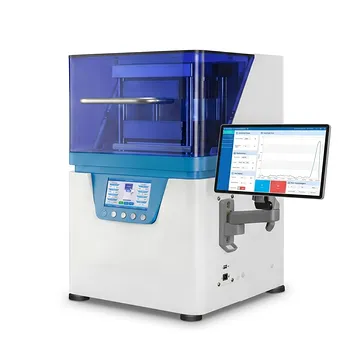
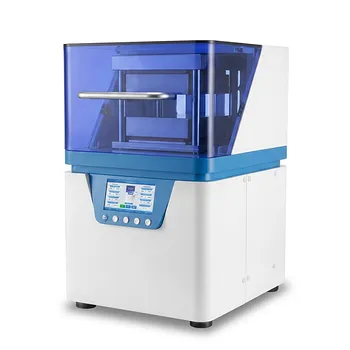
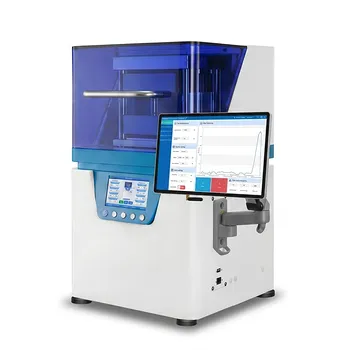
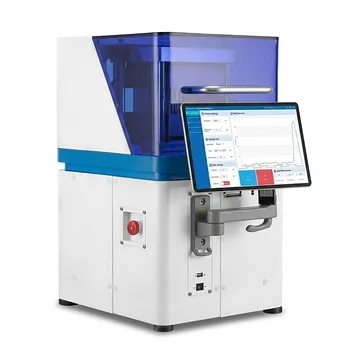
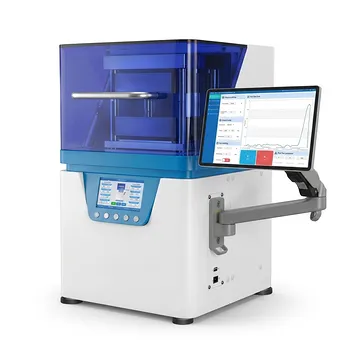
A heated hydraulic press is a fundamental tool in spectroscopic sample preparation, utilized to transform loose powders into solid, uniform discs or films. By applying magnified force via hydraulic fluid—often combined with heat—the device compresses materials into dense pellets, such as KBr discs, rendering them optically suitable for high-precision analysis.
The core objective of using a heated hydraulic press is to eliminate air pockets and inconsistencies within a sample. By creating a perfectly homogenous pellet or thin film, the press ensures that analytical results from techniques like FTIR and XRF are based on the material's chemistry rather than physical defects.
The Principles of Spectroscopic Preparation
Compacting for Consistency
The primary role of the press is to crush and compact powdered materials. This process forces disparate particles into a singular, cohesive solid, known as a pellet or thin film. Achieving this solid state is critical because it standardizes the path length and density of the material being analyzed.
Eliminating Optical Noise
Loose powders contain air gaps that scatter light and X-rays, leading to noisy or inaccurate data. The hydraulic press applies sufficient pressure to evacuate these air pockets completely. This results in a dense sample that allows for clear transmission or reflection of energy, which is vital for accurate readings.
Ensuring Homogeneity
For a spectrum to be representative, the sample must be uniform throughout. The press ensures that the components of the mixture are evenly distributed and locked into place. This prevents the segregation of particles, ensuring the analysis reflects the true composition of the bulk material.
Specific Applications in Analysis
FTIR (Fourier Transform Infrared Spectroscopy)
In FTIR workflows, the press is frequently used to create Potassium Bromide (KBr) pellets. The sample is mixed with KBr powder and pressed until the KBr becomes transparent. This transparency allows infrared light to pass through the sample, providing high-resolution spectral data.
XRF (X-ray Fluorescence)
For XRF analysis, the press produces general sample pellets with a smooth, flat surface. This flatness is essential for maintaining constant geometry relative to the X-ray source. Proper pressing preserves the elemental integrity of the sample, allowing for precise determination of chemical composition.
Operational Mechanics and Benefits
How the Force is Generated
The operation relies on a hydraulic pump pressurizing fluid against a plunger. This pressure is transmitted to a larger ram, which significantly magnifies the force applied to the workpiece. Once the cycle is complete, the pressure acts to mold the powder before the ram retracts.
Advantages of Hydraulic Systems
Hydraulic presses offer significant advantages in speed, particularly for laboratories with high sample throughput. They allow for rapid switching between samples, which is often a bottleneck in manual preparation methods. Furthermore, they provide versatility through adjustable pressure and temperature settings to accommodate different material hardnesses.
Common Pitfalls to Avoid
Over-Pressing and Crystallinity
While pressure is necessary, excessive force can sometimes alter the crystalline structure of sensitive samples. It is crucial to dial in the correct pressure settings to compact the sample without chemically or physically degrading it.
Inconsistent Pellet Formation
If the pressure is not applied uniformly, the resulting pellet may have density gradients. A pellet that is denser in the center than the edges (or vice versa) can lead to non-reproducible results. Ensuring the die is properly loaded and the press is calibrated is essential for avoiding this issue.
Making the Right Choice for Your Goal
To maximize the effectiveness of your spectroscopic analysis, align your preparation method with your specific analytical target.
- If your primary focus is FTIR Analysis: Prioritize pressing KBr pellets until they achieve optical transparency to minimize infrared scattering.
- If your primary focus is XRF Analysis: Focus on creating a pellet with a perfectly smooth surface and high density to ensure accurate elemental quantification.
- If your primary focus is Lab Throughput: Leverage the rapid cycle times of the hydraulic system to process high volumes of samples without sacrificing consistency.
A heated hydraulic press is not just a crushing tool; it is a stabilization device that turns volatile powders into reliable data points.
Summary Table:
| Application | Sample Type | Key Benefit of Pressing | Analysis Goal |
|---|---|---|---|
| FTIR | KBr/Sample Mix | Optical transparency & low light scattering | High-resolution spectral data |
| XRF | Mineral/Powder | Smooth surface & constant geometry | Precise elemental quantification |
| General | Solid Films | Homogeneity & air pocket removal | Standardized path length |
| High-Volume | Various | Rapid cycle times & automation | Increased lab throughput |
Elevate Your Spectroscopic Accuracy with KINTEK
Maximize your analytical precision with KINTEK’s comprehensive laboratory pressing solutions. Whether you are conducting advanced battery research or routine material testing, our range of manual, automatic, heated, and multifunctional presses—including glovebox-compatible and isostatic models—ensures perfect sample homogeneity every time.
Why choose KINTEK?
- Versatility: Solutions for KBr pellets, XRF discs, and thin film preparation.
- Precision: Adjustable temperature and pressure settings to protect sensitive crystalline structures.
- Efficiency: Designed for high-throughput labs needing rapid, repeatable results.
Ready to transform your sample preparation? Contact KINTEK today to find the perfect press for your lab!
Related Products
- Heated Hydraulic Press Machine with Heated Plates for Vacuum Box Laboratory Hot Press
- Automatic High Temperature Heated Hydraulic Press Machine with Heated Plates for Lab
- Automatic Heated Hydraulic Lab Press with Programmable Touch Screen Controls and Precision Temperature Regulation
- Automatic Hydraulic Heat Press Machine with Multi Stage Programmable Control and Integrated Water Cooling Plate Size 180x180mm
- Automatic Hydraulic Hot Press with Large Plate and Precision Temperature Control for Advanced Material Sample Preparation and Industrial Research
People Also Ask
- How does a laboratory heated hydraulic press facilitate PBN sample prep for WAXS? Achieve Precise X-Ray Scattering
- What are the requirements for electrode pressing with high-viscosity ionic liquids like EMIM TFSI? Optimize Performance
- What are the industrial applications of heated hydraulic presses? Master Heat & Force for Precision Manufacturing
- Function of a Laboratory Hydraulic Press with Heated Platens in SSE? Enhance Battery Density & Conductivity
- How are heated hydraulic presses utilized in the preparation of thin films? Key Mechanisms and Applications