
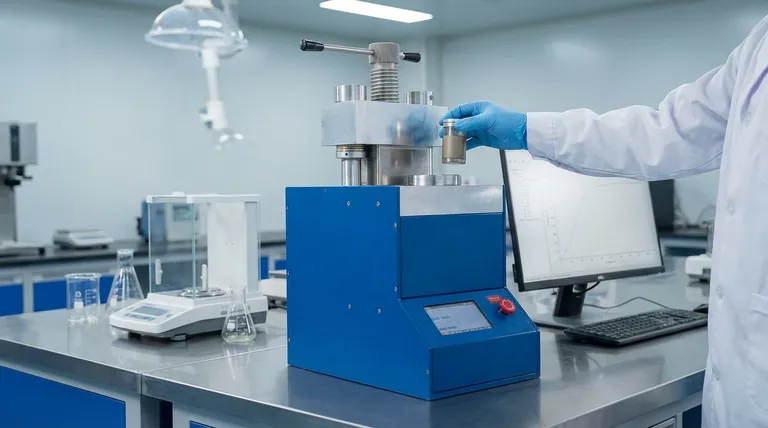
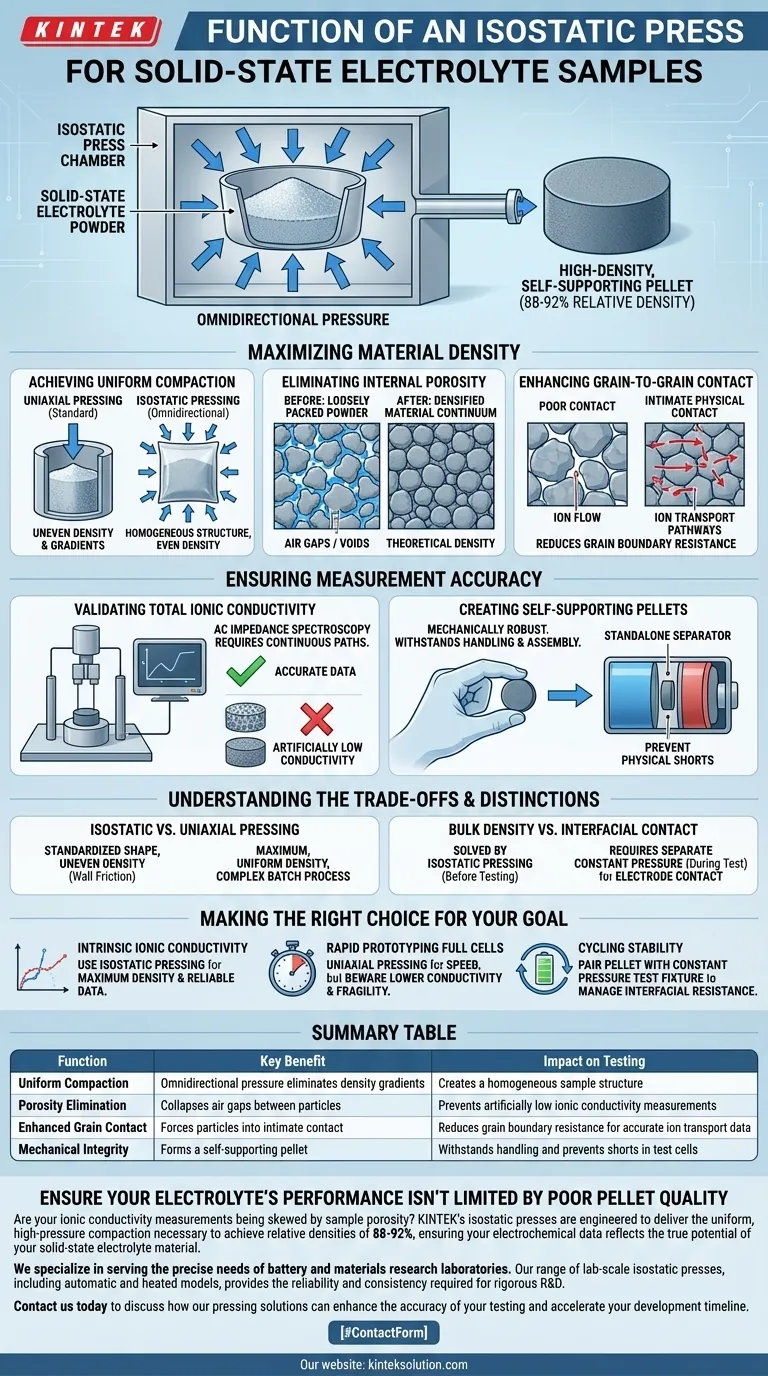
The primary function of an isostatic press in this context is to apply uniform, omnidirectional pressure to solid-state electrolyte powder, compacting it into a high-density, self-supporting pellet. By achieving relative densities often between 88% and 92%, the press minimizes internal porosity and forces individual particles into intimate contact. This densification is the critical first step to ensuring that subsequent electrochemical data accurately represents the material's capabilities.
The core value of isostatic pressing lies in its ability to eliminate microscopic voids through uniform force distribution. By removing air gaps that block ion flow, it ensures that your conductivity measurements reflect the intrinsic properties of the electrolyte material rather than the artifacts of loose packing.
Maximizing Material Density
Achieving Uniform Compaction
Unlike standard presses that apply force from a single direction, an isostatic press applies pressure from all directions simultaneously.
This omnidirectional force ensures that the electrolyte powder is compacted evenly throughout the entire volume of the sample. The result is a homogeneous structure devoid of the density gradients often found in pellets prepared via simpler methods.
Eliminating Internal Porosity
The primary physical goal is to drastically reduce internal porosity.
When electrolyte powder is loosely packed, air gaps exist between particles. Isostatic pressing collapses these voids, creating a dense continuum of material that approaches the theoretical density of the solid.
Enhancing Grain-to-Grain Contact
For ions to move through a solid electrolyte, they must hop from one grain to the next.
High-pressure compaction forces particles into intimate physical contact. This reduces the grain boundary resistance, creating clear pathways for ion transport and maximizing the material's overall performance potential.
Ensuring Measurement Accuracy
Validating Total Ionic Conductivity
Accurate characterization depends on the quality of the sample preparation.
Techniques like AC impedance spectroscopy require a continuous path for ionic movement. If the sample retains high porosity, the measured conductivity will be artificially low, masking the true potential of the chemistry you are trying to evaluate.
Creating Self-Supporting Pellets
Beyond electrochemical performance, the sample must be mechanically robust.
Isostatic pressing creates a self-supporting pellet that can withstand handling and assembly. This mechanical integrity is essential when the pellet acts as a standalone separator, preventing physical shorts between the cathode and anode.
Understanding the Trade-offs and Distinctions
Isostatic vs. Uniaxial Pressing
It is important to distinguish isostatic pressing from uniaxial pressing.
Uniaxial pressing creates a standardized shape (often at high pressures like 600 MPa) but may result in uneven density distributions due to wall friction. Isostatic pressing is superior for achieving maximum, uniform density, though it is often a more complex, batch-based process.
Bulk Density vs. Interfacial Contact
While isostatic pressing solves the issue of bulk density, it does not solve interfacial resistance on its own.
Isostatic pressing densifies the pellet before testing. However, during the actual electrochemical test, a separate constant pressure (applied via a testing fixture) is still required to ensure contact between the pellet and external electrodes (such as lithium foil or stainless steel).
Making the Right Choice for Your Goal
To ensure your electrochemical data is reliable, align your pressing method with your specific testing objectives.
- If your primary focus is determining intrinsic ionic conductivity: Use isostatic pressing to maximize relative density and eliminate porosity-driven errors in your impedance spectroscopy data.
- If your primary focus is rapid prototyping of full cells: You may start with uniaxial pressing for speed, but be aware that lower density may result in lower apparent conductivity and mechanical fragility.
- If your primary focus is cycling stability: Ensure you pair your pressed pellet with a testing fixture that maintains constant pressure to manage interfacial resistance during operation.
A high-quality electrolyte material will effectively fail in the lab if poor compaction prevents ions from moving through it.
Summary Table:
| Function | Key Benefit | Impact on Testing |
|---|---|---|
| Uniform Compaction | Omnidirectional pressure eliminates density gradients | Creates a homogeneous sample structure |
| Porosity Elimination | Collapses air gaps between particles | Prevents artificially low ionic conductivity measurements |
| Enhanced Grain Contact | Forces particles into intimate contact | Reduces grain boundary resistance for accurate ion transport data |
| Mechanical Integrity | Forms a self-supporting pellet | Withstands handling and prevents shorts in test cells |
Ensure Your Electrolyte's Performance Isn't Limited by Poor Pellet Quality
Are your ionic conductivity measurements being skewed by sample porosity? KINTEK's isostatic presses are engineered to deliver the uniform, high-pressure compaction necessary to achieve relative densities of 88-92%, ensuring your electrochemical data reflects the true potential of your solid-state electrolyte material.
We specialize in serving the precise needs of battery and materials research laboratories. Our range of lab-scale isostatic presses, including automatic and heated models, provides the reliability and consistency required for rigorous R&D.
Contact us today to discuss how our pressing solutions can enhance the accuracy of your testing and accelerate your development timeline.
Visual Guide
Related Products
- Warm Isostatic Press for Solid State Battery Research Warm Isostatic Press
- Manual Cold Isostatic Pressing CIP Machine Pellet Press
- Lab Ring Press Mold for Sample Preparation
- Automatic Laboratory Hydraulic Press for XRF and KBR Pellet Pressing
- Laboratory Hydraulic Pellet Press for XRF KBR FTIR Lab Press
People Also Ask
- Why must composite cathodes be sealed in vacuum lamination bags for WIP? Ensure Battery Stability and Density
- What is the function of elastic molds in warm isostatic pressing? Achieve Uniform Density in Composite Particles
- How do sacrificial volume materials (SVM) maintain microchannels in isostatic pressing? Ensure Structural Integrity
- What is the role of the flexible material in warm isostatic pressing? Key to Uniform Density & Precision
- What is the process involved in warm isostatic pressing? Mastering Uniform Density with WIP Technology

















