
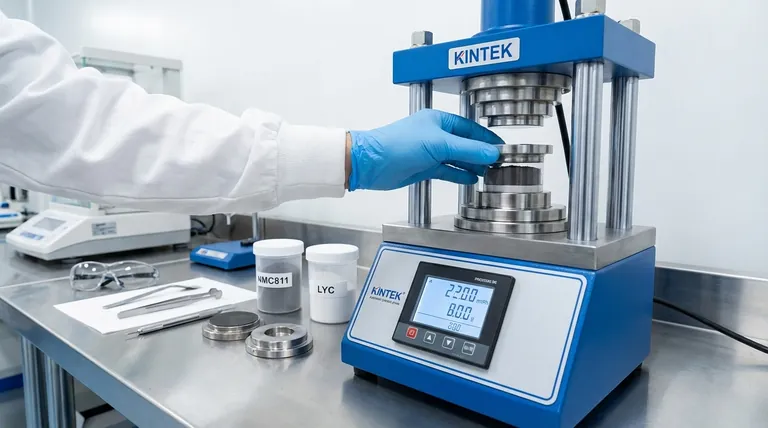
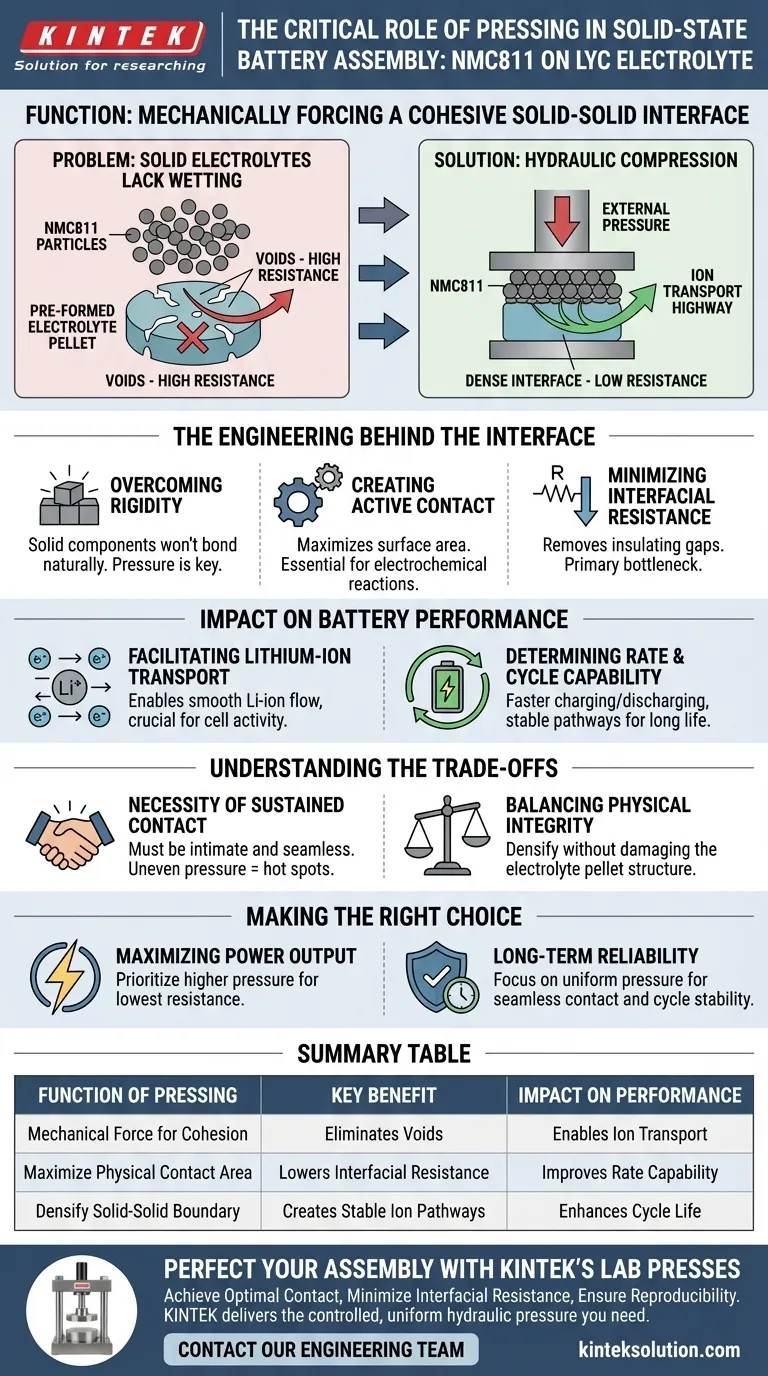
The primary function of pressing NMC811 onto an LYC pellet is to mechanically force a cohesive solid-solid interface. Because solid electrolytes lack the wetting ability of liquid electrolytes, this hydraulic compression is required to eliminate voids and establish maximum physical contact between the cathode active material and the electrolyte particles.
The absence of liquid components in all-solid-state batteries means ion pathways are not formed naturally. External pressure is the critical manufacturing lever used to lower interfacial resistance, ensuring lithium ions can physically migrate between the cathode and the electrolyte.
The Engineering Behind the Interface
Overcoming Material Rigidity
Unlike conventional batteries where liquid electrolytes flow into porous electrodes, solid-state components are rigid. The NMC811 cathode and the Li3YCl6 (LYC) electrolyte will not bond or interact chemically on their own.
Creating Active Contact Points
Using a laboratory hydraulic press applies significant force to the composite powder. This physically jams the NMC811 particles against the LYC pellet surface.
This process maximizes the active surface area where the two materials touch. Without this mechanical force, the contact points would be insufficient to support the battery's electrochemical reactions.
Minimizing Interfacial Resistance
The immediate result of this compression is a drastic reduction in interfacial resistance. Resistance at the boundary layers is one of the primary bottlenecks in solid-state battery performance.
By densifying the boundary between the cathode and the electrolyte pellet, you remove the physical gaps that act as insulators to ion flow.
Impact on Battery Performance
Facilitating Lithium-Ion Transport
A tight interface creates a "highway" for ions. The references highlight that this smooth transport of lithium ions is impossible without the intimate contact created by pressing.
If the particles are not pressed tightly enough, ions cannot bridge the gap between the cathode and the electrolyte, rendering the cell inactive or highly inefficient.
Determining Rate and Cycle Capability
The quality of this pressurized contact is a predictor of long-term success. A well-formed interface allows for faster charging and discharging (rate performance).
Furthermore, a seamless contact point is essential for cycle life. It ensures that the ion pathways remain stable over repeated use, rather than degrading due to poor connectivity.
Understanding the Trade-offs
The Necessity of Sustained Contact
It is not enough to simply touch the materials together; the contact must be intimate and seamless.
If the pressure applied during assembly is uneven or insufficient, the solid-solid interface will harbor voids. These voids create high-resistance hot spots that impede ion flow.
Balancing Physical Integrity
While pressure is vital, the goal is a specific quality of contact. The process aims to densify the composite layer without damaging the structural integrity of the pre-formed LYC pellet.
Success relies on finding the optimal pressure to minimize resistance while maintaining the mechanical stability of the electrolyte layer.
Making the Right Choice for Your Assembly
- If your primary focus is Maximizing Power Output: Prioritize higher pressure (within material limits) to achieve the absolute lowest interfacial resistance for rapid ion transport.
- If your primary focus is Long-Term Reliability: Focus on the uniformity of the pressure distribution to ensure a seamless contact that prevents degradation over many cycles.
The effectiveness of your all-solid-state battery is ultimately defined by how successfully you mechanically bridge the gap between the cathode and the electrolyte.
Summary Table:
| Function of Pressing | Key Benefit | Impact on Performance |
|---|---|---|
| Mechanical Force for Cohesion | Eliminates Voids | Enables Ion Transport |
| Maximize Physical Contact Area | Lowers Interfacial Resistance | Improves Rate Capability |
| Densify Solid-Solid Boundary | Creates Stable Ion Pathways | Enhances Cycle Life |
Perfect Your Solid-State Battery Assembly with KINTEK's Lab Presses
Building a high-performance all-solid-state battery hinges on creating a flawless, low-resistance interface between your electrode and electrolyte materials. KINTEK's precision lab presses deliver the controlled, uniform hydraulic pressure essential for this critical step.
Our automatic lab presses and heated lab presses are engineered to help researchers like you:
- Achieve Optimal Contact: Apply precise, repeatable pressure to maximize the active surface area between NMC811 and LYC pellets.
- Minimize Interfacial Resistance: Create seamless ion pathways for superior rate performance and long-term cycle stability.
- Ensure Reproducibility: Automate the pressing process for consistent, reliable results in every cell you assemble.
Stop struggling with inconsistent manual pressure. Let KINTEK's expertise in laboratory pressing solutions empower your solid-state battery R&D.
Contact our engineering team today to discuss how our lab presses can enhance your assembly process and accelerate your development timeline!
Visual Guide
Related Products
- Automatic Laboratory Hydraulic Press for XRF and KBR Pellet Pressing
- Manual Laboratory Hydraulic Press Lab Pellet Press
- Laboratory Hydraulic Split Electric Lab Pellet Press
- Assemble Square Lab Press Mold for Laboratory Use
- Automatic Laboratory Hydraulic Press Lab Pellet Press Machine
People Also Ask
- Why is pressing powder into a pellet critical before sintering? Ensure Dense, Conductive Solid-State Electrolytes
- What is the role of a laboratory pressure machine and KBr in FTIR? Master Sample Preparation for Flame Retardants
- What are the advantages of using a laboratory automatic hydraulic press for HEA green compact forming?
- What are the advantages of using a lab automatic hydraulic press for HEA green body molding? Ensure Material Integrity
- How does an automatic laboratory hydraulic press improve KBr pellet preparation? Achieve Precision IR Spectroscopy












