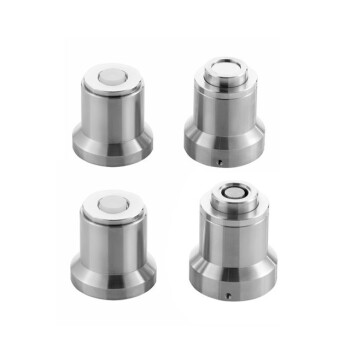
Specialized laboratory pressure cell molds act as a critical mechanical restraint system designed to apply and maintain constant stacking pressure during the active electrochemical testing of all-solid-state batteries (ASSBs). Unlike standard battery casings, these molds are engineered to dynamically compensate for the volume changes of electrode materials, preserving the physical integrity of the solid-state stack throughout charge and discharge cycles.
Core Takeaway In solid-state batteries, ion conduction relies entirely on physical contact between solid particles. Pressure cell molds ensure this contact remains unbroken by counteracting the mechanical stress of electrode expansion, preventing interface failure and ensuring that test data reflects true chemical performance rather than mechanical defects.
The Critical Role of Pressure Maintenance
The fundamental challenge in ASSBs is that solid electrolytes cannot flow to fill voids like liquid electrolytes. Pressure cell molds address the mechanical instabilities that arise during operation.
Compensating for Volume Change
During lithium insertion and extraction, electrode materials undergo significant expansion and contraction. Without external constraint, this "breathing" causes the battery stack to loosen.
Pressure cell molds provide a stable pressure environment that accommodates these fluctuations. This is particularly vital for cells utilizing high-entropy solid electrolytes, where maintaining mechanical equilibrium is essential for consistent operation.
Preventing Delamination and Cracking
The primary failure mode in many ASSB tests is not chemical degradation, but mechanical separation.
By maintaining constant pressure, these molds prevent the delamination of the active material from the solid electrolyte. They also suppress the formation of cracks at the interface, which effectively stops the creation of "dead" active material that can no longer participate in the reaction.
Ensuring Scientific Accuracy
The use of specialized molds is not just about battery operation; it is about the validity of the data collected.
Eliminating Contact Resistance Variables
If pressure fluctuates during a test, internal resistance changes unpredictably. This makes it impossible to distinguish between chemical behavior and mechanical contact issues.
Specialized molds ensure the repeatability of cycle life and rate performance tests by removing mechanical variation as a variable. This allows researchers to isolate the true electrochemical properties of the materials being tested.
Bridging Assembly and Operation
While hydraulic presses are used to create the initial dense pellet (often at extremely high pressures like 370 MPa), the pressure cell mold is responsible for sustaining the necessary operational pressure.
The mold preserves the low-impedance, void-free interfaces established during assembly. It ensures that the atomic-level contact required for efficient lithium-ion transport is not lost once the hydraulic press is removed and the cycling begins.
Understanding the Trade-offs
While pressure cell molds are essential for accurate ASSB evaluation, they introduce specific constraints that must be managed.
The Density vs. Fracture Balance
Applying pressure is a delicate balance. The mold must apply enough force to minimize interfacial resistance and grain boundary resistance.
However, excessive or uneven pressure can crush brittle solid electrolyte layers or cause short circuits, particularly with ultra-thin films (e.g., 30 micrometers). The mold mechanism must be precise enough to maintain contact without exceeding the mechanical yield strength of the components.
Equipment Complexity vs. Fidelity
Standard coin cells, often used for liquid electrolytes, generally cannot maintain the high uniform pressures (e.g., 50-300 MPa range depending on the stage) required for ASSBs.
Specialized molds are bulkier and more complex to assemble than coin cells. However, relying on standard casings for ASSBs often results in false negatives—batteries that appear to fail chemically but actually failed mechanically due to insufficient stacking pressure.
Making the Right Choice for Your Goal
The configuration of your pressure cell mold should be dictated by the specific performance metric you are trying to isolate.
- If your primary focus is Cycle Life: Prioritize a mold design with robust spring-loading or hydraulic maintenance to actively buffer volume expansion and suppress the formation of interfacial voids over long periods.
- If your primary focus is Rate Performance: Ensure the mold can sustain higher compression levels to minimize interfacial impedance and maximize the contact area for rapid ion transfer.
Ultimately, the pressure cell mold converts a fragile stack of powders into a cohesive electrochemical system, validating that your material chemistry works in a mechanically viable environment.
Summary Table:
| Feature | Function in ASSB Evaluation |
|---|---|
| Mechanical Restraint | Compensates for electrode volume expansion during cycling |
| Interface Preservation | Prevents delamination and cracking of solid-state stacks |
| Impedance Control | Minimizes interfacial resistance for high-rate performance |
| Data Validation | Eliminates contact resistance variables to isolate chemical behavior |
| Void Suppression | Maintains low-impedance, void-free interfaces post-assembly |
Optimize Your Battery Research with KINTEK Precision
Unlock the true potential of your solid-state materials by eliminating mechanical failure variables. KINTEK specializes in comprehensive laboratory pressing solutions, offering a versatile range of manual, automatic, heated, and multifunctional models. Whether you require glovebox-compatible setups or advanced cold/warm isostatic presses, our equipment is engineered to provide the stable, high-pressure environments critical for battery innovation.
Ready to achieve repeatable, high-fidelity test results?
References
- Feipeng Zhao, Xueliang Sun. A Perspective on the Origin of High‐Entropy Solid Electrolytes. DOI: 10.1002/adma.202501544
This article is also based on technical information from Kintek Solution Knowledge Base .
Related Products
- Lab Cylindrical Press Mold for Laboratory Use
- Carbide Lab Press Mold for Laboratory Sample Preparation
- Lab Infrared Press Mold for Laboratory Applications
- Lab Button Battery Tablet Press Sealing Mold
- Lab Button Battery Disassembly and Sealing Mold
People Also Ask
- What is the purpose of incorporating cartridge heaters into a lab press mold for MLCC block compression? Optimize Results
- Why is precise cooling management of the lab press mold necessary? Protect Core Integrity in Thermoforming
- What is the function of a pressing tool in thermoplastic panels? Master Precision Shaping & Fusion Bonding
- Why is a high-performance laboratory molding press critical for in-situ electrolyte formation? Unlock Battery Success
- How does the geometry of laboratory molds influence mycelium-based composites? Optimize Density and Strength