
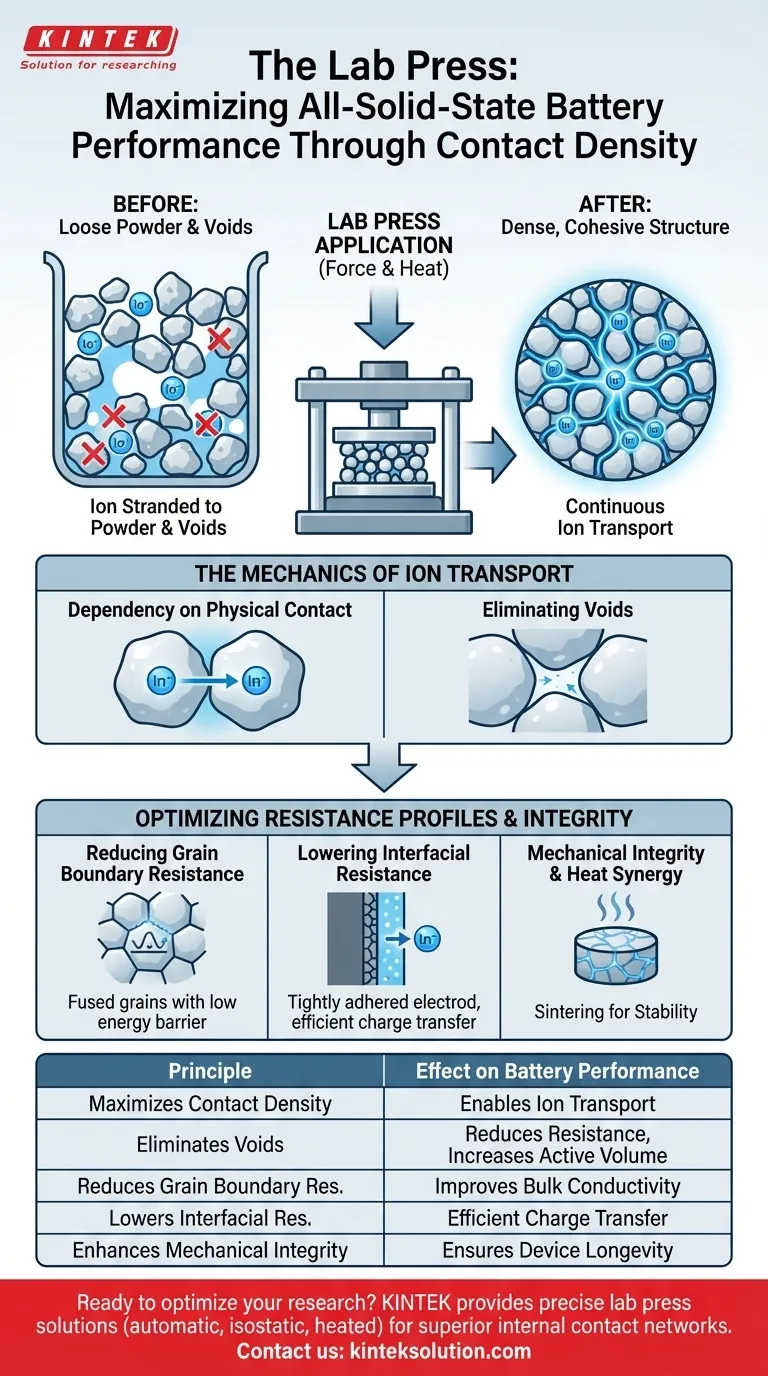
The fundamental principle is the maximization of physical contact density to enable ion transport. In an all-solid-state battery, ions cannot travel through air gaps or voids. Using a lab press applies the necessary force to compress powder particles into a dense, cohesive structure, effectively minimizing electrical resistance and creating a functional path for charge movement.
The lab press solves the "solid-solid interface" problem. By mechanically eliminating voids, it transforms loose powders into a unified system with low-impedance pathways, which is the absolute prerequisite for battery performance.
The Mechanics of Ion Transport
The Dependency on Physical Contact
Unlike traditional batteries that use liquid electrolytes to wet the electrodes, solid-state systems rely entirely on physical points of contact.
If the material is loose, the ions are stranded. The lab press forces particles together to ensure that the solid electrolyte and electrode materials physically touch, creating a continuous network for lithium ions to traverse.
Eliminating Voids
Voids, or air pockets between particles, act as insulators. They represent dead ends for ionic current.
By applying significant pressure, the lab press collapses these voids. This increases the active volume of the material, ensuring that the maximum amount of the battery's mass is contributing to charge storage and transport.
Optimizing Resistance Profiles
Reducing Grain Boundary Resistance
Solid electrolytes are often composed of compressed powders. The resistance found at the edges where these individual powder grains meet is known as grain boundary resistance.
High-pressure densification fuses these grains closer together. This significantly lowers the energy barrier required for ions to hop from one grain to the next, improving the bulk conductivity of the electrolyte layer.
Lowering Interfacial Resistance
The most critical bottleneck in solid-state batteries is often the interface between the electrolyte and the electrodes.
A lab press minimizes interfacial resistance by ensuring these distinct layers adhere tightly to one another. A well-formed, low-impedance solid-solid interface allows for efficient charge transfer across the layers, which is directly correlated to higher power output.
The Role of Mechanical Integrity
Creating Structural Stability
Beyond electrochemical performance, the lab press ensures the sample holds together. It provides the mechanical integrity required for the battery to be handled and tested without falling apart.
The Synergy of Heat and Pressure
While pressure is the primary driver for density, many lab presses also utilize heat. This combination helps "melt" or sinter specific powdered materials, allowing them to flow into a more uniform shape before solidifying, further enhancing the density and durability of the pellet.
Making the Right Choice for Your Goal
To maximize the effectiveness of your pressing process, align your technique with your specific research objectives.
- If your primary focus is maximizing ionic conductivity: Prioritize achieving the highest possible density to eliminate voids and minimize grain boundary resistance.
- If your primary focus is device longevity: Concentrate on the mechanical integrity of the layers to ensure the solid-solid interface remains stable during handling and testing.
A solid-state battery is only as effective as its internal contact network; the lab press is the tool that defines that network.
Summary Table:
| Principle | Effect on Battery Performance |
|---|---|
| Maximizes Contact Density | Creates continuous pathways for ion transport, enabling charge movement. |
| Eliminates Voids & Air Gaps | Reduces electrical resistance and increases the active material volume. |
| Reduces Grain Boundary Resistance | Lowers the energy barrier for ions to hop between particles, improving bulk conductivity. |
| Lowers Interfacial Resistance | Ensures tight adhesion between electrolyte and electrode layers for efficient charge transfer. |
| Enhances Mechanical Integrity | Provides structural stability for handling and testing, ensuring device longevity. |
Ready to optimize your all-solid-state battery research?
The principles of maximizing contact density and minimizing resistance are critical for performance. KINTEK specializes in providing the precise lab press equipment—including automatic, isostatic, and heated lab presses—needed to achieve the necessary densification and mechanical integrity for your laboratory's solid-state battery development.
Contact us today via our [#ContactForm] to discuss how our solutions can help you build a superior internal contact network and accelerate your R&D.
Visual Guide
Related Products
- 24T 30T 60T Heated Hydraulic Lab Press Machine with Hot Plates for Laboratory
- Manual Heated Hydraulic Lab Press with Integrated Hot Plates Hydraulic Press Machine
- Laboratory Hydraulic Pellet Press for XRF KBR FTIR Lab Press
- Lab Infrared Press Mold for Laboratory Applications
- Laboratory Hydraulic Press Lab Pellet Press Machine for Glove Box
People Also Ask
- Function of a Laboratory Hydraulic Press with Heated Platens in SSE? Enhance Battery Density & Conductivity
- Why is a laboratory hydraulic press with heating plates required for PLA/TEC films? Achieve Precise Sample Integrity
- What role does a laboratory heated hydraulic press play in LTCC? Essential for High-Density Ceramic Lamination
- Why reduce load when applying composite strengthening tabs? Protect Specimen Integrity and Data Accuracy
- Why is a laboratory heated hydraulic press required? Ensure Precise Vulcanization for NBR/EPDM Nanocomposites



















