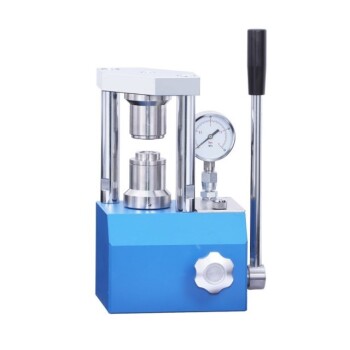
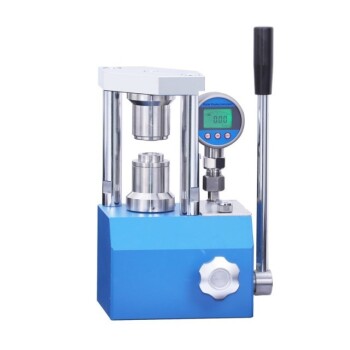
The laboratory hydraulic press acts as the definitive control variable for mechanical consistency in battery assembly. It applies precise, constant pressure to crimp or seal the battery casing, ensuring a hermetic enclosure while simultaneously compressing internal components to minimize electrical resistance.
Core Takeaway In aqueous zinc-ion battery research, the hydraulic press is not merely a closing tool, but a calibration instrument. By standardizing the pressure applied during assembly, it eliminates physical variability between samples, ensuring that performance data reflects the chemistry of the materials rather than inconsistencies in the assembly process.
The Critical Role of Sealing Integrity
Creating an Airtight Environment
The primary function of the hydraulic press is to deform the battery case (typically a coin cell) and the sealing ring to create a physical, airtight seal.
Preventing Electrolyte Failure
For aqueous zinc-ion batteries, this seal is vital to prevent the evaporation of electrolyte moisture. A compromised seal leads to the gradual drying of the cell, which alters concentration levels and causes premature failure, unrelated to the active materials being tested.
Eliminating Leakage Risks
Precise pressure control prevents the physical leakage of the liquid or gel electrolyte. This protects the testing equipment and ensures the calculated volume of electrolyte remains constant throughout the experiment.
Optimizing Electrochemical Performance
Reducing Contact Resistance
The press forces the internal "stack"—the zinc anode, separator, and cathode—into tight interfacial contact.
Minimizing Ohmic Drop
Insufficient pressure results in microscopic gaps between layers. These gaps create high ohmic internal resistance (impedance), which artificially lowers the battery's voltage and capacity readings during testing.
Interfacial Stability in Gel Systems
When using gel electrolytes, the press plays a distinct role in forcing the flexible gel into close microscopic contact with the electrode materials. This eliminates physical voids and reduces the interface impedance that often plagues quasi-solid-state systems.
Understanding the Trade-offs
The Risk of Under-Pressurization
If the sealing pressure is too low (e.g., failing to reach the necessary threshold for the specific casing), the physical seal will be incomplete. This leads to immediate leakage or high impedance, rendering the test data unusable.
The Danger of Over-Pressurization
While tight contact is necessary, excessive pressure can crush the separator or deform the casing beyond its tolerance. This can cause internal short circuits or damage the delicate structure of the cathode material, leading to false negatives regarding material stability.
Pressure Uniformity
Manual presses rely on operator consistency, while automatic presses offer programmable precision. Variations in applied pressure between different test cells will introduce statistical noise into your data, making it difficult to reproduce results.
Making the Right Choice for Your Goal
To ensure valid results in zinc-ion battery assembly, align your equipment usage with your specific research objectives:
- If your primary focus is material characterization: Prioritize repeatable pressure settings to ensure that any difference in performance is due to the material, not the contact resistance.
- If your primary focus is long-term cycling stability: Ensure the press delivers sufficient force to create a perfect hermetic seal, as even minor evaporation will ruin long-duration tests.
Ultimately, the hydraulic press transforms a stack of loose components into a unified electrochemical system, acting as the gatekeeper for data accuracy.
Summary Table:
| Feature | Impact on Zinc-Ion Battery Assembly | Benefit for Researchers |
|---|---|---|
| Sealing Integrity | Prevents electrolyte evaporation and leakage | Ensures long-term cycling stability |
| Interfacial Contact | Minimizes ohmic internal resistance | Delivers accurate voltage and capacity data |
| Pressure Control | Standardizes mechanical variables | Eliminates statistical noise between samples |
| Uniformity | Prevents separator crushing/short circuits | Protects delicate electrode structures |
Optimize Your Battery Research with KINTEK Precision
Don't let mechanical variability compromise your electrochemical data. KINTEK specializes in comprehensive laboratory pressing solutions designed for the rigorous demands of battery research. Whether you require manual, automatic, heated, or multifunctional models, or specialized cold and warm isostatic presses, our equipment ensures the perfect hermetic seal and interface contact every time.
Our glovebox-compatible presses are engineered to maintain the highest standards of consistency for your aqueous zinc-ion or solid-state systems. Contact KINTEK today to find the perfect pressing solution for your lab and ensure your results reflect your chemistry, not your assembly tools.
References
- Jin‐Young Lee, Sungwook Mhin. Electrochemical Performance of Diamond-like Carbon (DLC)-Coated Zn Anodes for Application to Aqueous Zinc-Ion Batteries. DOI: 10.3390/batteries11060228
This article is also based on technical information from Kintek Solution Knowledge Base .
Related Products
- Button Battery Sealing Press Machine for Lab
- Manual Button Battery Sealing Machine for Battery Sealing
- Automatic Lab Cold Isostatic Pressing CIP Machine
- Manual Cold Isostatic Pressing CIP Machine Pellet Press
- Button Battery Sealing Machine for Button Batteries
People Also Ask
- Why use standardized CR2032 components & high-precision presses? Ensure reliability in lithium metal battery research.
- Why is a laboratory battery sealing press essential for desolvation energy testing? Ensure Reliable Kinetic Data
- Why is a laboratory hydraulic press or battery sealing machine essential? Ensure Coin Cell Data Integrity
- How do laboratory battery sealing machines ensure performance consistency? Master Your Lithium and LFP Battery Assembly
- What role does a laboratory sealing press play in thermal analysis of solid dispersion films? Ensure Data Integrity