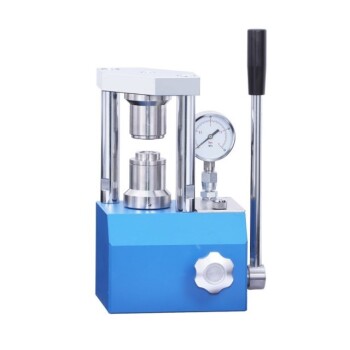
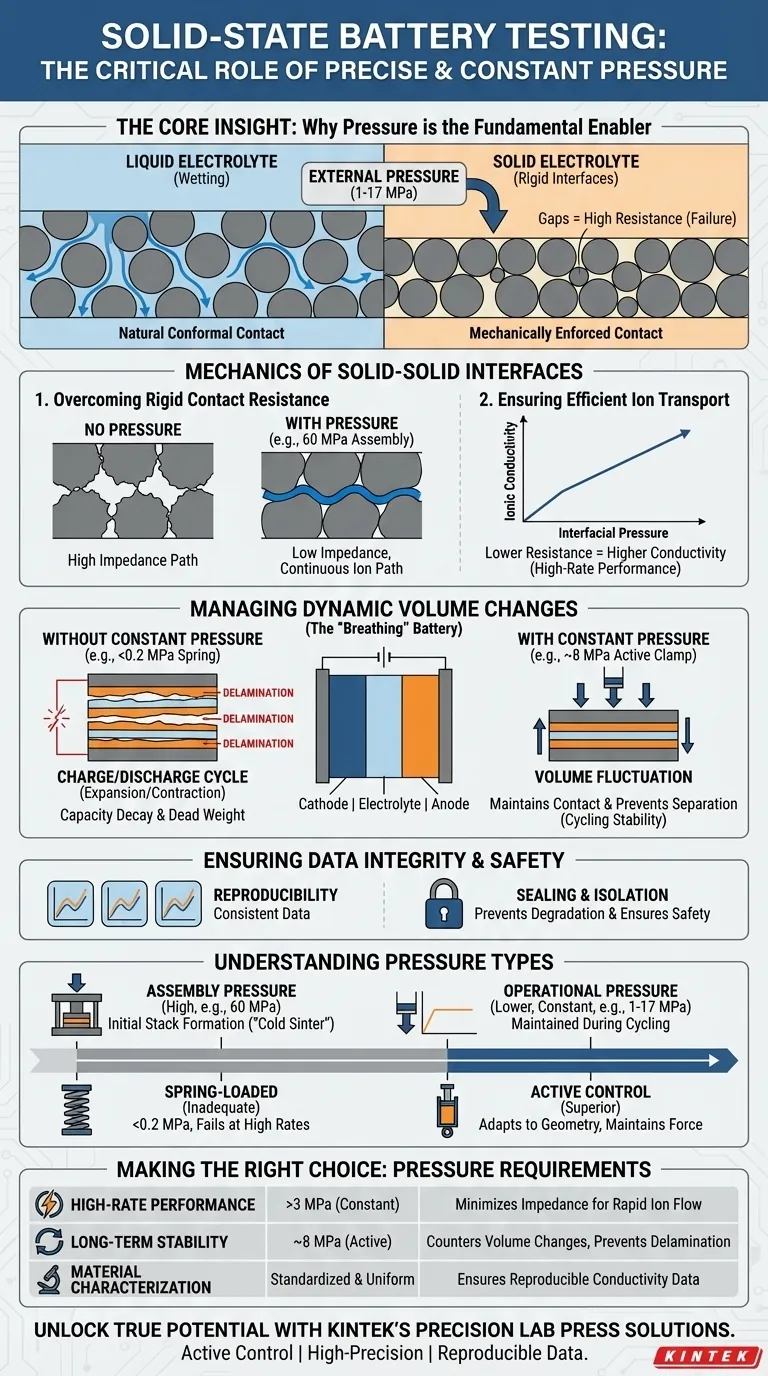
The application of precise and constant pressure is the fundamental enabler of performance in solid-state batteries (SSBs), acting as a physical substitute for the wetting properties of liquid electrolytes. Because solid interfaces are rigid and mechanically static, external pressure (often ranging from 1 to 17 MPa) is required to force electrode and electrolyte particles into the intimate contact necessary for ion transport.
The Core Insight: In liquid batteries, the electrolyte naturally flows into pores to create contact. In solid-state batteries, this "conformal contact" does not exist naturally; it must be mechanically enforced. Without regulated pressure, gaps form between layers, causing resistance to spike and the cell to fail prematurely.

The Mechanics of Solid-Solid Interfaces
To understand why pressure is non-negotiable, you must look at the microscopic reality of the battery stack.
Overcoming Rigid Contact Resistance
Unlike liquids, solid electrolytes cannot flow to fill the microscopic voids on an electrode's surface. A dedicated pressure apparatus is required to mash these rigid particles together.
By applying significant pressure—sometimes as high as 60 MPa during initial assembly—you force the materials to conform to one another. This creates a continuous, low-impedance path for lithium ions to travel between the cathode, electrolyte, and anode.
Ensuring Efficient Ion Transport
The primary metric for battery efficiency is interfacial impedance. If the layers are merely touching rather than pressed together, the resistance at the boundary becomes too high for effective operation.
Controlled pressure minimizes this resistance, directly enabling higher ionic conductivity. This is a prerequisite for high-rate performance; without it, the battery cannot deliver power quickly.
Managing Dynamic Volume Changes
The challenge in SSBs is not just establishing contact, but maintaining it while the battery "breathes."
Compensating for Expansion and Contraction
During charge and discharge cycles, electrode materials naturally expand and contract (volume change). In a rigid solid-state system, this movement can be catastrophic.
Constant pressure, such as a maintained 8 MPa, acts as a dynamic clamp. It accommodates these volume fluctuations, ensuring that the internal components do not drift apart as they change size.
Preventing Delamination
If pressure is insufficient, volume contraction leads to delamination—the physical separation of the electrode from the electrolyte. Once these layers separate, the connection is lost, and that portion of the battery becomes dead weight.
References indicate that cells tested with minimal spring pressure (less than 0.2 MPa) suffer from rapid capacity decay. Conversely, maintaining around 3.2 MPa effectively suppresses this delamination, preserving cycling stability.
Ensuring Data Integrity and Safety
Beyond performance, pressure control is a matter of scientific validity and operational safety.
Guaranteeing Reproducibility
In a laboratory setting, specialized fixtures that control stack pressure are essential for obtaining consistent data. If pressure varies between tests, measurements of ionic conductivity and capacity utilization become unreliable.
Sealing and Isolation
Properly calibrated pressure is also critical for the cell's seal. This mechanical integrity isolates sensitive internal components from external air and moisture, preventing electrolyte degradation and ensuring the safety of the test environment.
Understanding the Trade-offs
While pressure is vital, the method of application matters as much as the amount.
Assembly Pressure vs. Operational Pressure
It is critical to distinguish between the two types of pressure required.
- Assembly Pressure: Extremely high pressure (e.g., 60 MPa) is often used initially to "cold sinter" or form the stack.
- Operational Pressure: A lower, constant pressure (e.g., 1–17 MPa) is maintained during cycling to manage interfaces. Confusing these two can lead to damaged materials or insufficient contact during testing.
The Limitation of Spring-Loaded Cells
Many researchers rely on simple springs, but these are often inadequate for high-performance testing. Springs may exert less than 0.2 MPa, which is insufficient to stop delamination at high rates. Active, precise pressure control is superior because it adapts to the cell's changing geometry without losing force.
Making the Right Choice for Your Goal
The level of pressure control you need depends on the specific aspect of battery performance you are investigating.
- If your primary focus is High-Rate Performance: You must apply higher, constant pressure (e.g., >3 MPa) to minimize interfacial impedance and allow rapid ion flow.
- If your primary focus is Long-Term Cycling Stability: You need a fixture that actively maintains pressure (around 8 MPa) to counteract volume expansion and prevent layer delamination.
- If your primary focus is Material Characterization: You require a standardized, uniform pressure to ensure that conductivity measurements are reproducible and not artifacts of poor contact.
Ultimately, treating pressure as a controlled variable—just like voltage or temperature—is the only way to unlock the true potential of solid-state battery chemistry.
Summary Table:
| Aspect | Key Pressure Requirement | Purpose |
|---|---|---|
| High-Rate Performance | >3 MPa (Constant) | Minimizes interfacial impedance for rapid ion flow. |
| Long-Term Cycling Stability | ~8 MPa (Active) | Counters volume changes to prevent layer delamination. |
| Material Characterization | Standardized & Uniform | Ensures reproducible and reliable conductivity measurements. |
| Assembly vs. Operation | High (e.g., 60 MPa) for assembly vs. Lower (1-17 MPa) for operation. | Establishes initial contact vs. maintains it during cycling. |
Unlock the true potential of your solid-state battery research with KINTEK's precision lab press solutions.
Our automatic lab presses and heated lab presses are engineered to deliver the precise, constant pressure control that is fundamental to reliable SSB testing. Stop relying on inadequate springs and start treating pressure as the critical variable it is.
We serve laboratories and researchers like you by providing:
- Active Pressure Control: Maintain constant force to counteract volume changes and prevent delamination.
- High-Precision Performance: Achieve the >3 MPa pressures required for accurate high-rate performance testing.
- Reproducible Data: Ensure your conductivity and capacity measurements are reliable and not artifacts of poor contact.
Ready to enhance your data integrity and accelerate your development? Contact KINTEK today to find the perfect lab press for your solid-state battery testing needs.
Visual Guide
Related Products
- Warm Isostatic Press for Solid State Battery Research Warm Isostatic Press
- Laboratory Hydraulic Press Lab Pellet Press Button Battery Press
- Button Battery Sealing Press Machine for Lab
- Lab Button Battery Tablet Press Sealing Mold
- Lab Infrared Press Mold for Laboratory Applications
People Also Ask
- Why must composite cathodes be sealed in vacuum lamination bags for WIP? Ensure Battery Stability and Density
- How do sacrificial volume materials (SVM) maintain microchannels in isostatic pressing? Ensure Structural Integrity
- What is the function of elastic molds in warm isostatic pressing? Achieve Uniform Density in Composite Particles
- What is the function of hydraulic pressure in warm isostatic pressing? Achieve Uniform Material Density
- What is the mechanism of a Warm Isostatic Press (WIP) on cheese? Master Cold Pasteurization for Superior Safety