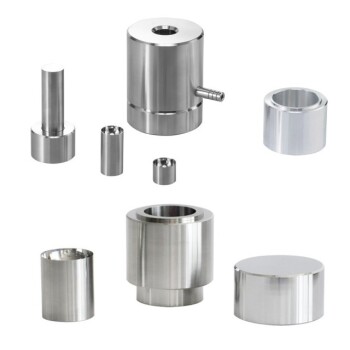
The vacuum system acts as the critical quality control mechanism in the Self-Propagating High-Temperature Synthesis (SHS) pressing process. It utilizes a vacuum chamber and specialized filter joints to actively evacuate air and exhaust gases generated during the chemical reaction. This removal is the deciding factor in preventing material oxidation and ensuring the final product achieves high density.
Core Takeaway The vacuum system transforms the synthesis environment by eliminating oxygen and trapped gases that cause structural defects. It acts as the primary safeguard for ensuring the purity, density, and mechanical robustness of TiB2-TiC composites.
The Mechanics of Defect Prevention
Active Gas Evacuation
The fundamental role of the system is the removal of volatile elements via a vacuum chamber and filter joints.
During the synthesis process, chemical reactions generate exhaust gases. The vacuum system extracts these gases, along with pre-existing air, before they can become trapped within the material.
Preventing High-Temperature Oxidation
SHS-pressing occurs at extremely high temperatures where materials are vulnerable to chemical degradation.
By removing air from the mold, the vacuum system creates an oxygen-free environment. This prevents unnecessary oxidation of the reactants, preserving the chemical purity of the TiB2-TiC composite.
Eliminating Internal Voids
Porosity is a major failure point for structural ceramics and composites.
The vacuum system ensures that gas pockets do not form between the particles during the pressing phase. By extracting these gases, the system allows the material to compact fully, eliminating internal pores that would otherwise weaken the structure.
Impact on Material Performance
Maximizing Density
The density of the final product is directly correlated to the efficiency of the vacuum system.
When gas is removed, the pressing force can compact the material more effectively. This results in a composite with significantly higher density compared to materials processed in ambient atmospheres.
Enhancing Mechanical Strength
A dense, oxidation-free microstructure leads to superior mechanical properties.
By reducing porosity and preventing oxide inclusions, the vacuum system ensures the TiB2-TiC composite retains the high strength and durability required for its intended application.
Understanding the Trade-offs
Process Sensitivity
While the vacuum system is essential for quality, it introduces strict requirements for mold integrity.
Any failure in the filter joints or vacuum seals can lead to immediate contamination. If the vacuum is compromised, trapped exhaust gases will ruin the density and mechanical properties of the entire batch.
Complexity of Setup
Implementing a high-vacuum environment adds complexity to the standard hydraulic pressing workflow.
Unlike simple hydraulic pressing used for lower-grade compaction, this method requires precise synchronization between the vacuum draw and the pressing cycle to be effective.
Making the Right Choice for Your Goal
The vacuum system is not optional if your goal is a high-performance structural material.
- If your primary focus is Material Purity: Ensure the vacuum system is engaged before heating begins to prevent initial oxidation of the raw powders.
- If your primary focus is Mechanical Strength: Monitor the vacuum pressure throughout the synthesis reaction to ensure all exhaust gases are evacuated, preventing internal voids.
The vacuum system is the difference between a porous, brittle ceramic and a dense, industrial-grade composite.
Summary Table:
| Feature | Function in SHS-Pressing | Impact on Material |
|---|---|---|
| Vacuum Chamber | Houses mold and removes ambient air | Prevents oxidation of reactants |
| Filter Joints | Facilitates gas extraction during reaction | Eliminates exhaust gases and volatiles |
| Gas Evacuation | Removes trapped air pockets | Minimizes porosity and internal voids |
| High-Vacuum Seal | Maintains inert atmosphere | Ensures maximum density and strength |
Elevate Your Material Research with KINTEK
Achieving the ultimate density and mechanical strength in TiB2-TiC composites requires precision-engineered vacuum environments. KINTEK specializes in comprehensive laboratory pressing solutions, offering a diverse range of manual, automatic, heated, multifunctional, and glovebox-compatible models, as well as advanced cold and warm isostatic presses widely applied in cutting-edge battery research and ceramic synthesis.
Don't let oxidation or porosity compromise your results. Partner with KINTEK to access the technology needed for superior material purity and structural integrity. Contact us today to find the perfect pressing solution for your lab!
References
- Gigo Jandieri, David Sakhvadze. Controlled Synthesis of TiB2-TiC Composite: Substantiation of the Homogenizing Joule Thermostatting Efficiency and Improvement of SHS-Compaction Technology in a Vacuum. DOI: 10.21272/jes.2024.11(2).c2
This article is also based on technical information from Kintek Solution Knowledge Base .
Related Products
- Special Shape Lab Press Mold for Laboratory Applications
- Lab Polygon Press Mold
- Lab Round Bidirectional Press Mold
- Lab XRF Boric Acid Powder Pellet Pressing Mold for Laboratory Use
- XRF KBR Plastic Ring Lab Powder Pellet Pressing Mold for FTIR
People Also Ask
- What is the purpose of incorporating cartridge heaters into a lab press mold for MLCC block compression? Optimize Results
- Why is a high-performance laboratory molding press critical for in-situ electrolyte formation? Unlock Battery Success
- Why are high-precision laboratory molds and specific compaction processes required? Ensure Data Integrity in Soil Research
- Why are precision laboratory molds essential for forming basalt-reinforced lightweight concrete specimens?
- How does the geometry of laboratory molds influence mycelium-based composites? Optimize Density and Strength