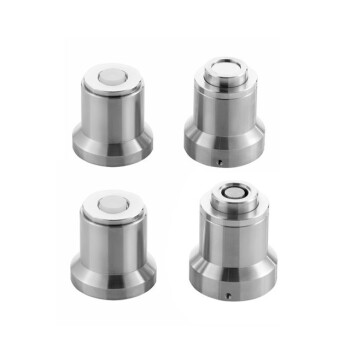
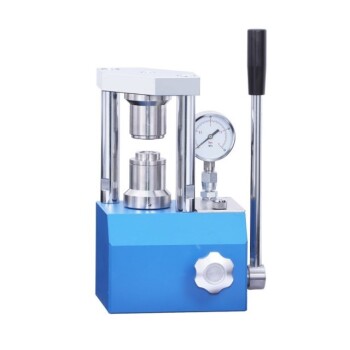
Precision pressure control is the fundamental prerequisite for obtaining valid data in solid-state battery testing. By utilizing high-precision laboratory assembly equipment, such as electric or hydraulic presses, researchers ensure tight and uniform interfacial contact between the cathode, the solid polymer electrolyte (SPE) membrane, and the lithium metal anode. This applied physical pressure is the primary mechanism for reducing interfacial impedance, suppressing crack propagation, and maximizing the active material's capacity utilization.
Core Takeaway unlike liquid electrolytes, solid-state materials lack the fluidity to self-repair physical gaps. Precision pressure equipment compensates for this by applying constant stack pressure, which forces tight contact between layers to prevent interface detachment and ensure the ion transport necessary for long-term cycling stability.
Overcoming the Solid-Solid Interface Challenge
Reducing Contact Resistance
The primary hurdle in solid-state batteries is the high resistance at the solid-solid interface.
Without sufficient pressure, microscopic gaps exist between the electrode and the electrolyte.
Precision presses force these layers together, creating a low-impedance interface that allows efficient ion transport.
Compensating for Lack of Fluidity
Liquid electrolytes can flow to fill voids; solid electrolytes cannot.
If gaps form, the solid electrolyte cannot self-repair to re-establish contact.
External pressure acts as the stabilizing force that maintains physical continuity in the absence of liquid wetting.
Managing Volume Expansion
Cathode particles and sulfide materials undergo significant chemo-mechanical volume changes (expansion and contraction) during cycling.
These fluctuations can cause particles to shrink away from the electrolyte, breaking the circuit.
Specialized fixtures with torque control or dynamic pressure sensors maintain constant stack pressure to compensate for this shrinkage, preventing contact failure.
Advanced Assembly Techniques
Multi-Layer Gradient Pressing
Precision presses allow for complex, sequential assembly within a single mold.
Researchers can press the main solid electrolyte layer first, then add composite cathode powders for a subsequent pressing cycle.
This gradient technique ensures strong mechanical bonding between different material layers, improving the battery's overall structural integrity.
Fabrication of Composite Membranes
Laboratory heated presses are essential for working with composite electrolytes (elastic polymers mixed with inorganic fillers).
These devices control both heat and pressure to fully composite the materials.
This results in membranes with uniform thickness and superior mechanical properties, ensuring the electrolyte maintains ionic conductivity even under bending or deformation.
Understanding the Trade-offs
The Risk of Static vs. Dynamic Failure
While initial pressure is critical, applying pressure only during assembly is often insufficient for long-term testing.
If the testing fixture cannot adapt to volume changes (dynamic pressure), the data collected may be inaccurate.
You must distinguish between equipment used for fabrication (initial pressing) and equipment used for cycling (maintaining stack pressure), as relying solely on the former can lead to premature failure during operation.
Making the Right Choice for Your Goal
Determining the correct equipment depends heavily on the specific failure mechanisms you are investigating.
- If your primary focus is Cycle Stability: Prioritize battery molds or fixtures with dynamic torque control to maintain constant stack pressure during expansion and contraction.
- If your primary focus is Composite Electrolyte Development: Ensure your equipment offers precise heating capabilities alongside pressure control to uniformize polymer and inorganic filler distribution.
- If your primary focus is Cell Fabrication: Look for presses that facilitate sequential, multi-step molding to create gradient structures with strong mechanical bonds.
Ultimately, the validity of your electrochemical performance data is directly tied to your ability to maintain the mechanical integrity of the cell through precise pressure control.
Summary Table:
| Feature | Role in Solid-State Testing | Benefit |
|---|---|---|
| Interfacial Contact | Forces tight bonding between SPE and electrodes | Reduces contact resistance and ion impedance |
| Volume Management | Compensates for chemo-mechanical expansion | Prevents circuit breaks and material shrinkage |
| Thermal Integration | Combines heat with precise pressure | Ensures uniform composite membrane thickness |
| Multi-step Molding | Enables sequential layer-by-layer pressing | Creates strong mechanical bonds and gradient structures |
Elevate Your Battery Research with KINTEK Precision
Don't let interfacial impedance compromise your research data. KINTEK specializes in comprehensive laboratory pressing solutions designed specifically for the rigorous demands of solid-state battery assembly. Whether you require manual, automatic, heated, or multifunctional presses, or advanced cold and warm isostatic presses, our equipment ensures the precise pressure control necessary for long-term cycling stability.
From glovebox-compatible models to dynamic pressure sensing, we provide the tools researchers need to overcome the solid-solid interface challenge. Contact KINTEK today to find the perfect pressing solution for your lab and ensure the mechanical integrity of your next-generation cells.
References
- Otaegui, Laida. Solvent - free processed polymer electrolyte for Li -metal batteries. DOI: 10.5281/zenodo.17749063
This article is also based on technical information from Kintek Solution Knowledge Base .
Related Products
- Warm Isostatic Press for Solid State Battery Research Warm Isostatic Press
- Lab Infrared Press Mold for Laboratory Applications
- Laboratory Hydraulic Press Lab Pellet Press Button Battery Press
- Button Battery Sealing Press Machine for Lab
- Carbide Lab Press Mold for Laboratory Sample Preparation
People Also Ask
- Why must composite cathodes be sealed in vacuum lamination bags for WIP? Ensure Battery Stability and Density
- What is the function of elastic molds in warm isostatic pressing? Achieve Uniform Density in Composite Particles
- How do sacrificial volume materials (SVM) maintain microchannels in isostatic pressing? Ensure Structural Integrity
- What is the significance of temperature control in Warm Isostatic Pressing? Unlock Uniform Densification and Process Stability
- What is the process involved in warm isostatic pressing? Mastering Uniform Density with WIP Technology