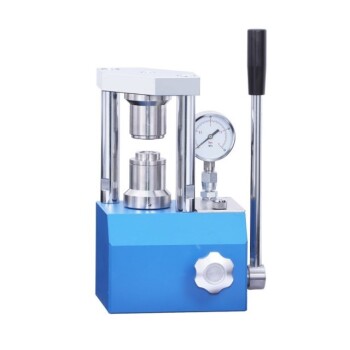
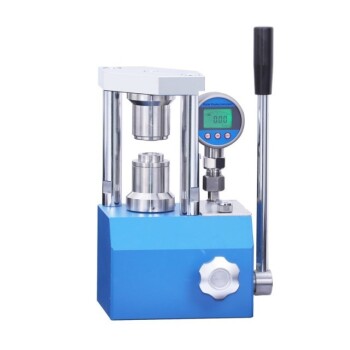
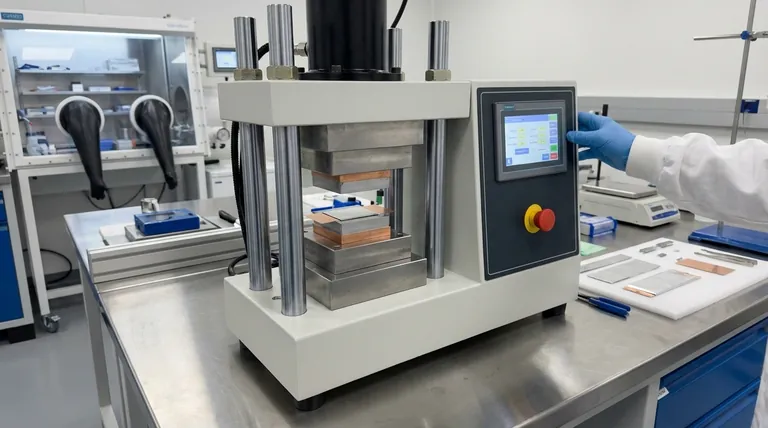
The application of precision pressure is the critical factor in establishing a coherent, low-resistance interface between lithium metal foil and the copper current collector. Without the uniform force provided by equipment like roller presses or laboratory presses, it is nearly impossible to eliminate microscopic voids that drastically impede electron and ion flow.
Core Insight: In solid-state battery assembly, mechanical contact is electrical contact. Precision lamination transforms two separate materials into a unified solid-solid interface, a prerequisite for preventing lithium dendrite growth and achieving stable long-term cycling.
The Physics of the Solid-Solid Interface
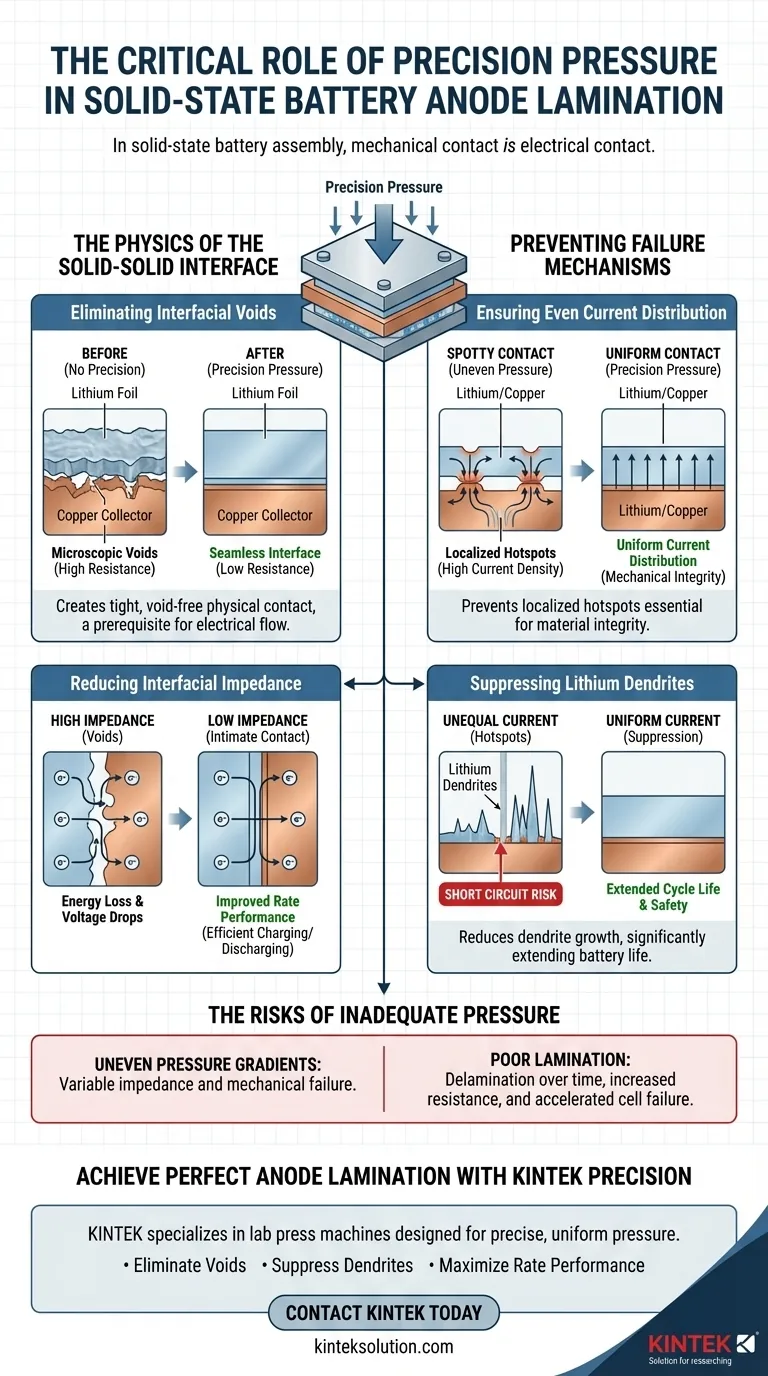
Eliminating Interfacial Voids
The primary goal of using precision equipment is to create tight, void-free physical contact. Unlike liquid electrolytes that can flow into gaps, solid-state components rely entirely on mechanical pressure to bridge the interface.
Any gap between the lithium foil and the copper collector acts as an electrical insulator. Precision lamination forces the malleable lithium to conform perfectly to the copper surface, removing these dead zones.
Reducing Interfacial Impedance
A seamless interface is the structural foundation for low interfacial impedance. High resistance at this junction causes voltage drops and energy loss during operation.
By ensuring intimate contact across the entire surface area, you maximize the pathways available for electron transport. This directly translates to improved rate performance, allowing the battery to charge and discharge more efficiently.
Preventing Failure Mechanisms
Ensuring Even Current Distribution
When contact is spotty or uneven, electrical current concentrates in the few points where contact is good. This creates localized hotspots of high current density.
Precision pressure ensures the current is distributed uniformly across the entire electrode area. This uniformity is essential for the mechanical integrity of the material layers during operation.
Suppressing Lithium Dendrites
Non-uniform current distribution is a primary cause of lithium dendrite growth. High current density in specific spots accelerates the formation of these needle-like structures.
Dendrites can puncture separators and cause short circuits. By laminating the foil uniformly, you suppress this non-uniform growth, significantly extending the cycle life and safety of the battery.
The Risks of Inadequate Pressure
Understanding the "Contact" Trade-off
While high pressure is necessary, the precision of that pressure is equally vital. Manual application or imprecise tools often result in uneven pressure gradients.
If pressure is applied unevenly, you create a mix of high-contact and low-contact zones. This inconsistency leads to variable impedance across the electrode surface.
The Cost of Poor Lamination
Failing to achieve a void-free interface compromises the mechanical integrity of the anode. Over time, the volume changes associated with lithium plating and stripping can cause the materials to detach.
This delamination increases resistance further and accelerates cell failure. The initial investment in precision lamination is the only way to ensure the solid-solid interface survives repeated cycling.
Making the Right Choice for Your Goal
To maximize the effectiveness of your anode assembly, consider your specific performance targets:
- If your primary focus is High Rate Performance: Prioritize equipment that delivers high, uniform tonnage to minimize interfacial impedance, enabling rapid ion and electron transport.
- If your primary focus is Long Cycle Life: Ensure your lamination process eliminates all microscopic voids to prevent the localized current densities that drive dendrite formation.
Uniform lamination is not merely a manufacturing step; it is the defining factor for the electrochemical stability of your solid-state anode.
Summary Table:
| Key Function | Impact on Anode Performance |
|---|---|
| Eliminates Microscopic Voids | Creates a coherent interface for efficient electron/ion flow, reducing impedance. |
| Ensures Uniform Current Distribution | Prevents localized hotspots and suppresses lithium dendrite growth. |
| Enhances Mechanical Integrity | Allows the solid-solid interface to withstand volume changes during cycling, extending battery life. |
Achieve Perfect Anode Lamination with KINTEK Precision
Building a reliable solid-state lithium battery starts with a flawless anode interface. The initial lamination process dictates the electrochemical stability, cycle life, and safety of your entire cell.
KINTEK specializes in lab press machines—including automatic lab presses and heated lab presses—designed to deliver the precise, uniform pressure required for R&D and pilot-scale production. Our equipment helps researchers and battery developers like you:
- Eliminate Interfacial Voids: Achieve intimate, void-free contact between lithium foil and copper current collectors.
- Suppress Dendrite Formation: Ensure even current distribution from the first cycle to prevent short circuits.
- Maximize Rate Performance: Create low-impedance interfaces essential for fast charging and discharging.
Don't let an inconsistent lamination process compromise your battery's performance.
Contact KINTEK today to discuss how our precision pressure equipment can be integrated into your solid-state battery assembly line and help you build more reliable, high-performance cells.
Visual Guide
Related Products
- Warm Isostatic Press for Solid State Battery Research Warm Isostatic Press
- Lab Infrared Press Mold for Laboratory Applications
- Lab Cylindrical Press Mold for Laboratory Use
- Lab Button Battery Tablet Press Sealing Mold
- Lab Polygon Press Mold
People Also Ask
- Why must composite cathodes be sealed in vacuum lamination bags for WIP? Ensure Battery Stability and Density
- What is the function of elastic molds in warm isostatic pressing? Achieve Uniform Density in Composite Particles
- How do sacrificial volume materials (SVM) maintain microchannels in isostatic pressing? Ensure Structural Integrity
- What is the role of the flexible material in warm isostatic pressing? Key to Uniform Density & Precision
- What are the advantages of using a Warm Isostatic Press (WIP) for batteries? Achieve Superior Interface Contact