
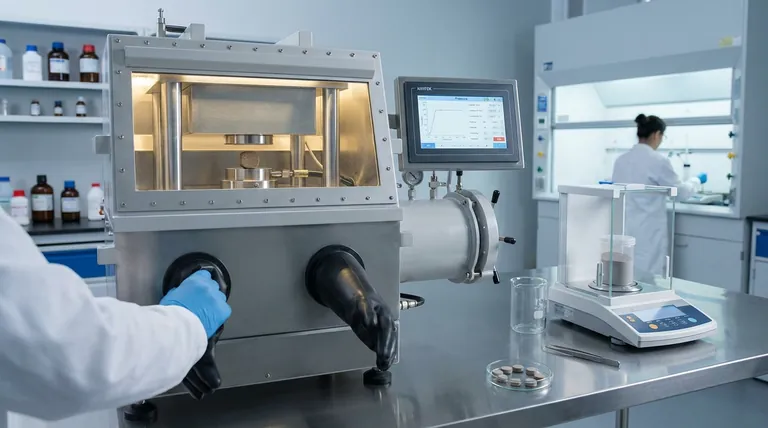
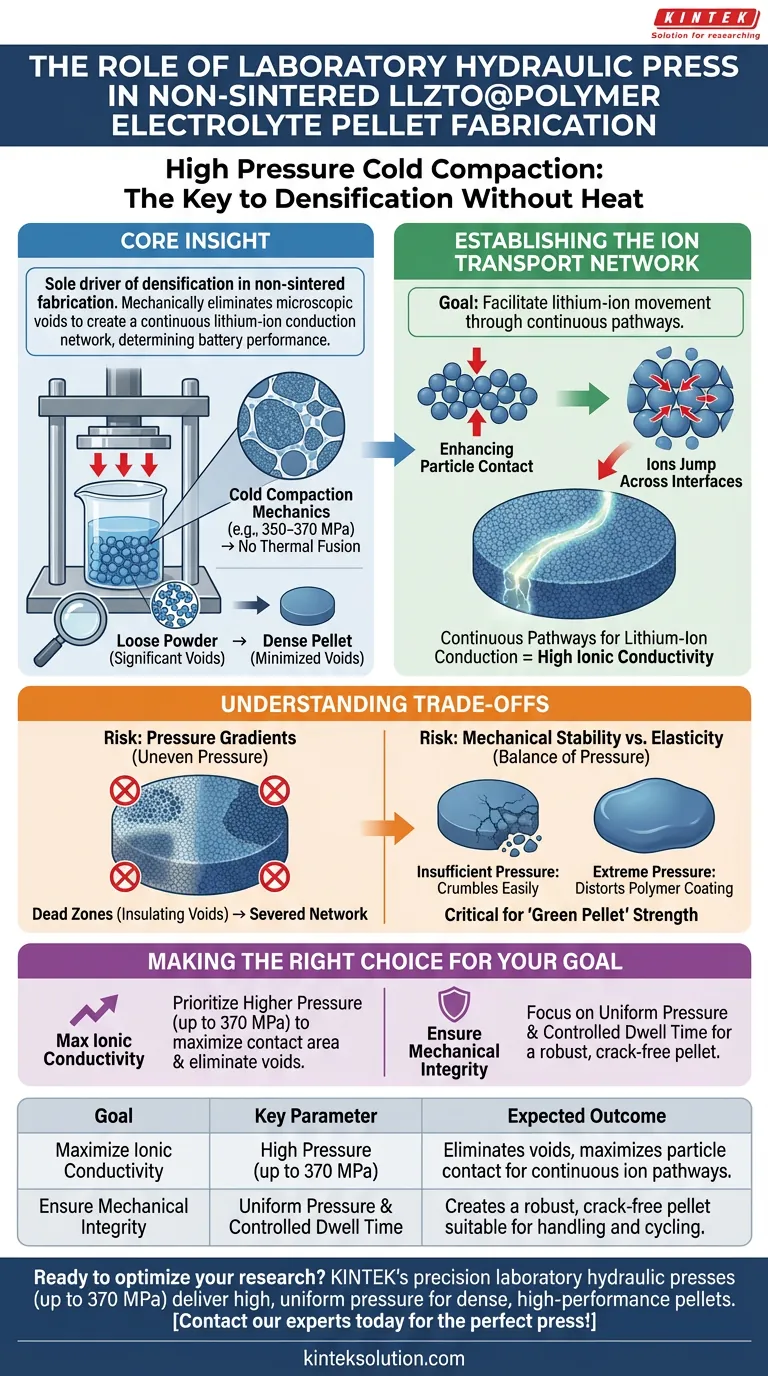
The primary role of a laboratory hydraulic press in this context is to apply high, uniform pressure to cold-press polymer-coated ceramic powder into a dense, mechanically robust pellet without the use of heat. By exerting pressures often reaching 370 MPa, the press forces the LLZTO@Polymer particles into intimate contact, replacing the need for high-temperature sintering while establishing the physical connectivity required for electrochemical function.
Core Insight: In non-sintered fabrication, the hydraulic press does not merely shape the material; it is the sole driver of densification. It mechanically eliminates microscopic voids to create a continuous lithium-ion conduction network, which is the direct determinant of the solid-state battery's final efficiency and performance.
The Mechanism of Densification
The fundamental challenge in solid-state electrolytes is transforming loose powder into a cohesive solid.
Cold Compaction Mechanics
Unlike traditional ceramics that rely on thermal fusion (sintering) to bond particles, non-sintered LLZTO@Polymer pellets rely entirely on mechanical force.
The hydraulic press applies significant uniaxial pressure, typically ranging from tens to hundreds of megapascals (e.g., 350–370 MPa).
Minimizing Inter-particle Voids
The immediate physical result of this pressure is the drastic reduction of internal porosity.
Loose powder contains significant air gaps that block ion movement. The press compacts the material to minimize these voids, creating a dense structure that mimics the solidity of a sintered ceramic but maintains the flexibility of the polymer coating.
Establishing the Ion Transport Network
The ultimate goal of using the press is to facilitate the movement of lithium ions through the material.
Enhancing Particle Contact
For ions to move, the electrolyte particles must touch. The press forces the polymer-coated ceramic particles into close, permanent contact.
This increases the effective contact area between particles, ensuring that the interface where ions jump from one particle to the next is as large and tight as possible.
Creating Continuous Pathways
A dense pellet is useless if the pathways are broken.
By achieving high uniformity in pressure application, the press establishes a continuous, uninterrupted network for lithium-ion conduction throughout the entire pellet. This structural continuity is the physical foundation for high ionic conductivity.
Understanding the Trade-offs
While the hydraulic press enables non-sintered fabrication, relying solely on pressure introduces specific challenges that must be managed.
The Risk of Pressure Gradients
If the press applies pressure unevenly, the pellet will have regions of varying density.
Low-density areas retain voids that act as insulators, severing the ion transport network and creating "dead zones" within the electrolyte.
Mechanical Stability vs. Elasticity
Achieving the right balance of pressure is critical for the "green pellet" strength.
Insufficient pressure results in a pellet that crumbles easily, lacking the mechanical robustness to withstand handling or battery cycling. Conversely, extreme pressure without precise control can distort the polymer coating, potentially affecting the interface quality.
Making the Right Choice for Your Goal
To maximize the effectiveness of your laboratory hydraulic press in this application, align your parameters with your specific performance targets.
- If your primary focus is Ionic Conductivity: Prioritize higher pressure settings (up to 370 MPa) to maximize particle contact area and eliminate insulating voids.
- If your primary focus is Mechanical Integrity: Focus on the uniformity of the pressure application and the dwell time to ensure the pellet remains crack-free and robust during handling.
Success in fabricating non-sintered solid-state electrolytes relies on using the press not just as a shaping tool, but as the critical instrument for establishing the material's internal conduction highway.
Summary Table:
| Goal | Key Hydraulic Press Parameter | Expected Outcome |
|---|---|---|
| Maximize Ionic Conductivity | High Pressure (up to 370 MPa) | Eliminates voids, maximizes particle contact for continuous ion pathways. |
| Ensure Mechanical Integrity | Uniform Pressure & Controlled Dwell Time | Creates a robust, crack-free pellet suitable for handling and cycling. |
Ready to optimize your non-sintered solid-state electrolyte research?
KINTEK's precision laboratory hydraulic presses are engineered to deliver the high, uniform pressure (up to 370 MPa) essential for fabricating dense, high-performance pellets. Whether you need an automatic lab press for throughput or a heated model for hybrid processes, our solutions provide the control and reliability your laboratory demands.
Elevate your battery development. Contact our experts today to find the perfect press for your specific LLZTO@Polymer fabrication needs!
Visual Guide
Related Products
- Manual Laboratory Hydraulic Pellet Press Lab Hydraulic Press
- Laboratory Hydraulic Split Electric Lab Pellet Press
- Automatic Laboratory Hydraulic Press Lab Pellet Press Machine
- Laboratory Hydraulic Pellet Press for XRF KBR FTIR Lab Press
- Laboratory Hydraulic Press 2T Lab Pellet Press for KBR FTIR
People Also Ask
- What is the primary purpose of manual lab hydraulic pellet presses? Achieve High-Precision Sample Preparation for Spectroscopy
- What is the primary purpose of a manual lab hydraulic pellet press? Ensure Accurate Sample Prep for XRF and FTIR
- What is the primary function of a laboratory hydraulic press in evaluating the ionic conductivity of Li6PS5X (LMSX)?
- What is the purpose of initial axial molding using a lab hydraulic press? Optimizing Electrolyte Green Bodies
- What role does a lab hydraulic press play in researching squishy granular matter? Expert Insights into Material Physics



















