
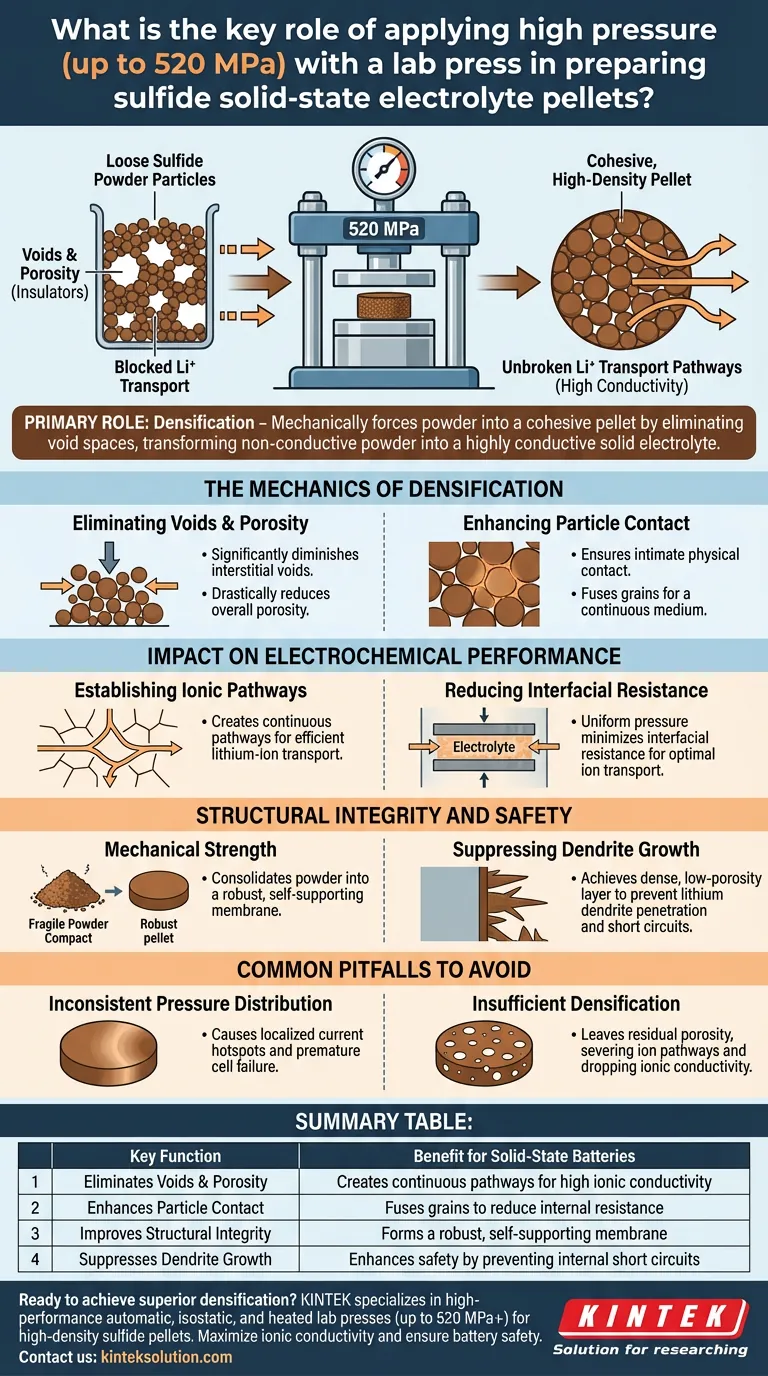
The primary role of applying high pressure, such as 520 MPa, is to mechanically force loose sulfide powder particles into a cohesive, high-density pellet by eliminating void spaces. This densification creates the intimate particle-to-particle contact necessary to form continuous pathways for lithium-ion transport, transforming non-conductive powder into a highly conductive solid electrolyte.
The application of extreme pressure is not merely for shaping; it is the fundamental mechanism for densification. By minimizing internal porosity, you minimize resistance, enabling the high ionic conductivity and structural integrity required for a viable solid-state battery.

The Mechanics of Densification
Eliminating Voids and Porosity
When sulfide electrolytes are in powder form, the air gaps (voids) between particles act as insulators that block ion movement.
Applying high hydraulic pressure significantly diminishes these interstitial voids. This forces the material to compact, drastically reducing the overall porosity of the pellet.
Enhancing Particle Contact
Reducing voids is only half the battle; the particles must physically touch to transfer ions.
High pressure ensures intimate physical contact among the sulfide particles. This tight packing allows the individual grains to effectively fuse at their boundaries, creating a continuous medium rather than a collection of isolated grains.
Impact on Electrochemical Performance
Establishing Ionic Pathways
The ultimate goal of a solid-state electrolyte is to facilitate the movement of lithium ions.
The continuous physical contact created by high pressure establishes unbroken lithium-ion transport pathways. Without this densification, ions cannot traverse the material efficiently, resulting in poor ionic conductivity.
Reducing Interfacial Resistance
Pressure is also critical when the electrolyte is pressed against electrode materials (like lithium foil or stainless steel).
Uniform pressure ensures optimal contact at these interfaces, minimizing interfacial resistance. This promotes efficient ion transport across the cell and allows for accurate measurement of properties like cycling stability.
Structural Integrity and Safety
Mechanical Strength
A loose powder compact has no structural integrity and cannot serve as a separator.
High-pressure cold pressing consolidates the powder into a robust, self-supporting membrane. This gives the pellet the mechanical strength necessary to withstand handling and the internal stresses of battery operation.
Suppressing Dendrite Growth
Porosity is a major failure mode in solid-state batteries, as lithium dendrites can grow through open pores and cause short circuits.
By achieving a dense, low-porosity layer, high pressure helps create a physical barrier. This densification is fundamental to preventing lithium dendrite penetration, thereby enhancing the safety profile of the battery.
Common Pitfalls to Avoid
Inconsistent Pressure Distribution
Applying high pressure is ineffective if it is not uniform.
If the pressure is uneven, the pellet will have density gradients—regions of high conductivity mixed with regions of high resistance. This can lead to localized current hotspots and premature cell failure.
Insufficient Densification
Shying away from sufficiently high pressures (e.g., staying well below the material's yield point) leaves residual porosity.
Even a small percentage of remaining voids can sever ion pathways and significantly drop ionic conductivity. You must apply enough pressure to achieve near-theoretical density for the specific sulfide chemistry you are using.
Making the Right Choice for Your Goal
Achieving the optimal pellet requires balancing pressure magnitude with the specific material properties of your sulfide electrolyte.
- If your primary focus is maximizing Ionic Conductivity: Ensure you apply pressure high enough to eliminate virtually all interstitial voids, creating a continuous path for ion flow.
- If your primary focus is Battery Safety: Prioritize achieving maximum relative density to close internal pores that could otherwise serve as channels for lithium dendrite growth.
- If your primary focus is Cell Assembly: Focus on applying uniform pressure to create a smooth, flat surface that ensures low-resistance contact with the anode and cathode.
High-pressure processing is the bridge between a raw chemical powder and a functional, high-performance battery component.
Summary Table:
| Key Function | Benefit for Solid-State Batteries |
|---|---|
| Eliminates Voids & Porosity | Creates continuous pathways for high ionic conductivity |
| Enhances Particle Contact | Fuses grains to reduce internal resistance |
| Improves Structural Integrity | Forms a robust, self-supporting membrane |
| Suppresses Dendrite Growth | Enhances safety by preventing internal short circuits |
Ready to achieve superior densification for your solid-state battery research? KINTEK specializes in high-performance lab press machines, including automatic, isostatic, and heated lab presses, designed to deliver the precise, uniform high pressure (up to 520 MPa and beyond) required to fabricate high-density sulfide electrolyte pellets. Our equipment helps you maximize ionic conductivity and ensure battery safety by achieving near-theoretical density. Contact our experts today to find the perfect press for your laboratory's needs!
Visual Guide
Related Products
- Automatic Laboratory Hydraulic Press for XRF and KBR Pellet Pressing
- Lab Ring Press Mold for Sample Preparation
- Laboratory Hydraulic Pellet Press for XRF KBR FTIR Lab Press
- Laboratory Hydraulic Press 2T Lab Pellet Press for KBR FTIR
- Automatic Laboratory Hydraulic Press Lab Pellet Press Machine
People Also Ask
- Why is pressing powder into a pellet critical before sintering? Ensure Dense, Conductive Solid-State Electrolytes
- What is the role of a laboratory pressure machine and KBr in FTIR? Master Sample Preparation for Flame Retardants
- What are the advantages of using a laboratory automatic hydraulic press for HEA green compact forming?
- What are the advantages of using a lab automatic hydraulic press for HEA green body molding? Ensure Material Integrity
- What are the advantages of using an automatic laboratory hydraulic press? Enhance Precision in Sample Preparation



















